
Tag Archives: Superstition

Lifting your feet over the drawbridge

Interviewer: “Ever since I could remember, whenever we drove over a drawbridge, you always told my brother and me to lift our feet over a drawbridge. Could you please explain why?”

D: “It’s always been that way. My dad had told me my whole life as well; it was just a thing, you cross over a drawbridge, so you lift your feet. I had to pass it on to my family as well.”

Interviewer: “Do you have any idea what it means, why you do it?”

D: “It’s for luck, not necessarily luck for your day, but more so luck for your future drives. You don’t want your feet touching the car floor when you feel the bumpy road from the texture of the bridge. Even I lift my feet up. Sure, I’ll have a little bit on the gas pedal, but otherwise I’m lifting my feet until the road is flat again.”

Context: Ever since I was a little kid I remeber driving with my dad. Anytime we would pass over a draw bridge, you had to lift your feet up. No matter how long or short the bumps of the bridge lasted. He would start with a warning by saying “ok get ready to lift your feet up!” and then when we hit the bridge said “Go!” and everyone in the car would lift both their feet off of the ground. Sometimes it would be difficukt to hold them up for a while – as an impatient child, but it would be over soon enough, and no way was anyone letting their feet touch the car floor. As soon as the car left the brdige he would say “good” and everyone would put their feet back down immediatly. I am unsure where this supersition came from, but from the interview I gathered my dad had done it his own life and took it on from his dad. My grandpa would say it to all of his 9 kids whenever passing over a draw bridge. This would take place most often from the drives from upstate NY to NYC, but happened anytime there was a drawbridge.

Analysis: This tradition is a form of family folklore that uses superstition and ritual to create a shared sense of meaning during an otherwise ordinary activity. The act of lifting feet over a drawbridge, framed as bringing “luck” for future drives, reflects how belief does not need a clear origin or logic to feel important. This supersition not only prvoides luck for the rest of the drive and future drives, but acts as a shared identity within the family.
Don’t Whistle At Night!

“I’ve always been told not to whistle at night, like ever. My grandma was super serious about it, too. She would hear even the tiniest whistle and immediately tell me to stop. The way she explained it was that whistling at night calls things to you…like spirits or bad energy, basically things you don’t want around. She said nighttime is when everything is quieter, so if you whistle, it travels farther, and whatever’s out there can hear you. I remember asking her what would actually happen, and she didn’t give a super clear answer, just that it could bring bad luck or something following you home. It honestly freaked me out as a kid, so I just never questioned it. I will stop anyone I hear whistling at night because I’m not trying to summon any demons.”

Context: AK is very superstitious; all people from Albania are, from what they told me. Whistling in the dark can summon bad energy or attract evil because sound travels farther when you can’t see as well, according to the belief. Since moving to America, AK has brought this Albanian superstition with them and stops anyone who whistles at night.

Analysis: This story shows how a simple belief can turn into a real habit just from growing up with it. Even now, AK reacts to it automatically, which shows how these kinds of superstitions can stay with you without needing proof. Bringing it from Albania to the U.S. also shows how cultural traditions can travel and continue in new places. This is a great example to show how superstitions spread throughout the world. AK heard it in Albania, and then spread it to their friends in the U.S. until they believed it too, and those friends could spread it on, etc.

“Cursed” Medallion

Text:

H: “So when I went to Florida with my family, I got on some sketchy website, there was like a weird like medallion with like snakes on it. And it was like probably like two bucks, um, but I just like got it ’cause I thought it was cute and I started wearing it. And all of a sudden, like I was getting a lot of bad luck … I had a really bad night, like of sleep, and I was like getting really bad nightmares, like very vivid, like as if it was like, I was like put in an alternate reality and it was actually happening to me. Like for example, since we were on vacation, I was sharing a bed with my sister, and like I would turn over, I would think that it’s real life, like we’d be talking and all of a sudden like her eyes would go red and she’d like… I don’t, she wouldn’t even do anything, but like it was just like scary.”

C: “And were you like still wearing the medallion?”

H: “Yeah, yeah. At this point I didn’t attribute it to the medallion. And then I went… And then like for example, like she turned evil at one point and then like I thought I went back to sleep, and then I thought I woke up again, but like it was still a dream and like she, ’cause she went normal and I was crying. I was like in tears and she was like helping me, like patting my head like, ‘Oh, it’s okay.’ And then like all of a sudden she would turn evil again and I’m like I can’t tell what’s real and fake, so I now attribute it to sleep paralysis. At the time I thought I was like possessed, um, and that was just like reoccurring all night. I was so scared. And then like the next day I asked I think my dad what to do and he told me to like get rid of the medallion, but I didn’t want to touch it so I made my brother put it in the sand, like just to like get it off my head, out of my hands … That night I had another awful night of sleep, not as bad as the first one, and I found out the next day that he [brother] didn’t put it in the sand. He like kept it in my room for some reason ’cause he was just being like a little brother. And I was like… I had like another like possession thing. So then we threw it in the ocean and it was gone for real. Everyone was mad at my little brother ’cause it was like I wasn’t kidding. I was like crying all night both nights. So yeah, now I attribute it to sleep paralysis, but I don’t know. It’s kind of weird. Like the second I started wearing it, it, that happened. And then it made it weirder with like the whole sand thing, like that, it was still in my room.”

Context:

H was on vacation in Florida with her family when she bought this medallion necklace with a two snakes on it. After purchasing it, H started to have terribly bad luck. After falling asleep, H started to have terrible night terrors like where her sister was evil with red eyes. She woke up screaming & crying, so she gave the medallion to her little brother and asked his to bury it in the sand at the beach. That night, H continued to have nightmares, but not as extreme as the previous night. She once again woke up crying only to find out that her brother didn’t get rid of the medallion but left it in her room. They then threw the medallion into the ocean, and she stopped having the nightmares and bad luck.

Analysis:

Since this is a story that takes place in the real world and is/could be believable, this narrative would be classified as a legend. To get more specific, this legend could also be defined as a Memorate since it is a personal narrative encounter with legendary “cursed item,” which are widely believed throughout the world.

Don’t Step on the Chalk Lines

Folklore:
Don’t step on the lines of a baseball field before the game starts. It is bad luck to step on the line during the warm ups or moving through the field before the start of the game.

Context:
The informant is a baseball player who “learned baseball superstitions through players” who heard it from their teammates, coaches, parents. The informant notes it likely “became a thing out of respect… [it’s] respectful to keep it in check.” It preserves the “feel of the game.” Practically, the lines serve as a marker to help play the game and count foul balls which are important for play.

Analysis:
The function of this folklore is a way to help keep the field of the baseball game cleaner before the game. It could hold many functions as a way for more experienced baseball players to identify newer or more inexperienced players. The folklore is spread from older members of the community to younger members. This superstition tends to help preserve values of the community and as the informant discussed, create respect for the caretakers of the field, who may also be their coaches or seniors. 

Kiss the Ring to Graduate

Folklore:
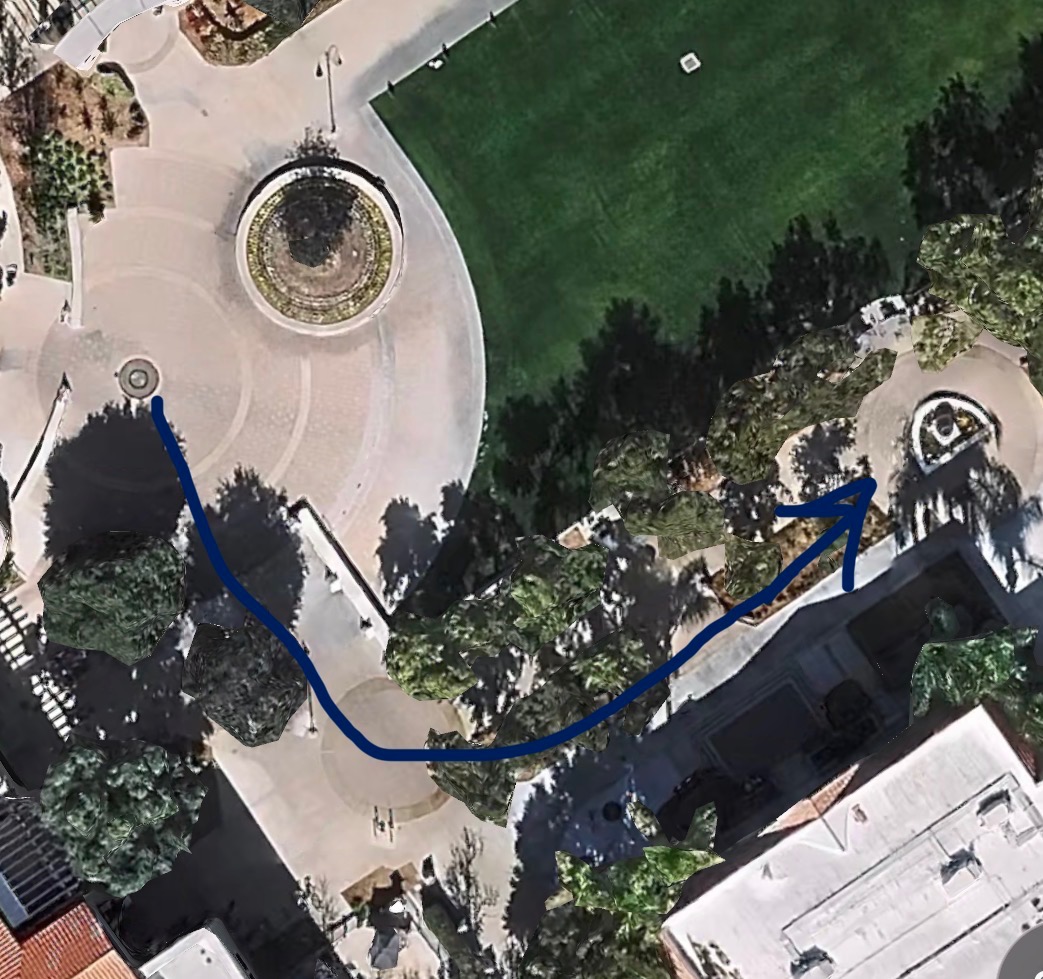
Don’t step on the emblem at California Baptist University or else you won’t graduate. You can break the bad luck by running as fast as you can to the ring statue and kissing it.

Map of the University from the Emblem to the specific Ring Statue

Context:
The informant is a freshmen at Cal Baptist University, where he learned from his First Year Experience Leader this folklore. There is a specific emblem placed on campus where if you step on it, he was told he won’t graduate unless he runs to a ring statue nearby and kisses it. His friends were forced to do it after they stepped onto the emblem. The informant noted it likely was to show respect to the university and a possible hazing ritual from upper class man to lower class men. It showed they were a part of the community.

Analysis:
The story and superstition is shared within the community and specifically shared from upper class men to lower class men. The experience helps build camaraderie between the students and create a distinctive identity for its members. It also on a practical level, helps discourage disrespect against the university and encourage attention to detail and care for the campus and its members. The bad outcome being failing to graduate also emphasizes the communities interest in education.