
Author Archives: garzai

Goat Jinn Wedding

Age: 18

Name: MB

Ethnicity: Tunisian 

Primary Language: English

Age: 18

Career: Student

Hometown: Aurora, Colorado

April 27, 2026

Goat Jinn Wedding

Context: “Jinn” are spirits in Arabic culture that can be good or evil, that aren’t visible but live among humans. It is believed that individuals are constantly surrounded by these invisible spirits. Sometimes, these spirits make themselves appear in moments of passion, anger, or lust. In this story, the Jinn appear from a moment of passion through dance. This story takes place in Kuwait during the 1990s, but is common folklore in Tunisia and other Middle Eastern countries. This story isn’t used as a tale to frighten people, but rather treated as a legend. 

Story: In Kuwait during the 90s, there was a famous singer named Noura who traveled with a small band. She would travel around people’s homes and sing for weddings and various other parties like that. One day, she went to this house to sing – a really big mansion outside of the city, in the middle of nowhere. Despite its ominous presence, they didn’t think anything of it, just another gig. They start to perform just as the guests start to arrive. Everything seems normal and fine, except as Noura stares at the guests, she notices they are dancing strangely. They are dancing in an almost hypnotic way, all swaying in sync. Noura is creeped out by this but keeps performing, assuming this was all some elaborate, choreographed wedding. Noura starts to feel sick and nauseous, but chalks it up to nerves. At midnight, she notices how everyone is taking short, choppy steps. She finally glances down at their feet, only to see no shoes, but goat feet. Every guest has goat feet. Noura is freaked out and terrified but tries to remain composed for fear of what they would do to her if she reacted or they knew she knew. Noura’s band also notices the goat feet but remain calm and keep playing. Noura and her band finish the night at the mansion and speed home. The next day, Noura brings police and reporters back to this mansion. However, the entire mansion is gone, with no trace of it left at all. 

Speaker’s Thoughts:

 “I believe in this story. Goat-footed people sightings in Tunisia aren’t unheard of. The majority of families in Tunisia have pet goats, so they are very much a part of society. I believe that there are Jinns in every corner of a room, with one good and one evil. These goat-footed people are good Jinns, peaceful and passionate about music. My Mom would joke I would grow goat feet when I would dance when I was younger.”

My Thoughts:

I find it interesting that many common ghost motifs, such as midnight and creepy mansions, take place in this story. However, instead of using these motifs to make the ghosts evil as these motifs traditionally do, they are eerie yet peaceful beings just dancing. This story has more of a mystical and enchanting tone rather than horror. 

In many African cultures, particularly West African, the use of music is a symbol of a bridge between ghosts and the living. Similarly, music serves as a bridge in this story, as these ghosts only “come to life” through music and are gone the next day when it is absent. 

Another feature I found interesting was the merging of animals and humans. MB told me nearly every family in Tunis owned goats, so I wonder if there is some familial tie to the animal, hence why they are merged. 

This story isn’t told to scare children or as a cautionary tale, but more of a historical legend. I found it interesting that my friend’s mother would tease her, saying she’d grow goat feet when she would dance passionately. I initially found this story hard to believe, but the fact that it is told so widely across Tunisia as more of a historical recounting than a tale to frighten others makes it more believable. 
Khonsuemheb and the Ghost

Age: 18

Name: JS

Ethnicity: Egyptian

Primary Language: Arabic and English

Age: 18

Career: Student

Hometown: Newport Beach, California

April 27, 2026

Context: 

JS and I were talking about where our families were from one day, and she mentioned her family was from Egypt. I had told her I had always wanted to go to Egypt to see the pyramids and the hieroglyphics. I asked her if she knew much about Ancient Egyptian history, to which she replied she didn’t- save for this one story. 

This story takes place in the Ramses era, 1279-1213 BCE in Egypt. During this time, it was believed that souls continue living in an afterlife when they die, as long as they are properly buried, or mummified. Their tombs would preserve their bodies and allow them entrance into the afterlife. However, only wealthy landowners or members of the court were commonly mummified and kept in tombs. 

Story:

Khonsuemheb and the Ghost

Long ago in Ancient Egpyt during the Ramses era, there lived a high priest named Khonsuemheb who served Amun, the king of gods. One day a frightened man came to Khonsuemhebm saying that a ghost had waken him when he was sleeping near a tomb in Theban necropolis (the city of the dead). That night, the priest prayed to the gods of heaven, earth, and the underworld, asking them to send the spirit to him. 

The ghost suddenly appeared before him, introducing himself as Nebusemekh, the son of Ankhmen and Tamshas. Nebusemekh had been powerful when he was living, serving as an official under a pharoh. He told the priest “ I am mad because nobody remembers my name, my tomb is in disarray, my tomb is exposed to the winds of the winter. I fear that I will no longer exist and be lost because my soul will have no home to contain it,”.

Hearing this, Khonsuemheb wept fot the spirit and took pity on him, saying “Please express to me a fine commission such as is fit to be done for you and I will surely have it done for you”. However the spirit isn’t convinced the priest will fufill his promises citing that many before him had promised the same. The priest has assured him already that, if he cannot build him a new tomb, he will have five men servants and five maidservants bring him food and water as offerings daily, but the spirit would not be consoled.

The sun then comes up, causing Nebusemekh to disappear. The priest is determiend to keep his promise, so he sends men to search for the ruined tomb. The priest completely renovates the tomb and instructs women to deliver food and water to it daily, ensuring that Nebusemekh will never be forgotten. 

The spirit of Nebusemekh was never seen wandering the world ever again, as he is thought to have finally achieved peace. 

Speaker’s Thoughts: I think it is very telling of Ancient Egyptian culture and symbolic of their religions and art, but it doesn’t carry to modern Egypt. I think a lot of people assume this is what modern Egyptians think and what they actively believe in but I personally don’t believe in this. I believe in ghosts for sure, but not in this story necessarily. 

My Thoughts:

This story is a classic ghost story in the sense that it follows the motif of improper burial. The ghost of Nebusemekh only appeared when his tomb was in disarray, and he was no longer properly buried. However, once this was righted, he disappeared – a common ghost story stereotype. 

However, this story drifts away from these classic stereotypes by not making it a horror story.  Nebusemekh only appears to people, pleading for help. Even the priest, Khonsuemheb, didn’t treat Nebusemekh as a being of horror, but rather a being worthy of empathy. This isn’t necessarily a horror story but more of a piece of folklore. I believe this story was told to Ancient Egyptians to convince them that if their pharaoh or other high society members received improper burials, they would exist in a life of misery in the afterlife. 

Given this story is centuries old, I wonder if its meaning or interpretation would change. Modern Egypt is a primarily Arabic nation, so I wonder if Nebusemekh would be considered a ghost or an Arabic “Jinn”. Jinns are considered to be natural spirits that always exist around people. My friend doesn’t believe in this story at all, but I wonder if any Egyptians believe in it and if so, do they interpret it differently, as their culture doesn’t believe in mummification and tomb burial. 

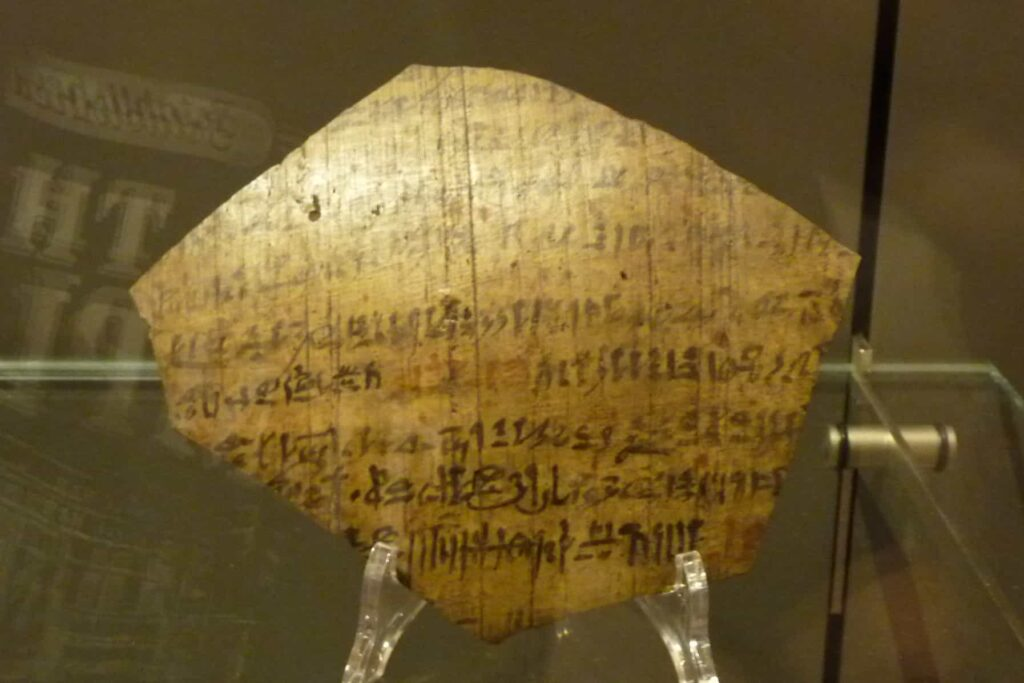
I find it interesting that this story is extremely old, first found on a piece of papyrus from the Ramesside period (13th Century BCE) and later passed down through generations as a piece of folklore. I wonder how long this story has been told, and what its effect on society has been. I find it fascinating that people have been telling each other ghost stories, the same way people are today in 2026.