
Tag Archives: Childhood

Star light, star bright….- Verbal Folklore/Ritual

Text: “Star light, star bright, first star I see tonight, I wish I may, I wish I might, have this wish, I wish tonight”

Informant: “So mine was about how to make a wish by wishing on the first star. You’d say, ‘Star light, star bright, first star I see tonight, I wish I may, I wish I might, have this wish I wish tonight,’ and then you’d say the wish in your head. You couldn’t tell anyone what it was or it wouldn’t come true. I honestly don’t know how I learned it. It might have been from preschool or from my mom, but I remember doing it when I was really young. Whenever I saw a star, I’d say the little chant or rhyme out loud and then make the wish.”

Interviewer: “Would you go out of your way to do this, or was it just whenever you happened to see a star?”

Informant: “It was usually just whenever I saw a star, and it had to be the first star I saw that night. Then I’d make the wish. But if I had a really important wish, I might try to look for a star. Usually though I wouldn’t remember to do that, so it was mostly just if I happened to see one. I’d think, ‘Oh, the first star I see tonight,’ and then say the rhyme.”

Interviewer: “Were you alone when you did this?”

Informant: “No. I vividly remember one time I was at a grocery store with my mom and we were walking in. I saw a star and said the rhyme right there. That’s the one time I clearly remember doing it. Maybe you were supposed to do it alone, but I never really did. My mom mostly looked at me like I was crazy when I did it, like ‘What are you doing?’ But I think I ended up teaching it to my little sister.”

Context:

The informant remembers learning this wishing rhyme when they were very young, possibly from preschool or from their mother. They recalled using the rhyme during childhood whenever they happened to see the first star at night and later teaching it to their younger sister.

Analysis:

The rhyme reflects a common cultural belief that wishes can be influenced by specific actions or conditions. The requirement to see the first star, speak the rhyme, and keep the wish secret creates a small ritual that gives structure to the act of wishing. For children especially, these steps make the wish feel more meaningful and possible, providing a sense of hope and imagination. The informant later teaching the rhyme to their younger sister demonstrates how these traditions are passed through families, showing how folklore helps preserve small moments of childhood belief and wonder across generations.

Stickers on my Computer

Context

“When I was 8 I loved collecting stickers. I would pay quarters at pizza restaurants to collect the random stickers and get sticker books. When I got older, I saw how popular it was for people to put stickers on their water bottles and binders. I was so happy to finally use my stickers, so I had the sticker-iest water bottle and binder. This childish thing I did seemed like a stupid phase, but it stuck with me as I grew. They were meaningless and fun until I got to high school.”

Text

“I was more mature in high school, in pursuit of meaning in life, and most importantly, I got a computer. I began to put stickers on the laptop signifying places I’ve been, passions I’ve had, or people I was close to. Some of these stickers have been transferred from my water bottle, taped over and over again because it keeps falling off. My favorite is a picture of Justin Bieber. Not because I love Justin, but becuase my little brother and I had a running joke that we were his biggest fans. The sticker reminds me of him now that I’m in college. Eventually, the computer will die, but the memories won’t. I’m keeping it to show my kids, and explain what I was like when I was their age through my favorite childhood accessory: my stickers.”

Analysis

The meaning that the simplest objects can have for different individuals show a key trait of typical folklore. In folklore, the piece of lore being shared is often underappreciated or meaningless to those outside of the folk group. Thus, this personal connection to different things such as stickers shows how folklore is so important in our lives. For my friend, his computer stickers carry memories of childhood and family giving his computer a piece of his identity. In contrast, I do not hold the same heartfelt connection to stickers which is why my laptop is bare. Still, I can appreciate his lore and pass it on to others who too like sticker decorations. As we discussed, material culture is a prominent form of folklore because it acts as a reminder of important things in one’s life. Through the stickers he is reminded of his family and childhood making a laptop into folk art that tells stories of his life.

Arctic Fox

The Story:

“When I was in third grade, I moved to a different part of the city and changed schools. The first book we read in class was The Fantastic Mr. Fox. Our teacher used an origami activity to tie into the book and taught us how to make origami foxes. In the class, we used orange origami paper, but since that class I have made the origami foxes out of whatever resources I had around- like i did in class on Thursday!”

Reflection:

Reflection:

The informant’s story was a good example of folk art when mixed with personal memory and communal creativity. The emphasis on the folk art being created with “whatever resources I had around” is an example of making do with whatever is at hand. This draws back to the importance of folk art, since it essentially is the presentation of messages or historical context via a multitude of mediums. Furthermore, the folk art and its prevalence in the informant’s life shows how the folk art, despite the material used to make it, will always carry the historical and contextual significance when being recreated and taught onto other individuals. The story exemplifies the folkloresque of the integration type. The origami fox activity is an attempt at a connection between book and another tangible media form, yet seems folkloric as it allows the opportunity for the children to form shared connected ideals and emotions of the origami.

Doljanchi

Text:


“So when I was one, I had this huge birthday party, and they laid out certain things — like a stethoscope, or money, or rice that symbolizes success. And then the baby has to pick one of them, and that’ll determine their path in life. A stethoscope would mean a doctor or something like that. I think I chose the rice. That’s from my Korean side.”

Context:


Doljanchi (also Dol) is the traditional Korean first-birthday celebration, and, officially, the Doljabi ceremony plays a vital role as an object-choosing ritual. Objects placed before the child vary by family and period but generally include objects that symbolize prosperity, health, scholarship, longevity, and professional achievements. The informant, who is half-Korean, inherited this practice from her father’s side and recalled it with pride, linking it to what she saw as a broader Korean cultural ethos of persistence and upward mobility.

Analysis:


Doljabi is one of the most recognizable folk rites in Korean culture, a fortune-telling performance at one of the earliest celebrations of a child’s life. Its endurance, even among second-generation Korean Americans, speaks to its profound cultural resonance. But most importantly, it’s not truly believed that the child’s choice is literally determining their future. The ceremony is more of an aspirational blend of parental hope and communal adornment. The informant’s observation is especially rich in that she ties the Doljabi to an understanding of Korean national identity, where the practice is not simply a matter of family heritage but an expression of a people’s relationship to ambition, hard labor, and prophetic evolving throughout life itself. And this shift from family tradition to ethnic pride is exactly how folk traditions maintain meaning in diasporic contexts: they become bearers of a larger tale about who a people are and where they have come from.

Folded Paper Football

Age: 20

Collection Date: 04/09/2026

Context:

During an in- class activity, my informant showed me how to fold a standard piece of paper into a football that he used to play small desk games with friends as a child. He said said that he learned this in elementary or early middle school and often created these footballs while bored in class. It was a fun way to stay busy and play with friends when class allowed it.

Text:

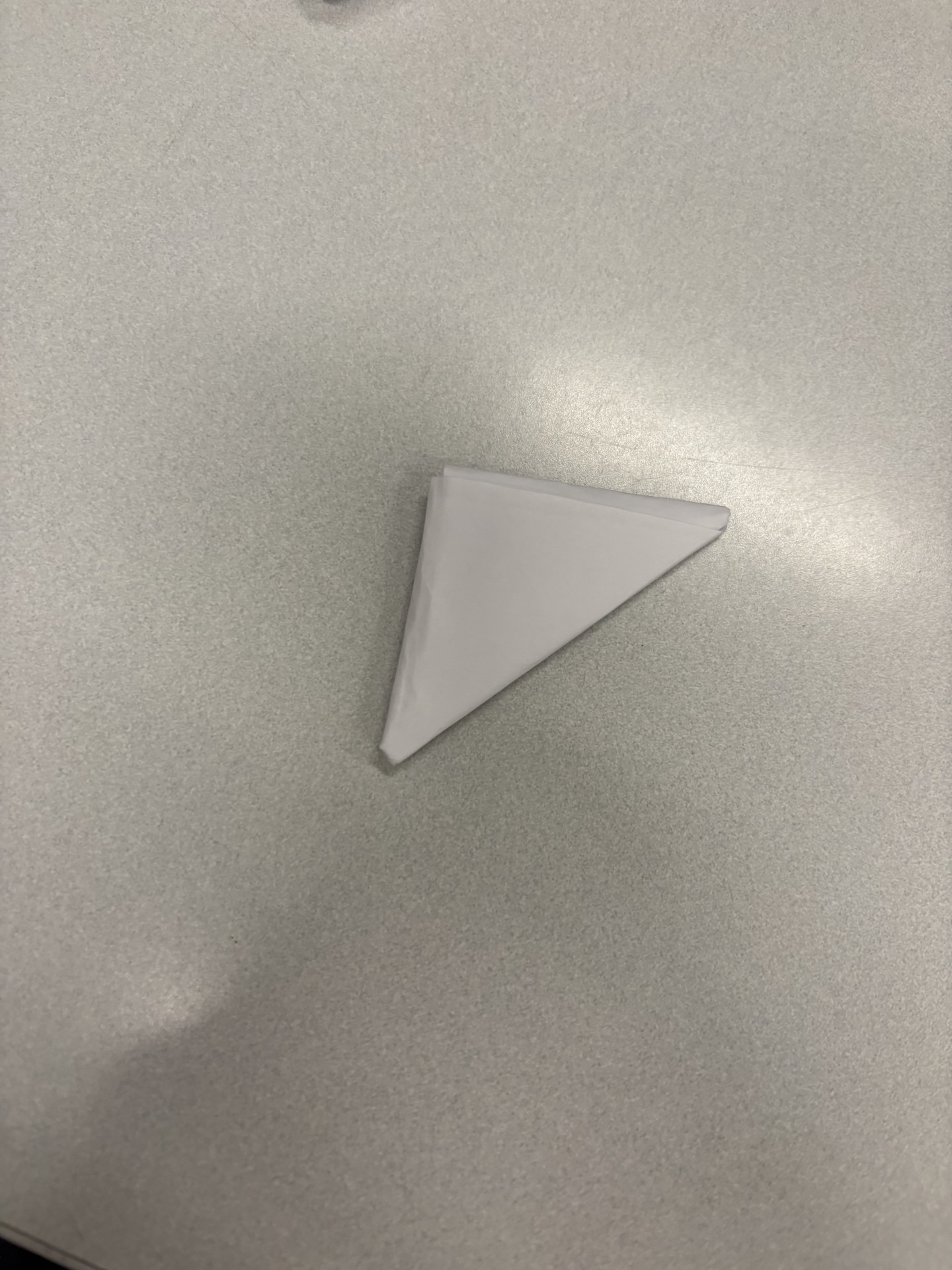
My informant repeatedly folded a standard 8×10 piece of printer paper, ensuring tight, straight folds with no unnecessary creases. The shape is formed by folding triangles into one another, making the final product dense and sturdy. My informant used an older YouTube video for assistance to remind him of some of the steps. He demonstrated the folding process and explained key details, such as the aforementioned tight folds, minimal creases, and common mistakes people make when folding them.

The final result is the Paper football pictured above, which can be used to play a fun game with a friend. Each takes a turn: one holds their fingers in the shape of a goalpost, the other positions the football in a punting position by holding the top corner and pushing down so it stands vertically. The “kicker” then flicks the football, propelling it forward into the goal. The player who gets five goals first wins.

Analysis:

It is interesting that he called it a football. I had never heard it called a paper football before, but when he showed me the process, I immediately knew what he was talking about, which I called a “paper triangle.” It’s funny, because I also learned how to make those from friends back in elementary school. These kinds of foldables often appear when we’re supposed to be learning, paying attention, or otherwise doing something else. Due to their location, students had to be somewhat sneaky when creating or playing with them, keeping them hidden from the teachers.

It is also a perfect representation of school children’s folk art. It is an item made informally from mass-produced materials, that’s taught from student to student, or unofficially online, and holds no monetary value. However, it does hold sentimental and nostalgic memories for the children and communities who grew up with these.

It is also interesting how he used some assistance from a random YouTube video. This reminds us that folklore continues to thrive online. There wasn’t one specific “right” video. Although the end product is roughly the same, each creator has a slightly different way of folding the paper or presenting the instructions, giving the process variety. Even though the digital tutorial exists, he still showed me in person how to make it, and the details (described earlier) he added were quite interesting and different than what the video did or could have mentioned.