
Tag Archives: Game

Chinese Red Date String Game- Children’s Folklore

Age: 54

Text:


Informant: “It’s something you say while doing a string trick. You use a piece of string and form a shape that looks like a date. The string represents the fruit, and through different movements it changes shape and eventually disappears while you say the rhyme out loud, ‘大枣大枣,越吃越小,吃了剩核,一拍没了。(Dà zǎo dà zǎo, yuè chī yuè xiǎo, chī le shèng hé, yī pāi méi le.)’. It’s meant to be a little like a magic trick. The phrase translated in English is something like, ‘Big date, big date, the more you eat it the smaller it gets, then you clap and nothing is left.'”

Interviewer: “When did you first learn it?”
Informant: “My mom taught me when I was very young. There weren’t that many things to do for fun back then, so we did a lot of hands-on activities like this, and all you need is a piece of string, it’s pretty easy to do.”

Interviewer: “Did you teach it to anyone else?”
Informant: “Yes, I taught it to my kids.”

Context:

The informant learned this string game from their mother during childhood while growing up in China in the 1980s. They explained that there were not many forms of entertainment available to children at the time, so simple hands-on activities like string tricks were a common way to play. Because the game only required a piece of string, it was easy for families to share and teach to children. The informant later passed the game on to their own children, continuing on the tradition.

Analysis:

This example can be interpreted as a form of children’s folklore, specifically a children’s game that combines a rhyme with a small physical activity. The game also demonstrates the folkloric concepts of multiplicity and variation. Similar string games appear in many cultures using the same simple materials but different shapes and rhymes. For example, it is similar to the string game cat’s cradle I learned as a kid, which also involves manipulating a loop of string to create patterns. Because the movements are difficult to understand without seeing them performed, games like these are usually learned directly from another person rather than through written instructions, which helps preserve their oral and performative nature.
Inky Binky Bonky

The Story:

“When I was younger, I had this tradition that I did with all of my friends. It started with my cousin, she taught it to me. But one of my favorite games growing up was tag and the way that we determined who would become or who would be the first to be it was Inky Binky Bonky. What we would do is we would come together and we would put our feet in a circle, and then we would chant the song while pointing onto each other’s toes. “

 “Inky Binky Bonky, 

daddy had a donkey, 

donkey died, 

daddy cried, 

what color was the donkey’s butt?”

“and then you land on somebody and then they give a color. If they’re like pink, you go P-I-N-K pink and then you’re out. That person’s out. And then you keep going until you have one person.

I taught the rhyme onto other people. My cousin did it because when I was younger the only rhymes I think were mutually accepted and known or widely known were like bubble gum bubble gum in a dish and Eenie Meenie Minie Moe, but Inky Binky Bonky, I had never heard of it. My cousin taught it to me and then I taught it to all of my friends.  The last age I played it, I would say maybe when I was like 11 or 12. I learned it, I want to say either kindergarten or first grade.  A twist I added was if it landed on me, I would count how many feet it would take for me to be it. Say a color that was longer, I knew that if I said pink, it would land on me, so I’m saying orange or I’m saying something else so that it’s somebody else. But yeah, I would just  use the color in my mind to navigate what I wanted to do and where I wanted to go.”

Reflection:

This interview and the informant reminded me of childlore and the multiplicity of folklore and how it can transcend regions but still have the original intent. The counting rhyme functions as a folk narrative in a shorter form, a verbal performance that assigns social roles and the weight they carry via rhythm, chance and choice. This also touches making do with whichever mediums are at hand and still perpetuating the original intent of the folk media. This version of a counting game, as well as some of the tactics used when determining social roles as implied by the rhyme are especially interesting. Although there is no direct author of this rhyme, it still exists and has several variations in different locations and regions. Further, it shows the creative control the informant and players of the game have when choosing the color when playing the game. It goes to show that while several versions of a game may exist, the original intent remains and the initiation players take to achieve the desired outcome. 

Children’s Game (Down by the banks)

Age: 21

Text:
“Down by the banks of the hanky-panky where the bullfrogs jump from bank to banky with a heap, off, over the top, land on a lily pad with the curplop.”

Context:
A girl from Denver, Colorado describing a game she used to play with her friends as a child where they sat in a circle with their palms facing up. Each person goes one by one, singing and clapping their neighbors hand at the rhythm of the song, typically increasing speed as the game progresses. If you are the last person to be slapped, you’re out of the game. The last man standing is the winner.

Analysis:
It was interesting to hear this rendition of the song because mine was slightly different in the second half from what I can remember. The beginning was the same, but the end of mine was slightly different, going, “heap, hop, soda pop, he missed the lily pad, he went curplop.” However, the heart and content was still the same, with the general storyline of the song and clapping hands while seated in a circle motion, trying to not get eliminated. This demonstrates the multiplicity and variation when passing along games.

Folded Paper Football

Age: 20

Collection Date: 04/09/2026

Context:

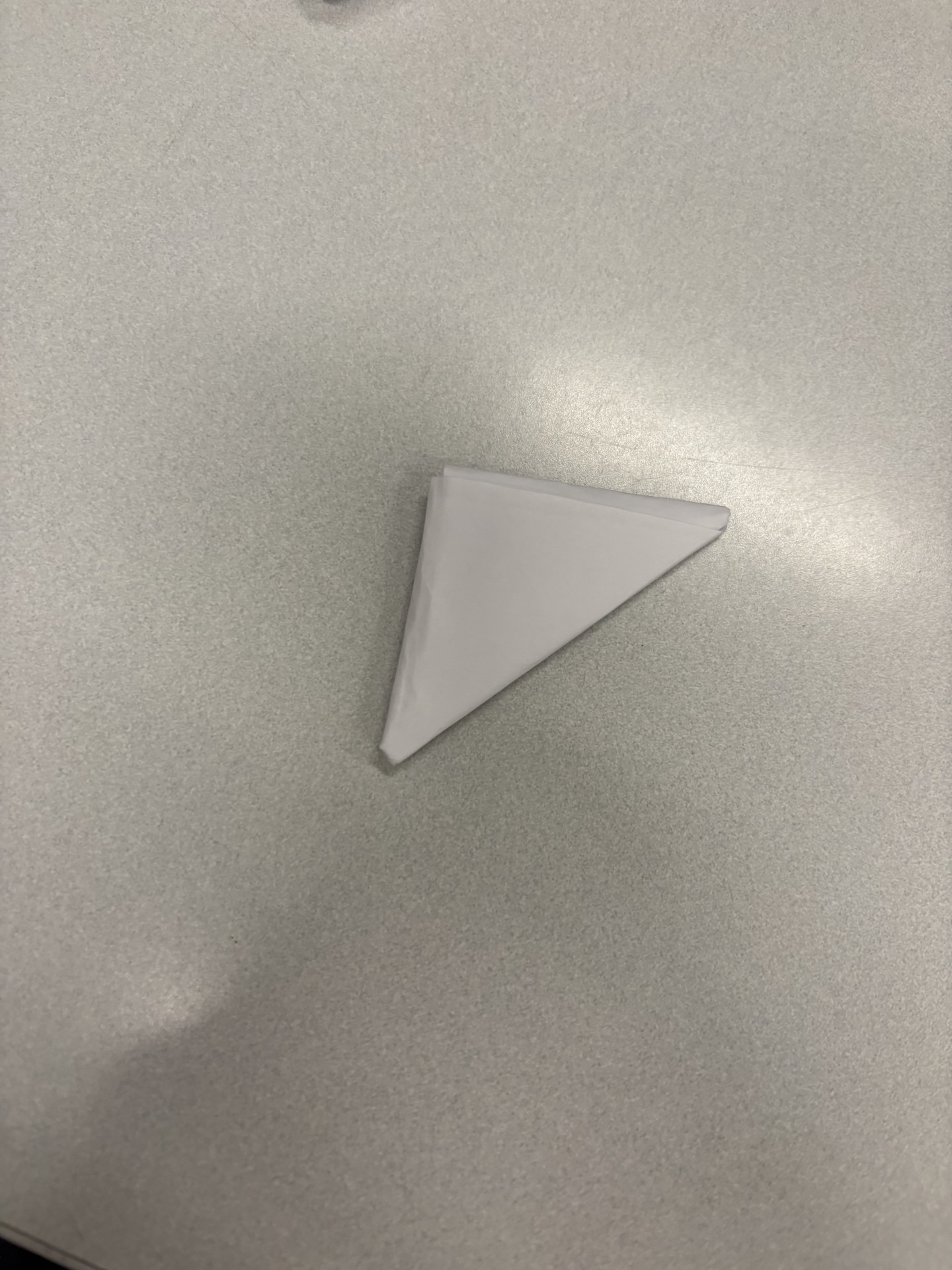
During an in- class activity, my informant showed me how to fold a standard piece of paper into a football that he used to play small desk games with friends as a child. He said said that he learned this in elementary or early middle school and often created these footballs while bored in class. It was a fun way to stay busy and play with friends when class allowed it.

Text:

My informant repeatedly folded a standard 8×10 piece of printer paper, ensuring tight, straight folds with no unnecessary creases. The shape is formed by folding triangles into one another, making the final product dense and sturdy. My informant used an older YouTube video for assistance to remind him of some of the steps. He demonstrated the folding process and explained key details, such as the aforementioned tight folds, minimal creases, and common mistakes people make when folding them.

The final result is the Paper football pictured above, which can be used to play a fun game with a friend. Each takes a turn: one holds their fingers in the shape of a goalpost, the other positions the football in a punting position by holding the top corner and pushing down so it stands vertically. The “kicker” then flicks the football, propelling it forward into the goal. The player who gets five goals first wins.

Analysis:

It is interesting that he called it a football. I had never heard it called a paper football before, but when he showed me the process, I immediately knew what he was talking about, which I called a “paper triangle.” It’s funny, because I also learned how to make those from friends back in elementary school. These kinds of foldables often appear when we’re supposed to be learning, paying attention, or otherwise doing something else. Due to their location, students had to be somewhat sneaky when creating or playing with them, keeping them hidden from the teachers.

It is also a perfect representation of school children’s folk art. It is an item made informally from mass-produced materials, that’s taught from student to student, or unofficially online, and holds no monetary value. However, it does hold sentimental and nostalgic memories for the children and communities who grew up with these.

It is also interesting how he used some assistance from a random YouTube video. This reminds us that folklore continues to thrive online. There wasn’t one specific “right” video. Although the end product is roughly the same, each creator has a slightly different way of folding the paper or presenting the instructions, giving the process variety. Even though the digital tutorial exists, he still showed me in person how to make it, and the details (described earlier) he added were quite interesting and different than what the video did or could have mentioned.

“Handball” rules at Williams Elementary School

Age: 22

TEXT

My informant and I talked about the rules of the most popular recess game back in elementary school, handball (more popularly known as four-square). We talked about how much more distinct and difficult our school’s version of four-square was, as we had a rule in which the ball had to bounce once in your own square before it went into another square and that you could not step out of your own square. In contrast, as shown in this video, it shows people playing four-square violating all the “rules” of our version of the game and while there is outrage over rules in the comments, none of the outrage is over the fact that they are hitting the ball without bouncing the ball in their own square first.

CONTEXT

This informant is my older brother, who currently works as an engineer in Cleveland, Ohio, but grew up and attended the same elementary school as me in San Jose, California. This topic came up when I sent my informant a TikTok post showing four square clips, where we became critiques of how bad other versions of the game was. As I talked with him more about his memories of four-square over the phone, he recounted how his classmate had taught him the rules of four-square on his first day of school when we moved to San Jose, and how the game holds a special place in his heart as his favorite recess game and our memories of playing the game together as kids. While he says he hasn’t played or thought about four-square in over ten years, he affirms that the version of four-square we grew up playing is the hardest and true version of four square.

ANALYSIS

The confusion and frustration my informant experienced from this conversation encapsulate a lot of the folklore concepts our class talked about. It shows the unique aspects of multiplicity and transmission of folklore. At its core, four square is played with the same playground rubber ball with a painted square on the concrete but each school/region seems to have their own rules, and the game was informally taught to each other by our classmates. In my opinion, I think the most interesting insight I took away from this folklore came from the reactions of all the comments online. With the internet, four-square was not only able to be transmitted all over the world as kids learn about the game online, but it also allowed people who grew up playing their variation of four square to see others’ versions. However, my informant’s and the video’s comment section’s negative reaction to this other variation shows how for all individuals, they believe their version is the most authentic and aren’t hesitant to judge anything else as wrong. As a metaphor, the rules of four square could be seen as similar to moral values that a certain religion, community, or people value. Depending on the region, these “rules” will change, and as we unfortunately see, things like discrimination and hatred often stem from individuals clinging to their “rules” as the most authentic and correct, while refusing to acknowledge the fact that that other variations may exist and label them as wrong without hesitation.