
Author Archives: Sophia Rosenberg

Lucky Number

“Since I was little, I always felt connected to my birthday, especially the numbers. My birthday is December 11 so the number I always look for at 1211. My fixation with 1211 started when I would see it everywhere: license plates, receipts, etc. So everytime I see the number, I now consider it an Angel/Lucky number and as a good sign from the universe.”

Context

The informant grew up in Miami, Florida and while growing up she has always known about angel numbers and believed in the luck they bring.

Analysis

The number 1211 functions as more than superstition for the informant. It acts as an anchor to her sense of self. Because it originates from her birthday, seeing it feels like the universe recognizing her personally. This shows how people often build personal belief systems out of ordinary details and turn coincidence into meaning as a way of feeling seen and grounded
Bloody Mary

Text

“When I was little, my older sister used to put me into the bathroom and turn the lights off and lock the door with her body and put a chair under the knob. And would scream, bloody Mary, bloody Mary, bloody Mary, 3 times, and I would look in the mirror and there would be a woman behind me. I’d be so scared.”

Context

The informant is from Los Angeles and has an older sister who would mess with her, like siblings do.

Analysis

Bloody Mary is one of the most widely circulated pieces of children’s folklore in the U.S., and what’s interesting about this account isn’t the legend itself but how it was performed. The informant didn’t encounter Bloody Mary through a calm explanation or a sleepover dare among peers. Her older sister forced the ritual on her by locking her in the bathroom and chanting the name for her. That changes the texture of the folklore considerably because it becomes a tool of sibling power rather than a shared rite of passage. Additionally, because she remembers actually seeing a woman behind her, whether it was imagination or the brain filling in shapes in a dark mirror, the experience was real to her, and that’s part of why this legend has survived for generations.

Origami

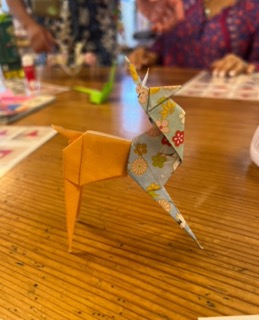
Image- Origami Deer

Context

Origami figure folded by someone who informally learned the technique from a local during a trip to Japan.

Analysis

This photograph documents an origami deer folded from two different sheets of paper, a plain orange for the body and legs, and a blue-grey washi paper printed with traditional Japanese floral motifs for the upper half. The figure was made by someone who learned to fold origami during a visit to Japan, where they were taught by locals they met there.

Origami is a strong example of material culture because it travels person-to-person through demonstration and imitation rather than written instruction. The decision to combine two different papers also reflects multiplicity and variation: though the deer follows a traditional pattern, small personal choices like paper selection give each piece its own character. What makes this artifact especially interesting is how the knowledge traveled with the maker. It was learned in Japan, then carried back through memory and muscle, only to eventually be reproduced in a completely different setting.