“If the wind changed while I was making a face, it’d stick like that.”

Text: 

“My grandfather told me that if the wind changed while I was making a face, it’d stick like that.”

Context: 

The teller would hear this saying from their paternal grandfather (opa) when they were around eight to ten years old. The teller grew up in Singapore, and they would hear this saying from their grandfather in English. The grandfather grew up in Indonesia, though the teller is unsure if their grandfather learned the saying from there specifically. 

Analysis: 

This particular quote is a variant of a common saying used by parents to warn children from making funny or extreme faces, leveraging a child’s fear of ugliness and perhaps permanence to prevent them from embarrassing either themselves or their parents when in public. The threat of the saying collected here is notably based on the random chance of the wind changing rather than any choice that the child has control over, perhaps in order to instill more fear of and consistency in the threat itself. There is also perhaps a real fear of paralysis that forms some foundation for the saying; I’ve certainly heard from friends in the past that they were afraid of getting a stroke while making a funny face and having their faces paralyzed like that. While a hypothetical and rather extreme scenario, it certainly lines up with the fear of random chance and permanence presented in this saying.

How do you spell “candy” with two letters only?

Text: 

Teller: “The basics of the riddle is very simple. It’s just: how do you spell ‘candy’ with two letters only.”

Another Observer [through text]: “Oh, is it C and Y?”

Me: “Oh, that’s pretty smart.”

Teller: “I… think it’s stupid.”

Context: 

The teller heard this riddle very recently from their father while he was visiting the teller at college. The teller and their father are from Singapore, but they have close family in and connections to the US as well. The riddle was performed in a group call with both voice call and text chat available, hence the involvement of an additional observer in the solving of the riddle.

Analysis: 

The fun and trick of this riddle comes from a simple bending of linguistic rules of English spelling, grammar, and understanding of the alphabet. I included the teller’s impression of the riddle not only because I thought it was funny, but also because it is a very logical response to a riddle that’s based on a logical fallacy. The solution of the riddle requires the solver to accept two contradictory truths: that “C” and “Y” are letters but “and” is not, and that “C,” “Y,” and “and” all equally function as letters used for spelling the word “candy.” In finding the solution, the solver must perceive these two principles as more dynamic, blurry, and transitory. The solution also benefits from a more visual understanding of spelling and language rather than an auditory one, as the visualization of “c and y” is much closer to the word “candy” than it is in speech.

Pelican Soup

Text: 

“Alright, here’s the riddle. A guy walks into a restaurant and asks for Pelican Soup and they serve it to him. And then, after he drinks the soup, he walks out of the restaurant and kills himself. Why did he kill himself?”

[For around the next twenty minutes there is a back and forth conversation between me and the riddle teller, where I ask questions about the given scenario and the riddler responds with yes/no and guiding comments. The conversation is too long to record completely in this post, but the general trend of the questions went from asking about the quality of the pelican soup, asking about the man’s family, discovering the man’s wife is dead, and uncovering the circumstances surrounding her death. The text is recorded from the end of the discussion.]

Me: “So the spouse’s body parts are not in the pelican soup.”

Teller: “Not in the one that he’s drinking at the restaurant.”

Me: “Oh! So did they make pelican soup out of her? …She’s not a pelican.”

Teller: “Um… You’re like on fire right now but you’re still not exactly there. Why did they make pelican soup out of her?”

Me: “Cause they were hungry.”

Teller: “Why were they hungry?”

Me: “Cause they were stranded on an island.”

Teller: “So why did the man kill himself?”

Me: “I’m sure that it would be bad to eat your spouse. I don’t think it would be very enjoyable, and to eat pelican soup and be like ‘hm, this pelican soup tastes different from the one that I had before – oh it was human flesh…’”

Teller: “Ok, so just for the sake of understanding, could you phrase what the story was then.”

Me: “I think they got stranded on the island, they did something with the spouse and she fucking died, I don’t know exactly… and then the friend was like ‘well I guess we’re going to have to cook her!’ and they didn’t tell the dude, and then they ate ‘pelican soup.’ And then he went back and was like “I’m so sad about my wife, this pelican soup tastes different.”

Teller: You got it! Let’s go. 

Context: 

I collected this riddle/game in a group call where this riddle was performed on me. The person telling the riddle had originally learned of it online from a video, but also had heard it from his friends throughout the years. Other members of the call also noted that they had heard the riddle from various different settings while growing up, such as summer camps, from friends at school, etc.. During this call of around 6 people, I was the only one who had not known of the riddle beforehand, and thus was the only one attempting to find the solution. Typically, as both the teller and other members of the group informed me, the riddle would be performed on a group of people who would collectively try to solve the riddle together. 

Analysis: 

The Pelican Soup problem provides very little information in the initialization itself, and thus requires the solver to continuously interact and question the teller and form a solution based on the information gained in this process. In this way, “Pelican Soup” acts closer to a logic puzzle or game than an actual riddle, with the main source of amusement coming from its dynamic interactivity between teller and solver. While there was only one solver in this particular performance of the puzzle, the typically communal context that this problem is given in also adds an additional level of interaction amongst the various solvers as well, as they each contribute a variety of questions to reach the truth. The Pelican Soup Problem, in this way, greatly resembles “20 Questions” – a game where solvers must identify a specific item that a teller is thinking of within twenty questions – though “Pelican Soup” possesses a more complex solution that warrants an unlimited number of questions. 

An additional level of entertainment comes from the morbidity of the scenario itself, based around an event of suicide and cannibalization. Given that this particular instance of the problem was learned in childhood and through programs like summer camps, I would argue that the level of morbidity in the puzzle acts as a sort of test of adulthood for those still in their youth – the better that they are able solve the puzzle and comprehend its darkness, the greater they are prepared for the more serious and severe “adult world.”

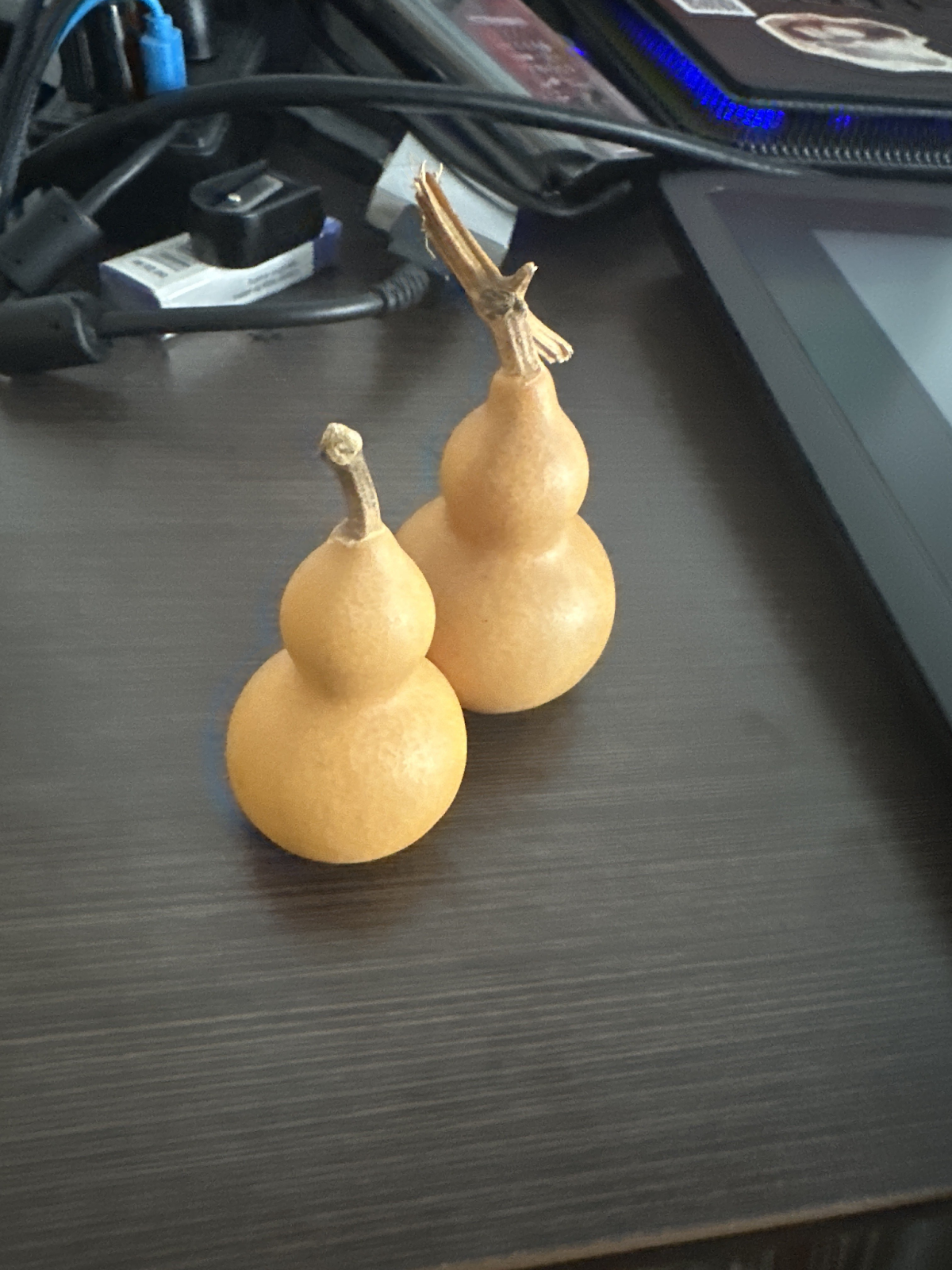
Hu Lu – Folk Object

Text: 

“So my dad got me two hulu because it’s like a lucky charm, and they’re like very round. I’m not really sure why they’re lucky, but I know there’s a show called Hu Lu Wa, and like there’s little guys who come out of the hulu and beat evil people up. Yeah, so my dad was like these two things are very, like, brings you luck and safety, security, whatever… good stuff.”

Context:

The teller is a first-generation Chinese American raised in the Bay Area of Northern California. She received the two hulu, or calabash gourds, as a gift from her father, who purchased the items while visiting a riverside ancient city area in China. The teller’s family is from Shanghai, but she notes that the hulu is a common symbol found throughout the country. 

Analysis: 

Within Chinese culture, the calabash is a common charm for luck, fertility, and protection, charms associated with it due to its shape and also historic use as containers for items like medicine. It is interesting to note that while the teller confesses she doesn’t truly understand the meaning behind the calabash, she is able to find personal meaning through the association of the gourds with the show Hu Lu Wa, or Calabash Brothers. Hu Lu Wa is a popular Chinese animated cartoon in which seven brothers born from a set of rainbow calabash gourds must protect their home from two demons, and it remains a common cultural experience for many in the Chinese diaspora of the current generation*. The teller’s association of this folk object with the show  points to how popular culture and media in the modern age influences how folklore is passed on and communicated, particularly to members of a diaspora and those who have a certain degree of separation from the culture and may not organically learn of specific meanings otherwise. 
*Note from the collector: I as a Chinese person raised in the US have bonded with many First-Generation Chinese Americans and Chinese immigrants over knowledge of Hu Lu Wa and other Chinese animations like it. Based on personal observation, I think it is common for Chinese parents born in the 70s to show these to their children as a way to connect our childhood to their own, which explains the popularity of the show amongst Chinese people of my generation in spite of the chronological distance between the 80s and the 2000s. Hu Lu Wa and other shows made by Shanghai Animation Film Studios occupy a similar role in Chinese pop culture that classic Disney movies have in American pop culture.

Origami Fortune Tellers

Text: A folk object (product and/or process) that you learned to make in elementary school

 – Origami fortune tellers

Informant: RM

Ethnicity: Indian

Primary Language: English

Age: 20

Residence: Cupertino

Context: 

The informant says that when she was in elementary school, she learned how to make origami fortune tellers from her friends (and in turn taught the process to others). These fortune tellers were often used in school to predict outcomes for a variety of things, including forecasts for the day, successfully talking to a crush, and the courses of friendships.

Analysis:

The widespread creation of origami fortune tellers by elementary schoolers reflects a convergence of cultural and social factors. Since the craft of origami originated in Japan and spread to China, it is worth noting that the informant went to a primarily Asian elementary school which, in turn, may have had an influence on their popularity. As a result, spreading the craft of making fortune tellers is a sort of cultural transmission, passing along preexisting folklore from a larger cultural group along to a new one consisting of children in the same age range. It can also be interpreted as a reflection of children’s desire to seize control of their lives in some way, as children do not have the same independence and agency as an adult; this can still resonate with adults who remember the craft, serving as a source of nostalgia (and many of them still take it up). Furthermore, the fortune tellers provide an avenue for creativity and imagination to shine through social interactions.