
A Strange Hangover Remedy

Interviewer: Do you have any special hangover cures you can recommend? 

GM: Promise not to judge me? It’s a little strange. 

Interviewer: Promise!

GM: My friend taught me the method some time ago. After my 20th birthday, I woke up so hungover that I wished I hadn’t been born at all. My friend, who was in a similar situation, suggested a method his dad had taught him that never failed to cure him. Here is the recipe: you take the cold pickle jar from your fridge, drain the pickle brine, mix it with sparkling mineral water, and add one shot of vodka. That’s it. You drink the whole drink in small sips, and you’re cured.

Interviewer: That sounds like it might just work. 

GM: It totally does! I don’t know whether it’s the electrolytes in the pickle juice, the carbonation, or the hair of the dog, but this concoction took me from a walking corpse to a semi-functioning human, so I can’t complain. 

Interviewer: Wow, I will make sure to try it next time I find myself in a similar situation. 

GM: You should, and you know what? The taste isn’t even that bad. I actually kind of like it. 

Context:

The informant is a 22-year-old male from Georgia. He is a student at University College London, and he has been living in London since he was eighteen. He is a social drinker and utilizes this cure method after particularly heavy nights of drinking. The origin of the recipe is unknown past the dad of the resplendent’s friend.

Analysis

Hangover cures are examples of folk medicine. Hangover cures such as this one are passed down through social networks rather than formal medical authority. It can also be noted that they are more prominently passed down between men. Cures are a natural extension of drinking culture, and they therefore must exist all around the world in variation. The performative and sensory aspects of this practice additionally add merit to them being a folk practice. The making of the drink, the strange appearance, and the strange taste and texture are all part of the performance.
A Georgian Spring Tradition

Interviewer: Do you remember any special yearly traditions from your childhood?

GM: One thing that comes to mind is chiakokonoba. It’s a yearly tradition around spring where we used to make a very large fire pit and take turns jumping over them. 

Interviewer: Interesting. Tell me more, please.

GM: All the kids in the neighborhood gathered around and competed in who could jump over the largest fire. You can see the appeal; either you make the jump or burn yourself. The adrenaline is what made it fun. 

Interviewer: Do you know where this tradition originated? 

GM: No, but the idea is that it scares evil spirits away. 

Interviewer: Did you believe this when you were participating as a kid? 

GM: Not really. If anything, it angered my mom so much that evil spirits weren’t what I was afraid of anymore. 

Context: The informant was born and raised in Tbilisi, . He often visited his grandparents in the village during spring break, where he used to participate in this tradition. According to him, this tradition is less popular in the urbanized parts of Georgia but still lives on in the more rural areas.

Analysis.

The informant describes a tradition for driving away evil spirits called chiakokonoba (ჭიაკოკონობა). It is interesting that this cleansing from evil spirits happens during a transitional period of early spring. The fire can be seen as a symbolic boundary itself. Facing danger and overcoming fear will cleanse you and protect you from evil spirits. Upon further investigation, I have found that this tradition has pagan roots and now can mostly be found in orthodox Christian countries such as Georgia.

Bad Juju

Interviewer: Did your family ever warn you against any supernatural beliefs such as ghosts or evil spirits? 

E: I guess Nigerian is a very spiritual culture, so we have things like juju.

Interviewer: What’s juju? 

E: It’s a spiritual system of belief, I guess. My relatives used to tell me that some people have certain capabilities that they can use for evil.

Interviewer: Have you ever been warned to be careful so that somebody doesn’t use their capabilities against you? 

E: Absolutely. It was always vague and never fully described to me how somebody might hex me, but it sure did scare me as a kid. I guess it’s a good thing because I was extra careful with strangers. 

Context: The informant is a student at the University of Southern California, majoring in business of cinematic arts. Her family is Nigerian, but she grew up in England. 

Analysis:

Juju is a supernatural worldview that involves using charms and spells that are believed to hold power. The informant didn’t grow up in Nigeria, so her relationship with this belief was limited to her family. An interesting thing that she mentioned during the interview was that it deterred her from interacting with strangers. This belief functions as a form of protection. Warnings about possible bad juju might have protected her from trusting strangers. Folk belief can function as a way of enforcing social norms.

Thai Yellow Balm

Interviewer: So does your family have any special home remedies for when you have a cold? 

KB: Do you mean something not necessarily medically accepted? 

Interviewer: Something traditional that may be passed down in your family. Have you yourself inherited any such practices, or do you remember any from your childhood? 

KB: Let me think about that … Oh, I know, the yellow balm my grandma always uses. 

Interviewer: The yellow balm? 

KB: Yeah, it’s a Thai thing that my entire Thai side of the family swears by. 

Interviewer: Oh, interesting! How is it used?

KB: It’s basically a panacea, at least according to my grandma. Any time I hurt myself as a kid or had a flu of some sort, my grandma used to apply this balm to my chest or anywhere I had hurt myself. 

Interviewer: Do you use it to this day? 

KB: Not really. I doubt it does anything, but as a kid I actually kind of liked it when my grandma made me apply it because it smelled nice. 

Context:

The informant is of half Indian and half Thai descent. She described her childhood experience with a popular Thai medicine made from Zingiber cassumunar (Plai), turmeric, and menthol.

Analysis:

We find this trope of a “cure-all” balm with often secretive recipes in many cultures around the world. More often than not, they are made from herbs that have a long history of use in folk medicine. I remember my Georgian grandma had a version of her own, and she insisted my mom, who is very skeptical towards these sorts of things, keep it in the house for emergencies. Despite traditional medicine, such as yellow balm, having questionable medical properties it still plays a significant role as tradition-bearer practices.

How to Turn a Common weed Into a Weapon

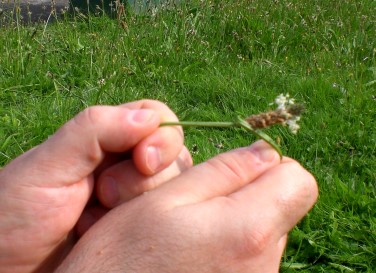
Ribwort Plantain Gun

context:

This is a techniques of turning a common Ribwort Plantain into a catapult. This technique was collected form my grandfather who grew up in Georgia and how to do this when he was very young.

Text:

This is the ribwort plantain, and it is very common in Georgia, where I grew up. My grandfather taught me how to turn one of these into a gun by folding the stem over itself and pulling hard to launch the bulb at the very top. My sister and I had full-on wars where our only artillery was this common weed. My grandpa told me that he himself learned it from his grandfather, so I assume this simple trick is very old. The origin of this practice is unknown, but I assume it exists in most places where this plant grow