
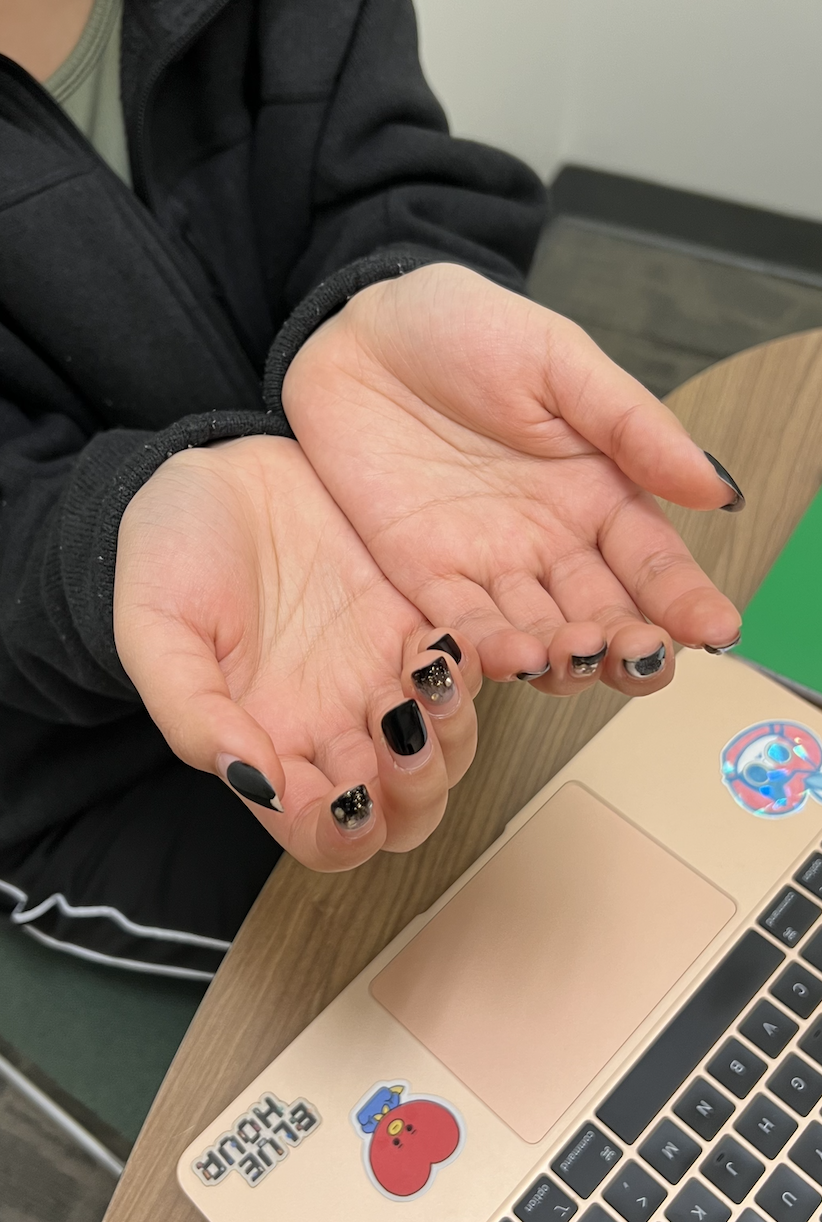
Gesture:

Nationality: German-American
Age: 18
Occupation: Student
Residence: USC
Performance Date: Feb 22nd, 2023
Primary Language: English
Language: German, Korean

Context: S is Korean as well as German, and they also showed me a gesture that they were taught growing up. Their parents told them to always accept a gift from someone with both of their hands rather than one because it showed respect and politeness and that you are giving your full attention to the person who is giving you the gift. 

Analysis: I believe that this is a big part of Asian culture. I was also taught to receive gifts with two hands and say thank you, especially if they were my elders, to show them my respect and my thanks. I know many of my Asian friends were also taught the same by their parents, and the gesture doesn’t always only apply to gifts, but when you are handed anything of importance because it signifies that you are giving the item and them your full attention and focus. I think it is a nice habit to have because so many interactions now aren’t even in person, but over the phone, or online, and they’ve lost their intimacy. It’s nice to slow down and just take a moment to put your focus entirely on one person and acknowledge and savour the moment you’re sharing.

Uff da

Nationality: White
Age: 22
Occupation: Student
Residence: Los Angeles
Performance Date: 21 February 2023
Primary Language: English

Context: EC is a white graduate student at USC studying linguistics. Up until attending USC, she lived in Pasadena, California. That being said, her dad is from Iowa, and her mom is from Indiana. I asked EC if there were any sayings that she learned as a kid from her family or community, and she responded with this folk saying. The word is used in casual conversation as an exclamation.

Text: One is from my dad’s side, which I always thought of is one word but apparently it’s two words, and it’s called uuf da. It comes from I think Norway or Scandinavia because my dad’s grandfather was from Sweden. It’s funny because my mom says phew, so when I was little I combined then, so now I say phewfda. Uff da, it’s kind of like… if you go to Minnesota, there will be merchandise with uff da on it because there are so many Scandinavian people in Minnesota. Basically uff da, you just kind of say it when something not big has happened. But it’s like “oh man uff da, that was really hard.” It doesn’t have a negative context, but you wouldn’t say “uff da that was so exciting!” It’s always like “ugh, uff da, that was a difficult test,” or “uff da, that was a workout.” It’s never for anything super bad, or at least how my family uses it, and honestly I’m not really sure what it translates to, but I think it’s one of those things like “ugh.”

“Uff da”


Thoughts/Analysis: From what I can gather, there’s no direct translation for uff da: it’s onomatopoeia like “oof” in English. It’s really an exclamation to express and release tension. Being onomatopoeia, different languages have different spellings for similar noises. I’ve used oof before, but it seems as though uff da is very specific to Scandinavians and those from that ancestry. EC’s combination of phew and uff da is especially interesting, exemplifying how the blending of cultures can impact the folklore that people spread. She’s the first to use it in her family, but as she ages and has children, her new version may spread as a fusion: an example of polygenesis in real time.

I hit my head on a piece of cornbread

Nationality: Black
Age: 19
Occupation: Student
Residence: Los Angeles
Performance Date: 16 February 2023
Primary Language: English

Context: CR is a black student at USC, currently a sophomore. They and their family are originally from Houston. The informant told me about their experience after class while we were discussing the pieces of folklore we’d picked up during our lives. The saying they talked about would normally be performed by their father whenever they and their siblings hit their heads.

Text: “Okay so like growing up my… like me and my siblings would always like hit our heads like maybe on the top of our bunk beds or the roof of a car or something, and my dad would always say like “Oh no! Like I hit my head on a piece of cornbread!” And then we would just laugh instead of cry. And it was just a way that he would get us to be playful and laugh instead of focus on our pain. And he would always model it for us too. Yeah, just “I hit my head on a piece of cornbread.” There’s very much a rhythmic element to it and a rhyme, like if you say it the wrong way, it won’t be right.

“I hit my head on a piece of cornbread.”


Thoughts/Analysis: I’ve never heard of “I hit my head on a piece of cornbread,” but I’ve encountered similar sayings across my life. It makes me think of the Spanish saying sana sana, colita de rana which is also used to pacify kids after they get hurt. Soothing children after injury seems to unite a lot of childhood sayings. After all, the experience is universal. In this specific instance, though, part of the comforting nature of the saying seems to lie in its humor: the imagery of hitting one’s head on a piece of cornbread—something soft and spongy—versus whatever one hits their head on, seems to create dissonance and a disconnect from their current reality of pain.

Two Jews, three opinions

Nationality: American
Age: 24
Occupation: student
Residence: New York City
Performance Date: 2/21/23
Primary Language: English

This joke comes from my sister, BZ, who converted to Judaism four years ago. 

Text:

A popular joke is “Two Jews, three opinions.” 

Context:

“This just means that Jews love to argue and debate so much that there are three opinions for every two Jews,” BZ said. “It is used when arguing and being silly.” She first heard this phrase used in “a Jewish arguing Facebook group.” She says she and her boyfriend, who is also Jewish, use this sometimes when they are arguing over things that aren’t very important. “I’m a very stubborn person with a lot of opinions so my boyfriend thinks it’s funny to say this to me when I’m ranting about something that doesn’t really matter.” 

Analysis:

I found this to be a fun and silly joke. I have heard harmful stereotypes about Jewish people being stubborn or even greedy in terms of their past as tax collectors in the Bible, so I think it’s nice that the Jewish community has kind of reclaimed their own stereotype and made it into a digestible inside joke to be enjoyed among themselves. I will say that I think this joke is best to be made by Jewish people, because I think if other groups use it, it enters back into the harmful stereotype category. 

The Double Mitzvah

Nationality: American
Age: 24
Occupation: student
Residence: New York
Performance Date: 2/21/23
Primary Language: English

This tabooistic vocabulary comes from my sister, BZ, who converted to Judaism four years ago. 

Text:

“We call having sex on Saturday ‘the double mitzvah.’”

Context:

“This means you have fulfilled two commandments at once: be fruitful and multiply, and enjoy the Sabbath,” BZ said. She first heard this phrase while at dinner at Hillel. She says she and her friends use this phrase quite often because they think it’s a funny innuendo that only their community would pick up on.

Analysis:

When my sister shared this tabooistic phrase with me, I thought it was really funny. I’ve obviously heard different sayings that refer to sex like “hook up,” but I hadn’t heard anything tied to religion. The only religion I’m extremely familiar with is Christianity and I have definitely not heard many sex jokes from that realm. I think it’s great that the Jewish community is able to be casual and playful when it comes to referring to sex instead of making it a shameful thing.