
Hồ Tinh: The Nine Tailed Fox

Background: This informant is an American-Born Vietnamese student who has grown up hearing and participating in classical Vietnamese Folklore.

Me: When did you first hear the story of Hồ Tinh?

TT: When I was in High School, I remember my parents talking about their belief in spirits, my Mom has always been a believer, my Dad on the other hand was a skeptic. However, he mentioned an experience he had with Hồ Tinh. A couple years prior my Dad woke up in the middle of the night and all he could remember was feeling a heavy animal-like presence on his torso and legs. He said that he couldn’t move, almost like sleep paralysis, until the morning and ever since then he has believed that it was an omen from Hồ Tinh.

Me: What is the actual story behind Hồ Tinh?

TT: From what I remember, Hồ Tinh was an evil Nine-tailed fox spirit who lived in a cave and fed on humans. He would deceive village men by disguising himself as a beautiful woman and would bring them back to his cave to get eaten. One day a warrior in the village, knowing of Hồ Tinh deceits, followed Hồ Tinh back to the cave in an attempt to kill him and to save the villagers who were still alive. After a long battle, the fox eventually lost to the warrior and the village was saved.

Analysis: I found this folklore interesting as when comparing to another piece of collected folklore, the story of Da Ji (a Chinese fox spirit), we can note that throughout the two different cultures, the fox as symbolic of deception and slyness remains, this connection is furthered by the fact that the deception of foxes is seduction in the form of a beautiful maiden. This may have to do with how interconnected the cultures of Vietnam and China are, but it is still interesting to note this connection.
Tết Festival

Background: This informant is an American-Born Vietnamese student who has grown up hearing and participating in classical Vietnamese Folklore.

The Tết Festival is the Vietnamese Celebration of the Lunar New Year, in Vietnam due to the historical use of the Lunar Calendar over the Gregorian Calendar, the Lunar New Year is celebrated over the Gregorian New Year.

TT (Informant): Whenever we (family) celebrate the Tết Festival, we dress up in traditional Vietnamese attire. One of the most important parts of the Tết Festival is the Dragon dance, the dance is performed by two people who train year-long at temple for the festival. During this dance the Dragon will open its mouth and we are supposed to put money into the Dragons mouth, this ritual is supposed to bring us good fortune as the Dragon has typically symbolized good fortune and specifically rain. The rain is important since in Vietnam there have been many droughts and by giving offerings to the Dragon, we will be blessed with rain. Additionally, there is also the tradition of the Red Envelope which has money which is given during Tết.

Analysis: It is interesting to see how the Dragon has come to symbolize more than just Good Fortune but specifically rain due to the number of droughts which have historically happened in Vietnam harvesting seasons, this contrasts to China which has similar traditions but a different symbol for which the Dragon stands for.

Love Days

Background: The informant was raised east of Los Angeles by a mother who was a practicing Jehovah’s Witness and was very active in the church. The informant was and is not religious herself, and her father was not a member of the church either. This was told to me in person.

Informant: My mom is very religious, she’s Jehovah’s Witness, and is the most dedicated…so we wouldn’t celebrate holidays when I was a kid. For Mother’s Day we had “love day,” and for Thanksgiving we’d just have a “family dinner,” but we didn’t celebrate any holidays… my dad celebrated our birthday but my mom never celebrated any holidays. She would give us “love gifts,” which could come on any day of the year but they always ended up coming the week before or the week after my birthday. There were different reasons for different holidays…Halloween celebrates the devil so that one’s obvious. Christmas was for different reasons…Jesus wasn’t born in the winter or the snow so Jehovah’s Witnesses don’t celebrate it.

Thoughts: I knew that Jehovah’s Witnesses were very dedicated to their religion, in a way that goes above and beyond other sects of Christianity, but I wasn’t aware that they are devout to the point where they don’t celebrate any holidays that would take away from Jehovah. It’s interesting to hear this from someone who grew up directly around it but wasn’t and isn’t an active practitioner in the Jehovah’s Witness religion.

Mitmit Ceremony

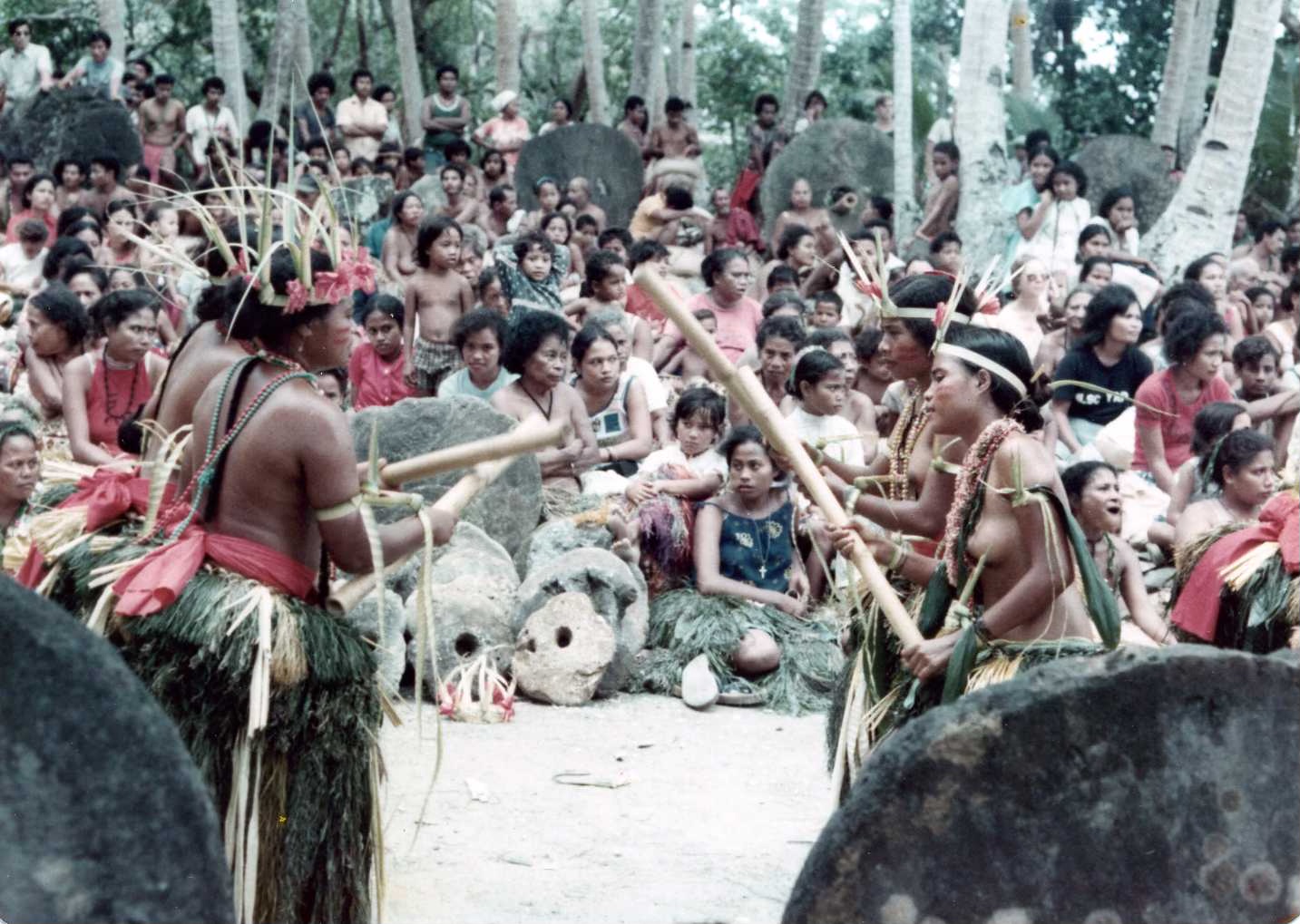
Background: The informant was born in the Philippines to a Filipino mom and a white dad, and spent his childhood, from age 2 to 13, from 1966-1977. Yap is a small group of islands in Micronesia, of which he grew up on the main island of Yap. I was told of this legend over the phone. 

Informant: A mitmit is a Yapese ceremony … a ceremony that… or rather a festival that signifies an exchange of wealth. Dances are performed, in this case, this is a stick dance, a bamboo dance and this next photo is men and boys bringing or delivering—and you can see, there’s stone money in the background—they’re bringing shell money, which is made out of mother of pearl shells, and they’re hung on a piece of coconut husk twine. So what they’re doing is they’re presenting this… well all of this money, really, currency, to another village.

Me: Why are they presenting it? What’s the significance of that exchange?

Informant: Yap has a very, very stringent caste system, not unlike the caste system in the Hindu tradition. There’s no concept of priests or Brahmins like in the Hindu system or the concept of an “untouchable,” but the caste system is based on another legend actually, and the caste system is based on villages, well actually, municipalities. 

Within a municipality, there are a number of villages which contain a number of family units. Frankly, the outer islands of Yap as well are included in this same caste system. There is a ranking system, a social hierarchy if you will, that is based on one’s municipality and even further, there is a village that holds the highest caste ranking within a municipality.

There are the municipalities of Tomil and Gagil, and those are the highest ranked two in Yap.

A mitmit is a celebration of a number of things however, but a very common reason for it, particularly if someone in a lower caste village slighted someone in a higher caste village. One village is paying tribute to another village or the chief of another village, so they bring these offerings of stone money—to the extent of which they can transfer it. 

In addition to the dance, there is a long procession of offerings. The stone money, again to the extent of which it can be carried, and the shell currency on coconut twine. 

Me: So, would you say a mitmit is a way for a village to atone? And does the mitmit have to be “accepted,” or is it unspoken that after a mitmit happens that all is well between the villages again?

Informant: Yes, and all is better after the gifts are accepted.

Me: Has it ever happened where the gifts aren’t accepted?

Informant: I am not aware of gifts being refused, I think the point is to overwhelm with lavish gifts so as to truly atone.

Thoughts: I’d never heard of a mitmit before, and it really shows the diplomacy and the level of respect that holds true between the villages. It’s hard to imagine a culture where disputes and issues were solved with a ceremony and then put to the side, and it’s beautiful that it’s a festival and ceremony where people can enjoy themselves while also atoning and solving their issues or disputes that they may have had.

Pito-pito

Background: Informant was born in the Philippines, on the island of Cebu, to a Filipino mom and a white dad. He sent his childhood in Yap, in Micronesia, but spent a lot of time in the Philippines as a child as well and is fluent in Cebuano, a Bisayan language and grew up playing games with his mother, who was born and raised in Cebu. The following is a children’s game that the informant played as a child, which was then passed down to me when I was a child. We spoke about this game over the phone.

Pito-pito ubod

Kan-on pulos budbud

Sud-an pulos utan

Piesta’s kadagatan!

Transliteration:

Seven-seven small fish

Rice all sticky rice cake

Viand all vegetable soup

Fiesta at the beach

Translation:

Seven small fish

Rice for sticky rice cake

Main course for vegetable broth

Fiesta at the beach

Informant: Pito-pito means seven, and ubod is a small fish. 

Kan-on is rice… ka-on is food, and kan-on is “that which you eat,” which also means food which is kind of silly, but it also refers to rice. Kan-on pulos budbud is “rice for sticky rice-cake.”

Sud-an, when you eat, you always have kan-on (the rise, the base), and sud-an is “the thing which you eat with your rice,” so sud-an could be anything. For example, teriyaki chicken or adobo is both sud-an with rice, which is the kan-on. There’s usually a connotation or implication that there is vegetables. But, sud-an pulos utan is “main course for vegetable broth or soup.”

All the phrases are silly and backwards, really… it doesn’t make sense grammatically. The second and third stanzas would be grammatically correct if they were flipped.

Budbud para kan-on

Utan para sud-an

Piesta’s kada gatan is a fiesta at the beach. Pista’s is really just the “filipinization” if you will of the Spanish word fiestas.

The whole thing is really just silly, but someone would hold out their hand and the other person would put their pointer finger in the center of the other person’s hand. The person with their hand outstretched would sing the lines as slowly or quickly as you want, you can play with the tempo on the first couple lines and then when the line “piesta’s kada gatan!” Is said, the person singing would close their hand while the second person tries to pull their finger away so their finger isn’t trapped.

Thoughts: I remember playing this game as a child, and this is the first I heard of the meaning behind it. I find it interesting that it’s all food-based lyrics, though it’s not entirely surprising as Filipino culture is centered so much around food, but it’s funny that even in a children’s game that’s fairly nonsensical with no relation between the lyrics and the actions, food still is still at the focal point.