
The Woman in the Cold

Age: 52

Interviewer: Dad, did anything strange ever happen when you were growing up?

ES: Yeah, there was one thing. I don’t talk about it much.

It happened when I was maybe… thirteen? Around that age.

Interviewer: What happened?

ES: Back then, we didn’t have much. Our house was small, and at night it got very dark. No streetlights, nothing like that.

I used to help my parents with chores, and sometimes that meant walking out to the storage shed behind the house, even late at night.

Interviewer: Alone?

ES: Yeah, usually alone. It wasn’t a big deal… until that night.

I remember I went out to get something, maybe tools, I don’t remember exactly, and on my way back, I saw someone standing near the edge of our yard.

Interviewer: Did they look like someone you knew? Like, do you think it could’ve been someone from around?

ES: No. That’s the thing.

At first I thought it was a neighbor, but… it didn’t feel right. They were just standing there, completely still.

It was hard to see clearly, but I remember their clothes looked old. Not like what people wore at that time, more like traditional clothing.

And they were facing toward the house… not toward me.

Then, I hadn’t made any noise, but slowly… they turned their head. Not their body, just their head.

And when they looked at me, I realized… I couldn’t see their face clearly.

It was like the darkness was covering it, even though the moon was out.

Interviewer: Did they do anything, maybe say something?

ES: No, not at first.

I just stood there, holding what I had, not moving. Then they took one step toward me.

Just one.

And then I heard it, very faint

“춥다…” (Translated from Korean: “It’s cold…”)

It didn’t sound like they were talking to me exactly. More like… saying it to themselves.

But I felt it. The cold.

Not like normal cold weather. This was a sudden change. Like it went straight through my clothes.

Interviewer: What did you do?

ES: I remembered something my mother used to say. Don’t respond to voices at night.

So I didn’t say anything. I just slowly stepped back… and then I turned and ran inside.

I told my mother the next day. She didn’t look surprised.

She just said, “You didn’t answer, right?”

And when I said no, she nodded and told me not to go outside at night unless I had to.

Interviewer: Did you ever see it again? Or see anything similar?

ES: No.

But sometimes, late at night, I would look out toward that part of the yard… and feel like someone was still standing there.

Context

This story was told to me during one of my visits home after a family dinner. I received it from my father, who used to live in rural Korea before moving to the US for education and work. He stated that the region was naturally superstitious and strongly spiritual, and many other ghost stories populated the area. He mentioned that two large Buddhist temples were there as well. Due to some imperfect English, the transcript was slightly edited to improve flow.

The Informant’s Thoughts:

The informant was disinclined to call the entity he encountered a ghost, and instead preferred to call it a spirit conjured by the struggles of his community. He talked about how encounters with spirits and other supernatural phenomena are more likely to occur when peoples’ futures are uncertain, and that this is especially true in places where life was harder. He discussed how life in rural Korea was very difficult due to poverty and lack of support. He recalled how his village would regularly be flooded during monsoon season, flooding houses, and that farming in the Korean climate was a physically arduous process.

My Thoughts:

I am skeptical of the supernatural by default, making me also not wholly believe the story. I though the happenings could be attributed to local folklore, an active imagination from his young age at the time, or dramatization of a memory over time. However, the idea that spirits appear before us during times of hardship resonated deeply with me. The stress we feel during times of uncertainty makes us more prone to believing in ghosts and superstitions which could bring some stability or consolation. I interpreted the ghost as not a malevolent spirit, but instead a kindred spirit, a companion who shares the suffering of the people in the informant’s community.
Speaking with the Dead

Age: 52

Context

This story was told to me over call while I was catching up with my family. I received it from my father, who used to live in rural Korea before moving to the US for education and work. He stated that the region was naturally superstitious and strongly spiritual, and many other ghost stories populated the area. Because it was conducted over call and not a formal interview, the story is written here more as a stream-of-thought.

The Story

When I was young, your grandfather passed away from a motorcycle accident. I was only just entering high school when it happened. In the time after, all of the members of my family had mysterious encounters, like voices and strange dreams with your grandfather. I think it was because he had an improper death because he died so young. Eventually, when I left to study abroad in Australia, your grandmother and my siblings in Korea visited some sort of mystic, I think he was a shaman. Buddhism was very strong in my village. He set up a pig’s head on a spike, and then shoved belongings of your grandfather up its nostrils. Then, he began shaking, and when he stopped, his entire demeanor had changed. He was talking differently, moving differently; I think he was channeling the ghost of my father. He said that he was cold, so cold. He asked for his coat to fight the cold and his notebook that he carried around with him everywhere in life. We threw them into the fire, and the spirit left the shaman. After that, we never had any of those strange dreams or encounters again.

The Informant’s Thoughts

My father believed that the shaman was being possessed by the ghost of his father. The fact that because the shaman’s demeanor shifted so much and that he requested very specific things from his life, there was definitely a link between the shaman and the world of the dead. He did mention that he was not there for the ritual himself, but heard of it through his relatives and vicariously experienced it.

My Thoughts

I found this to be a fascinating example of spirit possession and using mediums to speak to the dead. It reflects other Korean traditions where the spirits of great generals are invoked by shamans through ritual. In both, the shaman exhibits the personality of the person they are possessed by, seemingly transforming into another person entirely. The use of items connected to the person to connect with them also reminded me of voodoo magic, where related items can connect two disparate things. The idea of improper death also appeared, which made sense to me personally, as I remembered hearing about his passing at the time and feeling that it was all too abrupt and not a true ending.

Goat Jinn Wedding

Age: 18

Name: MB

Ethnicity: Tunisian 

Primary Language: English

Age: 18

Career: Student

Hometown: Aurora, Colorado

April 27, 2026

Goat Jinn Wedding

Context: “Jinn” are spirits in Arabic culture that can be good or evil, that aren’t visible but live among humans. It is believed that individuals are constantly surrounded by these invisible spirits. Sometimes, these spirits make themselves appear in moments of passion, anger, or lust. In this story, the Jinn appear from a moment of passion through dance. This story takes place in Kuwait during the 1990s, but is common folklore in Tunisia and other Middle Eastern countries. This story isn’t used as a tale to frighten people, but rather treated as a legend. 

Story: In Kuwait during the 90s, there was a famous singer named Noura who traveled with a small band. She would travel around people’s homes and sing for weddings and various other parties like that. One day, she went to this house to sing – a really big mansion outside of the city, in the middle of nowhere. Despite its ominous presence, they didn’t think anything of it, just another gig. They start to perform just as the guests start to arrive. Everything seems normal and fine, except as Noura stares at the guests, she notices they are dancing strangely. They are dancing in an almost hypnotic way, all swaying in sync. Noura is creeped out by this but keeps performing, assuming this was all some elaborate, choreographed wedding. Noura starts to feel sick and nauseous, but chalks it up to nerves. At midnight, she notices how everyone is taking short, choppy steps. She finally glances down at their feet, only to see no shoes, but goat feet. Every guest has goat feet. Noura is freaked out and terrified but tries to remain composed for fear of what they would do to her if she reacted or they knew she knew. Noura’s band also notices the goat feet but remain calm and keep playing. Noura and her band finish the night at the mansion and speed home. The next day, Noura brings police and reporters back to this mansion. However, the entire mansion is gone, with no trace of it left at all. 

Speaker’s Thoughts:

 “I believe in this story. Goat-footed people sightings in Tunisia aren’t unheard of. The majority of families in Tunisia have pet goats, so they are very much a part of society. I believe that there are Jinns in every corner of a room, with one good and one evil. These goat-footed people are good Jinns, peaceful and passionate about music. My Mom would joke I would grow goat feet when I would dance when I was younger.”

My Thoughts:

I find it interesting that many common ghost motifs, such as midnight and creepy mansions, take place in this story. However, instead of using these motifs to make the ghosts evil as these motifs traditionally do, they are eerie yet peaceful beings just dancing. This story has more of a mystical and enchanting tone rather than horror. 

In many African cultures, particularly West African, the use of music is a symbol of a bridge between ghosts and the living. Similarly, music serves as a bridge in this story, as these ghosts only “come to life” through music and are gone the next day when it is absent. 

Another feature I found interesting was the merging of animals and humans. MB told me nearly every family in Tunis owned goats, so I wonder if there is some familial tie to the animal, hence why they are merged. 

This story isn’t told to scare children or as a cautionary tale, but more of a historical legend. I found it interesting that my friend’s mother would tease her, saying she’d grow goat feet when she would dance passionately. I initially found this story hard to believe, but the fact that it is told so widely across Tunisia as more of a historical recounting than a tale to frighten others makes it more believable. 

Khonsuemheb and the Ghost

Age: 18

Name: JS

Ethnicity: Egyptian

Primary Language: Arabic and English

Age: 18

Career: Student

Hometown: Newport Beach, California

April 27, 2026

Context: 

JS and I were talking about where our families were from one day, and she mentioned her family was from Egypt. I had told her I had always wanted to go to Egypt to see the pyramids and the hieroglyphics. I asked her if she knew much about Ancient Egyptian history, to which she replied she didn’t- save for this one story. 

This story takes place in the Ramses era, 1279-1213 BCE in Egypt. During this time, it was believed that souls continue living in an afterlife when they die, as long as they are properly buried, or mummified. Their tombs would preserve their bodies and allow them entrance into the afterlife. However, only wealthy landowners or members of the court were commonly mummified and kept in tombs. 

Story:

Khonsuemheb and the Ghost

Long ago in Ancient Egpyt during the Ramses era, there lived a high priest named Khonsuemheb who served Amun, the king of gods. One day a frightened man came to Khonsuemhebm saying that a ghost had waken him when he was sleeping near a tomb in Theban necropolis (the city of the dead). That night, the priest prayed to the gods of heaven, earth, and the underworld, asking them to send the spirit to him. 

The ghost suddenly appeared before him, introducing himself as Nebusemekh, the son of Ankhmen and Tamshas. Nebusemekh had been powerful when he was living, serving as an official under a pharoh. He told the priest “ I am mad because nobody remembers my name, my tomb is in disarray, my tomb is exposed to the winds of the winter. I fear that I will no longer exist and be lost because my soul will have no home to contain it,”.

Hearing this, Khonsuemheb wept fot the spirit and took pity on him, saying “Please express to me a fine commission such as is fit to be done for you and I will surely have it done for you”. However the spirit isn’t convinced the priest will fufill his promises citing that many before him had promised the same. The priest has assured him already that, if he cannot build him a new tomb, he will have five men servants and five maidservants bring him food and water as offerings daily, but the spirit would not be consoled.

The sun then comes up, causing Nebusemekh to disappear. The priest is determiend to keep his promise, so he sends men to search for the ruined tomb. The priest completely renovates the tomb and instructs women to deliver food and water to it daily, ensuring that Nebusemekh will never be forgotten. 

The spirit of Nebusemekh was never seen wandering the world ever again, as he is thought to have finally achieved peace. 

Speaker’s Thoughts: I think it is very telling of Ancient Egyptian culture and symbolic of their religions and art, but it doesn’t carry to modern Egypt. I think a lot of people assume this is what modern Egyptians think and what they actively believe in but I personally don’t believe in this. I believe in ghosts for sure, but not in this story necessarily. 

My Thoughts:

This story is a classic ghost story in the sense that it follows the motif of improper burial. The ghost of Nebusemekh only appeared when his tomb was in disarray, and he was no longer properly buried. However, once this was righted, he disappeared – a common ghost story stereotype. 

However, this story drifts away from these classic stereotypes by not making it a horror story.  Nebusemekh only appears to people, pleading for help. Even the priest, Khonsuemheb, didn’t treat Nebusemekh as a being of horror, but rather a being worthy of empathy. This isn’t necessarily a horror story but more of a piece of folklore. I believe this story was told to Ancient Egyptians to convince them that if their pharaoh or other high society members received improper burials, they would exist in a life of misery in the afterlife. 

Given this story is centuries old, I wonder if its meaning or interpretation would change. Modern Egypt is a primarily Arabic nation, so I wonder if Nebusemekh would be considered a ghost or an Arabic “Jinn”. Jinns are considered to be natural spirits that always exist around people. My friend doesn’t believe in this story at all, but I wonder if any Egyptians believe in it and if so, do they interpret it differently, as their culture doesn’t believe in mummification and tomb burial. 

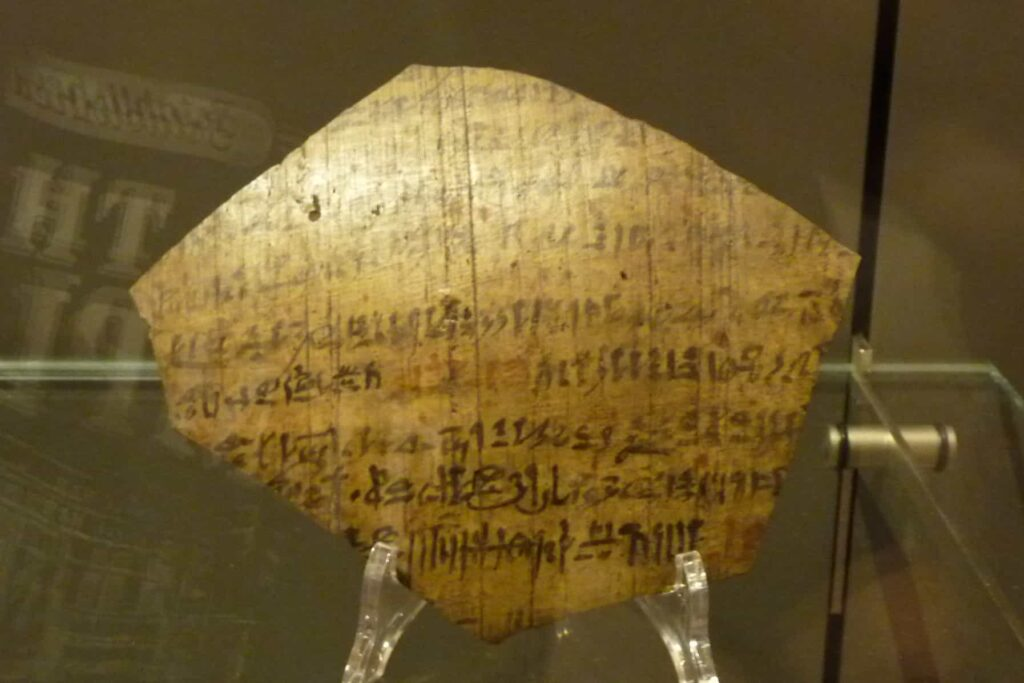
I find it interesting that this story is extremely old, first found on a piece of papyrus from the Ramesside period (13th Century BCE) and later passed down through generations as a piece of folklore. I wonder how long this story has been told, and what its effect on society has been. I find it fascinating that people have been telling each other ghost stories, the same way people are today in 2026. 

Ghost in the House

Age: 23

A.B.: All right. So do you have any questions, or do you just want me to retell my experience?

Interviewer: I think you should retell your experience, and if there’s cultural significance for the particular ghost, context would also be great.

A.B.: Yeah, absolutely. So when I was a kid, we lived in this really old house, about 250 years old. It was a farm, used to be a significantly large farm in Pennsylvania, about 30 to 45 minutes outside of Philadelphia, the Westchester area. The farm had a ton of land originally, and then as the suburbs sprung up, it got smaller and smaller. When my parents left Philly, we moved to this farm, about six acres, which is large for the suburbs. Really the only farm left in that area. But a lot of the original structures were still on our property: the original house, the original barn, milksheds, silos, this really creepy cool structure built with slats to dry corn. We still had all of that, though the property had obviously shrunk.

As a kid, I had a pretty wild imagination and I was terrified of this house. I loved it, there were aspects I loved, but I’m an only child, so I was really the only kid in that space. When friends were over, I’d be happy to go into the super creepy basement, explore all of these parts of the house that were really old and seemingly random. But when I was alone, I was afraid. Things would happen, the house would creak, the house would move, weird noises. I was convinced, because I knew it was an old house, that it was haunted. I’d get the stereotypical chills, a cold draft here and there, doors would open and close. My parents would say it’s just how the house is built, it’s just drafty, it’s just an old house, all of those parental excuses. I did have the hair-pulling experience. I never saw anything, but it was stuff you can explain away, or make sense of however you see fit.

We also had a house cat we brought from Philly, and she hated this house. She never came out, always hiding. She’d eat and dip, that was her game. It got so bad that when I was about nine or ten, she started coming out in the evening. My mom would be on the couch watching the news, the cat would come out of the kitchen, jump on my mom, and literally piss on her. Very odd behavior, she was purposely doing this. We had to put her on Prozac. We moved out when I was eleven or twelve. The cat completely changed.

As a teenager and young adult, we started having conversations about the old house as a family, and my parents admitted that yes, the house was haunted, because a family friend had seen ghosts there. There was the hair-pulling. She would see a little girl. It turned out, unsurprisingly for a very old house, people had died there, because people didn’t go to hospitals, doctors came to you. And there was a man who committed suicide. Perhaps that was the angry old man. He did it in either the basement or the attic. I hated the attic as a kid. Would not go up there alone. To this day, if you took me to that house, I would not go in the attic alone.

This little girl also died somehow in the house. The craziest part, especially on my parents’ part, there is a portrait of her, and we still have it. She’s adorable. I feel some sort of kinship with her now, I can look at it and feel warmth. But as a kid, absolutely not. The eyes follow you, the usual portraiture thing.

It was a really interesting experience to grow up in a space like that. Old houses are so fun for kids, and watching The Haunting of Hill House reminded me so much of my childhood. Obviously it wasn’t frightening in the same way. I didn’t have siblings daring me to go different places, there wasn’t a locked room. But all of these elements of haunting are really attractive to kids because they’re fun. Going somewhere different, somewhere unexplored, that’s what you do as you’re growing up, getting to know your own home.

It’s very weird to experience something like that, have your own relativist take on it, and then have it validated years later, particularly by people like my parents, who are incredibly logical. My mom is one of the most logical people I’ve ever met, and yet she accepts that the house was haunted and happily names it. As a teenager I thought, oh my god, you lied to me. As a young adult, it’s like, of course they did. They weren’t going to say, yeah kid, the house is haunted, good night. But it’s very interesting to see that side of your parents, the ones who have to say this isn’t happening. You see that in Hill House too, the adults experiencing it, having to come to grips with what this is, knowing or thinking they know, being okay admitting one thing but creating a different narrative around it.

Interviewer: Was this house known within the community, was it a thing where people said yes, this place is haunted by this particular ghost? Or was it more of a happenstance sort of thing?

A.B.: We weren’t close with a lot of our neighbors, they didn’t really have any interest in being around us. But in my parents’ social circles, yes, for sure. They just kind of accepted it, that’s the fact of the matter. There wasn’t a lot of drama surrounding it. There was a reason my parents chose to live in an old house. They love old houses, old structures, they feel very comfortable in them, and a lot of their friends do too. They just accepted it. It wasn’t a don’t-go-in-there situation, nobody visits, reclusive. This isn’t Wuthering Heights, this isn’t Nosferatu’s mansion with peasants along the way saying don’t go in there.

Interviewer: Okay, yeah, thank you for telling me that. I think that’s going to be a very interesting thing to write about for your submission.

A.B.: Honestly. What I’ve thought about a lot as an adult, especially with what I’m writing about, is how rural spaces exist within the encroaching of suburban development. To me, it’s really fascinating that this space persisted among stucco suburban homes. I’ve thought about the ghosts with empathy, because yeah, they lived and existed here in a very different fashion than we did. They didn’t have neighbors calling to complain about farm animals, they just had them, and it wasn’t an issue.

Interviewer: Right.

A.B.: It’s really interesting to think about in terms of how Pennsylvania exists, particularly southeastern Pennsylvania, where you can drive 20 minutes out of Philly or 20 minutes out of Westchester in any direction and be in a completely different space, simply because of how development has taken over. I’m sure the same can be said of a lot of other purple states, of smaller older cities that haven’t really expanded. Not the massive cities like Houston or New York. Those states with smaller, older cities that haven’t expanded as much.

Context: This story was told to the Interviewer by his high school English teacher in early April. This occurred to her when she was growing up in rural Pennsylvania with the area around them being known to be haunted.

Their Thoughts: This tale illustrates a ghostly take on the classic haunted childhood home situation often portrayed in pop culture. A.B had not fully reckoned with the extent of the haunting until her adulthood due to being constantly told that it was just her overactive imagination by her parents. Her encounters are unique because she never fully saw the ghost but experienced the effects of its haunting regularly. She fully believes in being haunted but does not believe there was any malice behind it.The cat being afraid of the attic is a common motif across ghost stories, with animals seeming to have a more attuned sense of haunting when compared to people.

Thoughts: I think this is an incredibly interesting story. The way it was described was a newer interpretation to me; I always thought of ghosts having an elaborate story and some kind of unfinished business. But here, the ghost seemed to just exist within the house like any normal person would.