AW is a 19 year old college student. She is a freshman computer science major and loves basketball. She played as a child and closely follows professional basketball today.
Context: This is performed during a basketball game, both amateur and professional. This was collected at the collectors house after eating dinner.
Transcript:
Collector: Are there any basketball gestures that only players or super-fans would know?
AW: Oh for sure. Two that kind of go together are when a player pats their head or presses their hand down by their side *gestures to collector*.
They are kind of opposites but also very similar if that makes sense? When a player pats their head after making a basket or playing good defense, it is them boasting about how they are bigger than the person guarding them. But when a player presses down, they basically refer to how short or small the person guarding them is. So if a player makes a basket after being guarded, they can press down or pat their head as a boast of how big they are compared to the other person. It just depends on if they want to refer to their height or the other players lack of height. I think it’s pretty f*cking funny.
Pat head gesturePress down gesture
Thoughts/analysis: These two gestures are a reflection of basketball and sports culture overall. When the players do well, they do not just praise themselves as individuals, they do so by putting other players down in a competitive way. This form of body language not only exhibits confidence in one’s self, but it is also used to get into the head of the opposing team. Overall, I thought these gestures were fun because it conveys a strong message without using words that could get players flagged for misconduct. It could also be interesting for teams to create variations of this that are unique to them. That could create a special identity for them.
GESTURE: Knocking on wood when speaking of one’s good fortune
INFORMANT DESCRIPTION: Female, 60, Mexican
CONTEXT: This woman was saying how happy she was and how lucky she felt and immediately knocked on a wood surface next to her. She says she learned this gesture from her family. Whenever you speak of something good in your life or something positive you want to happen you must knock on wood.
ANALYSIS: This traces back to Jesus who she says was the step son of a carpenter, Joseph. Also Jesus was crucified on a wooden cross, she says when we knock on wood we are saying “God help us” or “God willing.” It is an anti-jinx mechanism that is supposed to prevent you from bad luck.
THOUGHTS: I learned this when I was a baby and have always practiced this gesture. Every single time I am grateful out loud I knock on wood or anytime I say something that I want to happen/come true. For me the wood symbolism doesn’t really matter, but the act of doing it unconsciously makes me feel like I have anti-jinxed myself.
DESCRIPTION OF GESTURE: When you see, come across, or pass a cemetery you must immediately touch your hair with your hands.
INFORMANT DESCRIPTION: Female, 54, Finnish
CONTEXT: This gesture was taught to her by her grandmother who was from Finland. She never knew where she learned it from but employed it her whole life. She said it meant you were adverting death. A way to not call death upon yourself, sort of like the evil eye. She said if you would see the dead they would come for you and since your hair was already dead it is a way to come into contact and save yourself.
THOUGHTS: I do think this gesture is very unique and seems to be very specific. I find the part about our hair already being dead fascinating and seems to make a little more sense to me.
My informant, AW, is my 15-year-old brother. He is homeschooled, and participates heavily in gaming culture. He told me about “the head nod” during an informal interview at home. He says the head nod is universally known amongst all guys, and is the only way to greet each other. I refer to myself as SW in the text.
AW: “You have? Do you understand any of what it means?”
SW: “Not really, please explain the head nod to me.”
AW: “Ok so the head nod is if you go something like… I don’t know how you put this on to paper but if you like *he does the very slight upwards head nod of greeting* – the head nod. If you’re walking by someone and you um… yeah if you’re walking near… if you’re passing a stranger in a hallway and it’s one on one you to do this. If you’re in a crowd and you accidentally lock eyes with people you have to do this. It’s just… it’s just law. But, if it’s someone you do not know or… yeah if it’s someone you do not know it’s generally just a sign of respect or I acknowledge your presence and I acknowledge I was staring at you or something. And it’s just a *he does the slight downwards head nod of respect* or something like. If it’s someone you know, or you’re trying to get attention from someone, it’s *he does the upwards head nod*.
SW: “So it’s like a… a downward head nod of respect with people you don’t know, and an upward head nod of like a ‘hey’ with the eyebrows if it’s someone you do know.”
AW: “If it’s someone you know and you’re about to talk to them it’s like ‘hey’ *he proceeds to do the upwards hey head nod* but if it’s someone you know and you don’t want to talk to them it’s just *he does the downwards respect nod*.”
Folk gestures are a very small thing, but arguably make up one of our most important ways of communicating with others. A known shared gesture helps link members of a group without anyone even needing to say anything. AW says that all guys know about head nod culture, and it is a way to show respect and communicate familiarity. It also is a way to differentiate who is “one of the boys” and on a peer level, versus someone you have a more formal relationship with.
Background: The informant is my twenty-two year old sister. She learned this piece from attending multiple raves and EDM music festivals in the southern California region. She is an avid metal and alternative music fan with a love of body modifications including tattoos and piercings as well as horror films.
Context: The following was collected in a casual in-person interview in the informant’s home.
Piece:
The following is a transcription of a conversation about the exchanging of Kandi (which are homemade bracelets often with colorful plastic beads) in EDM culture through the handshake dubbed “P.L.U.R.”
Collector: What does PLUR mean?
Informant: “Peace, love, unity, respect. So basically to anybody it means coming together and sharing something with like another person. My favorite part about it is like if you’re really connecting with someone at like party or you know like a rave um I’ll look at somebody and I’ll be like okay you look like you’re a hella stoner so we’ll like talk about be like ‘Hey like what’s your name oh my god you’re so cool’ and maybe dance a little bit and then we’ll do like this thing. So it goes peace, love, unity, and respect. And I would bring it over and then you would look at what it says. And it says ‘Smoke weed everyday.’
Collector: Do all of the bracelets have words on them?
Informant: “Um not all of them have words. So like some people will be like ‘Oh it’s my first rave blah blah blah’ and you could just give them whatever. But like, for me like why I enjoy it is like I’ve been lucky enough to have people who have given me stuff with words. And I like to spread ones with words because its like way more personal and shows that like you really connect with somebody.”
Collector: So you wouldn’t do it with someone you don’t really vibe with.
Informant: “No but um I mean I feel like you vibe with everybody at those events. Usually though like if I’m giving you one, you’re giving me one back. So like you would have one and we would both look at our things and be like oh this relates to you or this is cute or you’ll like this or I hate this one so. For people I don’t really vibe with I’ll give them my ugliest one.”
Images of the process are included here:
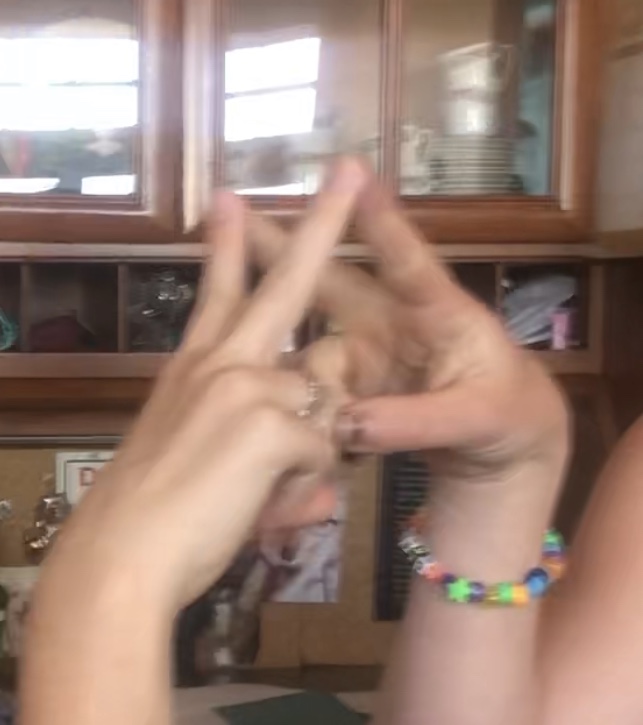
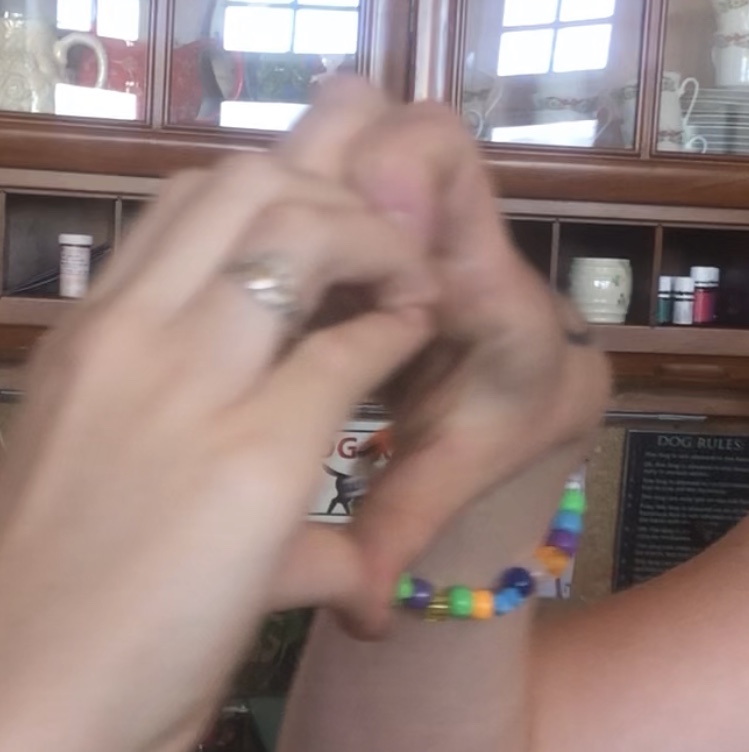
Peace is represented by the two participants touching their index and pointer fingers to each other, making peace signs. Love is represented by the two participants joining curved hands to form a heart. Unity is represented with two flat hands with the palms touching each other and thumbs wrapped around the opposite hand. Respect is represented with the interlacing of the two individuals’ fingers and the bracelet being drawn from the wrist of one individual to another.
Analysis: The PLUR handshake is a fun and fast way of building a community and making friends at raves, parties, and even the beach. Kandi is a way to visibly identify those who participate in EDM culture and serves as a sort of invitation to others who participate in this culture to engage in conversation and even friendship. Historically, raves have been dangerous places with illicit drugs and little supervision. Woodstock 99, a 1999 music festival, ended in destructive riots and other festivals like Electric Daisy Carnival have had numerous deaths. Although raves and festivals are much safer today, with medical staff readily standing by, the PLUR and Kandi traditions began in 1990s underground rave culture when this wasn’t the case. I believe the ritual functions to reassure rave goers and build a network of accountability and trust. Since drugs like ecstasy and LSD are often consumed at these events, the handshake may also serve as a positive affirmation in order to assure that participants are having a “good trip.” Furthermore, EDM culture has historically been inclusive toward minority groups and LGBTQ. I believe this handshake is an extension of the welcoming and respectful undertones of EDM culture.