
Tag Archives: kandi

Kandi and PLUR

Age: 23

Date Collected: 4/27/2026

Context:

My roommate and good friend of three years is involved in the rave scene here in LA. He does operations for one of the largest hard techno organizations in California. He is mostly involved in the hard techno scene, but occasionally he goes to festivals and dub shows where passing out kandi bracelets (pronounced “candy”) is more popular. He showed me his collection of goodies he’s gotten in his 5 years raving, and these stood out to me.

Text:

Kandi bracelets are a great representation of the exciting and friendly rave scene. Kandi are handmade elastic bands made of colorful plastic pony beads, featuring fun messages, images, or small items tied to them. Some of them are quite complicated, including finger designs, while others are quite large and stretch up the arm. The most common, though, are simple bands with funny messages or jokes. My friend explained that “they’re connected to the dub, trance, and outdoor-festival communities.” You can see kandi passed around at mainstream shows like Tomorrowland, Lollapalooza, or Electric Daisy Carnival. Those festivals are during the day, when you can get away with lighter clothing and show off your kandi. People wear loose clothes with bright clothing to match the fun color of their kandis. My friend has gotten several kandi bands at Outside Lands, smaller Afro house shows, and other events with chill crowds. Its normal to give kandi to people you like or just feel a positive vibe from.

He mentioned that there’s a specific ritual to giving them away. The PLUR (Peace, Love, Unity, Respect) handshake is the way ravers exchange their kandi. He learned it from someone when they came up to him and gave one to him. He showed me holding up a peace sign, and I held up a peace sign to his hand. “To the beat, you dance around. Then you make half a heart shape.” I completed the heart for “love.” Now, you place your palms together his for “unity,” like a high five.” Finally, we interlocked fingers for “respect.” At that point, the initiating raver would pull one of their kandi bracelets from their arm, over their hands to their arm, all while their fingers are still interlaced. All this is done to the beat of the music, or in a fun flow state. Then you should pass one of your kandis over your arm to theirs. Then you can dance around and either part ways or make a new friend. But “you don’t need to actually give any back; people just want to give them out.” For example, my friend never brings kandi to shows; he doesn’t make them either, yet he has gotten around five from his time raving and has built up quite a collection. He doesn’t wear them to shows because, well, mostly they aren’t his style. But also because kandi bracelets are not common or popular at the shows he goes to. They are more associated with the mainstream EDM scene. He goes to underground techno shows, which are typically held at night and where kandi is far less common.

People trade them, give them away, and they are all made by hand independently. He doesn’t really remember who gave them to him; he was just enjoying the music. All the ones he has are very unique, and no two look really all that similar. He told me they’re all usually unique and like a fingerprint. Each artist has their own style. People try not to copy one another, and they all try to have unique ones so that you can remember that show or specific interaction. As you can see from the picture, they’re all made from relatively cheap beads and elastic string from Amazon or a craft store, yet each seems to have a unique bead pattern, color choice, and style. There’s one that says “sploinky” (no real meaning, just fun). Another says “xing”, which probably stands for crossing the threshold or barrier, and tripping. The final one says “cum bucket,” which was given to him by a girl. This highlights the ironic and really funny humor at these shows. There’s even one with a pacifier on it, which you can use if you’re grinding your teeth. Very practical. Another, pictured above, is pink and star-shaped and goes over the back of your palm. That one is great if you are wearing long sleeves or want a full sleeve of kandi.

Analysis:

Out of his collection, these stood out to me. I immediately thought of them as folk art and, more specifically, I think they are a perfect example of bricolage. They are made of mass-produced items recombined to create something new. These items aren’t meant to sell; they have no real monetary value. But, they do have sentimental value. One of their main purposes is to serve as a physical reminder of your great time at a show or of a new friend you made. Each Kandi is given new meaning based on the context in which it is given. They are also deeply rooted in the festival and mainstream EDM scenes, and associated with rave culture at large. To me, they’re instantly recognizable as a great folk element of that scene that was made by the people. A company, the festival organization, for instance, can’t profit from or poach these Kandi. They’re just beads and string. Any unique bead design could be made by a raver using a 3d printer at a public library. I don’t think it could really be commodified easily. There is also a paradox that something sentimental or valuable is made out of such cheap materials. It’s funny because it reminds me of a crappy macaroni plate a kid makes for their parent’s birthday. Each individual piece is worthless; even together, it isn’t that valuable. But to ravers, these are memories. They hold so much individual value because of the context in which they were given. If my friend gave me a Kandi just for fun or sold one to me, I probably wouldn’t care as much as if I had gotten my own at a show. So the context is the value, a company can’t easily replicate that or profit off of it, which ensures it is of the people and for them.

Aside from being a tangible record of interactions, they also serve as a way to build community. I mentioned that these are very common in the mainstream scene. They’re bright, colorful, fun, and inviting. They help create bonds between ravers and give people an opportunity to connect. This is especially important because at these venues, the music is very, very loud. People wear earplugs or AirPods to protect their hearing. That makes casual conversation and small talk really hard. So, the kandi gives you an easy way and a reason to approach a stranger who is part of your community. It is also very helpful in the mainstream scene, since new ravers or shy people might be uncomfortable. But if they’re given a Kandi, that be like inviting them into the fold. They could feel valued and seen and a member of the community which is really cool and helps keep the scene thriving and positive.

Aside from the purity of the folk art, the PLUR handshake is also a great example of how folk gestures are taught and learned in real time. He said he felt a little confused, but he got the idea pretty quickly. I had a similar experience. The PLUR gesture also highlights the friendly vibes that rave scenes go for. The acronym isn’t just for fun, its a code. To be part of that culture, you need to be peaceful, show others love and respect, and be unified. The community really does care about being respectful. To the shows I have personally been to with him, I’d say they were far more respectful than your average line at Walmart or Disneyland. The PLUR is a great acronym that effectively sums up the values and code of the rave scene into one fun gesture. Its a great way to teach new members and remind old ravers what’s important.
PLUR Handshake and the Exchanging of Kandi – Rave Culture

Nationality: American
Age: 22
Occupation: Unemployed
Residence: San Diego, CA
Performance Date: 4/24/20
Primary Language: English

Background: The informant is my twenty-two year old sister. She learned this piece from attending multiple raves and EDM music festivals in the southern California region. She is an avid metal and alternative music fan with a love of body modifications including tattoos and piercings as well as horror films. 

Context: The following was collected in a casual in-person interview in the informant’s home. 

Piece: 

The following is a transcription of a conversation about the exchanging of Kandi (which are homemade bracelets often with colorful plastic beads) in EDM culture through the handshake dubbed “P.L.U.R.” 

Collector: What does PLUR mean?

Informant: “Peace, love, unity, respect. So basically to anybody it means coming together and sharing something with like another person. My favorite part about it is like if you’re really connecting with someone at like party or you know like a rave um I’ll look at somebody and I’ll be like okay you look like you’re a hella stoner so we’ll like talk about be like ‘Hey like what’s your name oh my god you’re so cool’ and maybe dance a little bit and then we’ll do like this thing. So it goes peace, love, unity, and respect. And I would bring it over and then you would look at what it says. And it says ‘Smoke weed everyday.’ 

Collector: Do all of the bracelets have words on them? 

Informant: “Um not all of them have words. So like some people will be like ‘Oh it’s my first rave blah blah blah’ and you could just give them whatever. But like, for me like why I enjoy it is like I’ve been lucky enough to have people who have given me stuff with words. And I like to spread ones with words because its like way more personal and shows that like you really connect with somebody.”

Collector: So you wouldn’t do it with someone you don’t really vibe with.

Informant: “No but um I mean I feel like you vibe with everybody at those events. Usually though like if I’m giving you one, you’re giving me one back. So like you would have one and we would both look at our things and be like oh this relates to you or this is cute or you’ll like this or I hate this one so. For people I don’t really vibe with I’ll give them my ugliest one.”

Images of the process are included here: 

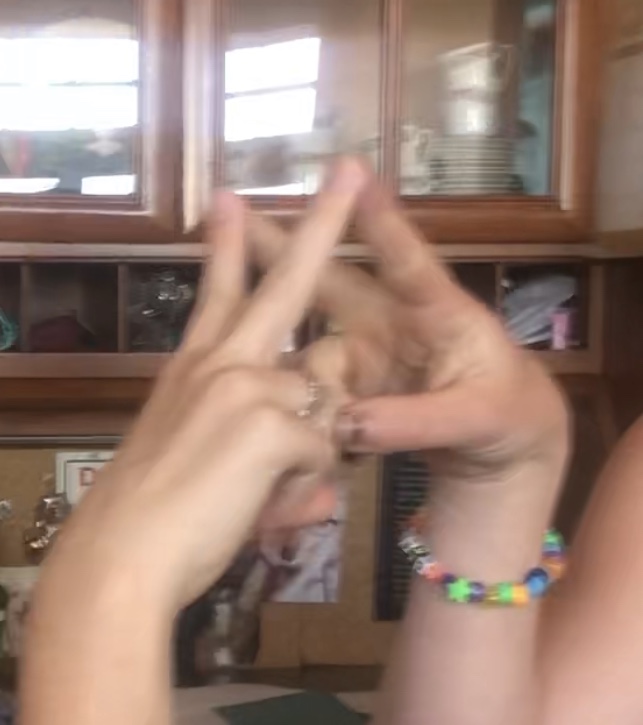
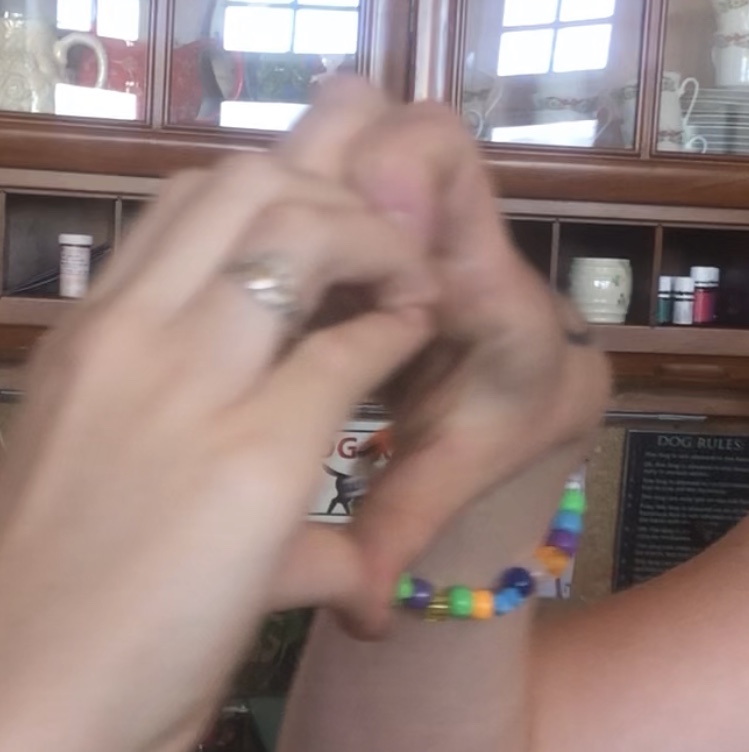
Peace is represented by the two participants touching their index and pointer fingers to each other, making peace signs. 
Love is represented by the two participants joining curved hands to form a heart. 
Unity is represented with two flat hands with the palms touching each other and thumbs wrapped around the opposite hand. 
Respect is represented with the interlacing of the two individuals’ fingers and the bracelet being drawn from the wrist of one individual to another. 

Analysis: The PLUR handshake is a fun and fast way of building a community and making friends at raves, parties, and even the beach. Kandi is a way to visibly identify those who participate in EDM culture and serves as a sort of invitation to others who participate in this culture to engage in conversation and even friendship. Historically, raves have been dangerous places with illicit drugs and little supervision. Woodstock 99, a 1999 music festival, ended in destructive riots and other festivals like Electric Daisy Carnival have had numerous deaths. Although raves and festivals are much safer today, with medical staff readily standing by, the PLUR and Kandi traditions began in 1990s underground rave culture when this wasn’t the case. I believe the ritual functions to reassure rave goers and build a network of accountability and trust. Since drugs like ecstasy and LSD are often consumed at these events, the handshake may also serve as a positive affirmation in order to assure that participants are having a “good trip.” Furthermore, EDM culture has historically been inclusive toward minority groups and LGBTQ. I believe this handshake is an extension of the welcoming and respectful undertones of EDM culture.

Rave kandies and the process of trading them at festivals

Nationality: Korean/White
Age: 21
Occupation: Student
Residence: Los Angeles, CA/Colorado
Performance Date: 4/19/2020
Primary Language: English

Main Piece 

Informant: The motto and the handshake of the community, and the code we live by is PLUR. It stands for Peace, Love, Unity, Respect. It means you’re peaceful, and not there to start shit. We gotta spread love, we gotta spread unity because we are all vibing together. Then there is respect, because you have to respect everyone there and the land where the concert is because we don’t want to leave trash around. 

One of the things that ravers do to express themselves are Kandies. They are bracelets made of elastic string and beads, they are really easy to make and people usually make them themselves, and then some people get really advanced. You can trade kandi with people, when you meet them usually you trade kandies when you are about to leave and there is a whole handshake for the trade. 

Interviewer: What is the handshake like?

Informant: First it is peace so you hold out a peace sign and touch both fingertips. And then you do love, so you make half of a heart with your hand and join it to theirs. So when they’re together they make one big heart. And then you do unity where you grab each other’s hands, like interlocking fingers. And then on respect, you trade the kandies and transfer it from your wrist to theirs while your hand is still interlocked. 

Interviewer: What are kandies usually made out of?

Informant: The kandies are usually handmade, they are made of beads. sometimes they spell out different artists, different DJs, different sayings. It is kinda like the pins at Disneyland, people are always looking to trade kandies with each other to collect memories of different times. 

Background

The informant is a great friend and housemate of mine, who is currently a senior at USC studying Health and Human Sciences whose family is living in a town four hours outside of Denver, Colorado. Coming from a military family, the informant has lived in various areas, the most memorable for him was New Orleans. The informant is half Korean and half Caucasian, and is a sports fanatic having played soccer for most of his life. The informant is also a very big raver, as he enjoys going to several festivals a year, originally beginning to attend in his senior year of high school. 

Context

One day while we were at our house I noticed that he had on a whole sleeve full of what looked like friendship bracelets, and when I asked him what they were for he explained that they were kandies for a rave he was attending that night. After he was willing to interview, I asked him about the bracelets and the customs of raves. 

Analysis

I think these folk objects are a very inexpensive and easy way to make and a great way for ravers to identify with one another when they are in crowds at large festivals. I think the practice of trading kandies and the handshake that goes along with it symbolize folk greetings at these festivals, and provide a sense of unity and togetherness. As the informant mentioned, it is also a way for people to remember certain festivals or raves that they attend. 

Kandi in the Rave Community

Nationality: United States
Age: 20
Occupation: Student
Residence: Los Angeles
Performance Date: 3/10/2020
Primary Language: English

The following is a retelling of a performative event experienced by the informant: 

Informant: 

“ In the rave culture, that is the community and happenings surrounding EDM (electronic dance music) there are a lot of things that everyone in the community partakes in together as acts to show unity and respect. Actually, there is a term P.L.U.R., this stands for Peace, Love, Unity and Respect. There are these bead bracelets that are worn called “Kandi” and people make all kinds of kandi, some are really simply and just a single strand of beads and some are very intricate and are even 3-D. Ravers have these kandi to trade with people at shows that they have moments with – like they dance together for a song or a set and have fun, one person lends someone something etc and then at the end of a moment they will exchange these bracelets with a handshake that emulates “P.L.U.R.” . For Peace they both make a peace sign, like a “v” with their index and middle finger, touch the finger tips together and from that they keep their hands pressed against each other and make the shape of a heart for “love” with each person making one side of the heart. For unity they move their hands so they are flat against each other’s, palm to palm like a prayer position, then they interlock their fingers on respect and while their hands are interlocked one of them pulls a bracelet from their wrist over their interlocked hands and then to the other person’s wrist and the other person with reciprocate. It’s a fun way to remember wholesome moments with strangers, and a lot of times people will keep their favorite Kandis and only trade them with people who mean a lot to them.” 

Background: 

The informant refers to himself as a raver and has partook in the giving and receiving of kandi. He says it is sometimes a really lovely moment and is one of his favorite things about going to EDM festivals. He says he often makes Kandi for people he is going to raves with, and then if he is with that friend at a set for a Dj they both love, he will trade the person a specialized kandi and it is always a really special moment for both of them as the other person has often also made a special kandi for the moment. 

Context: 

The informant is a friend of mine and I was asking him questions about why he likes raving so much. He then brought me a kandi and he taught me the handshake.

My thoughts: 

I think this is a really wholesome way to share and remember events with strangers. Not only is it a performative moment that can serve as an initiation into the in-group since it’s a big deal to receive your first kandi. 

Rave Culture: PLUR and Kandi

Nationality: Brazilian-American
Age: 20
Occupation: Student
Residence: Los Angeles, CA
Performance Date: October 2011/April 2012
Primary Language: English
Language: Portugese

This is my informant’s account on the rave term PLUR and the exchange of Kandi,

“I first heard about PLUR in Electric Daisy Carnival LA: 2010. I heard of it because my friend and I saw everyone exchanging kandi, which are beaded bracelets that ravers make. These beaded bracelets are color and nice to look at, which include messages of love and such. We wanted our own so I asked a girl who was fully decked out in kandi if I could have a bracelet. She said yes enthusiastically and held two fingers up expectantly. Little did I know it was the beginning of a kind of ritual that is involved in the trading of kandi. You press two fingers together against your partners, create half a heart and complete it with your partner’s hands, and then clasp your hands together and each person pulls a bracelet from the others’ arm onto theirs. These actions represent Peace, Love, Unity, and Respect, respectively. These values constitute rave culture that started in the 90s. I later heard that PLUR originally included an extra “R” which stood for responsibility, but it’s not usually thought of because it was left out of the handshake.”

My informant stated that he now practices saying PLUR to people whenever he sees a kind act at raves. Such acts would be sharing water, menthol cigarettes, and also exchanging kandi.He states this is very prevalent at raves and such with the inclusion of kandi.

My analysis on this is that raves are generally a place where people have fun and want to feel a sense of happiness. The inclusion of drugs most likely help with this ritual of sharing pleasantries and connecting with people through the act of sharing “kandi” and also stating PLUR. The acronym of PLUR even explains the message of this act. Interestingly this also proves that the rave culture contains beneficial messages of peace and happiness. These rituals also help unite and connect people through the sharing of items that are visually pleasing. My informant’s experience of attaining Kandi, even demonstrates how simple the process is. Also supposedly the drug ecstasy makes lights and bright colors look better, thus kandi is attractive to users to see one women and men dancing.