
Author Archives: Emma Yuan

The Gold that Has Legs

Text:

Interviewee:

My grandparents told me that “gold has legs” when we were in a jewelry shop. There were many things made of gold: gold rings, gold bracelets, gold necklaces… When they saw the gold, my grandparents told me, “Do you know that gold has legs and can run?”

I was very surprised and confused at first. I was like, what? Gold can run?

My grandma then explained that when my father was younger, he tried to hide gold underneath the floor of our house as a way of keeping it safe. However, he failed—after several years, when he tried to dig it out, he was unable to find the gold he had previously stored.

This then led to my grandparents’ conclusion: since it was hidden at home, and nobody has ever taken it or checked it—everything seemed to be very secure—it must be that the gold has run away by itself.

Context:

My informant learned of this folk belief last year, when he and his grandparents were browsing gold jewelries in a jewelry shop in his hometown. He was then told of this belief when his grandparents started telling him how his father used to use the soil to “store” gold underneath their floor, while failing to find it later after time passed.
My informant’s interpretation: He believes that by telling him of this belief, his grandparents were telling him, “Don’t try to hide your expensive things in a place for too long.”


Analysis:

This is a folk belief (and a superstition) shared by the elderly generation in China.

This folk belief exemplifies the use of folklore to fill an explanatory gap: The belief that “gold has legs and can run” is a way to explain the seemingly weird, inexplicable situation that happened to the informant’s father when he tried to store gold underneath the ground. The scientific reason, in reality, is that the ground shifts over time due to geological reasons and crustal movement. In addition, gold has weight, so it is reasonable from a scientific aspect that the gold has either changed its location or sunken into deeper parts of the ground (soil).
Lake Monster

Age: 19

Interviewee:

This story was told by my father when both of us were swimming in a lake in my hometown, a town in China. My dad told me that there was a lake monster who dwelled in this lake. This lake monster will punish travelers who have done something evil recently, and the way that the monster acts out this, sort of, punishment, is that they will kill them in the water. According to my father, victims often described that something held on to their legs and pulled them down to the deep water. They were either killed or deeply injured.

Interviewer: Does this monster only haunt you if you have done something wrong? And if you are a morally good person, it will not haunt you?
Interviewee: According to the myth, yes.

Interviewer: Has this story been used to explain, or was it proved to be “real” in any real incidents?
Interviewee: Yes. A few years ago, a person in my hometown died in that lake, and his family explained this as him being killed by the water monster. That day, he went to swim in the lake near a reservoir. When they found the deceased person, folks in my hometown believed it was the lake monster who caused his death. While scientifically speaking, it’s seaweeds. He couldn’t really swim well, and it was wild water, so some seaweeds must have trapped him from the bottom.

Interviewer: When you’re swimming in the lake, are you scared of the monster?
Interviewee: No. Cuz I didn’t do anything bad (laughs).

Context:

In the words of the interviewee: “This story was shared by my father, a middle-aged man who grew up in a small town in China. He told it to me while we were actually swimming together in the very lake he was describing—it’s a lake in the wild, without much protection and very close to nature.”


Analysis:

  • Vernacular transmission: This story was told to the informant by his father when they were swimming in a local lake in his hometown. The monster is very specific to that lake. The way the informant’s father tells him of this monster legend makes it very vernacular—informal, local to their hometown, a small town in China.
  • Moral story and cautionary tale: This legend serves the purpose of “education” under Bascom’s functionalist framework. The informant’s father, by telling this legend, educates the informant to be a good person and live with integrity—when being asked if he was scared, the interviewee said he wasn’t scared “because he hasn’t done bad things.” This mirrors exactly what this legend is used for—to caution people not to do morally bad things, or they will get into trouble. Thus, certain moral ideologies are reinforced by telling a scary story. This makes this legend a mixture of a cautionary tale and a moral story.

Hammer and Nail

Text

Interviewee: In a summer camp I attended while in elementary school, my teacher told us about this proverb: “If you are holding a hammer, everything you see is a nail.” In Chinese: “手里拿着锤子,看什么都像钉子.”

Hammer and nail are a perfect duo. However, when a hammer becomes the only tool you reach for, it distorts perception. In this proverb, the message is that if you always hold a hammer and see everything as a nail, you will forever be seeing this world through a single, fixed way of thinking.

It was a simple, concrete way for my teacher to educate me about not being hindered by my preconceived notions—my “hammer”—when seeing the world. It’s about teaching kids to have an open mind and think outside of the box sometimes.

Context:

My interviewee first encountered this proverb in China, shared by a teacher when she was attending a summer camp as an elementary school student.

Analysis:

This proverb is an educative proverb that teaches the audience about cognitive bias using the metaphor of a hammer and nail. It is vernacular because, while this was shared in a summer camp by a teacher, this proverb wasn’t in the textbook, and neither was it formally written down. It’s essentially a metaphor about having an open mindset: it warns against the human tendency to fit problems to our existing solutions rather than seeking solutions suited to the actual problem.

Genre analysis:
Metaphorical structure: This proverb’s metaphorical structure—using a concrete, well-known physical object to metaphorically render an abstract lesson—is characteristic of a proverb.

Sentence structure / phoenetics: In addition, the sentence structure in Chinese—each clause having the exact same number of Chinese characters—makes this proverb rhyme and easier to remember and tell from a structural/phonetic perspective.

Willy’s Story

Age: 22

Text:

Interviewee:
The story is kind of a monster-ghost story from my hometown, Thousand Oaks, California. It’s about Willy, the moster.

There is this forest area behind my neighbor’s house, and they always warn their kids “Don’t go in the forest after dark, because there is a monster in the woods named Willy, and he’s gonna grab you.”  Willy was like a old, mean, adult figure that’s kind of a spirit in a sense, and he came with a cane. Then, this story got circulated around my neighborhood, and all the kids know this story.

Essentially, if kids disobeyed, like went into the forest, they would get taken. It’s kind of like the classic, like, be weary of stranger danger story. So yeah, that basically is the gist of the story itself. All the kids in my neighborhood know this story. We always tease each other, “Be careful of Willy, don’t go in the forest.” It kind of has that local legend feel, which is kind of interesting.

I was never brave enough to go in the forest and check on that, like I didn’t want to be the person to see that Willy’s real, you know, so I trusted everyone’s judgement.


Interviewer: This story kind of reminds me of Little Red Riding Hood, like don’t go off the track.
Interviewee: Yeah, yeah. Otherwise you will get into trouble.


Interviewer: Is there a prototype, or, is there someone who was actually taken, that you know of?
Interviewee: Lucky for my neighborhood—no. No one got taken by the monster. It was more of
just a cautionary tale. There is no specific people who got taken, but my parents would joke around and, like, have items being taken from my backyard, when I was like, “Oh where did my ball go?” They’d be like, “Oh, Willy took it,” and they probably just donated it or something.

Context:

When the interviewee was growing up, around 8 to 9 years old, he was told this story by his parents. All the kids in his neighborhood know this story, and some of the parents even brought this up too——according to the interviewee, “I think that’s actually where it originated, a friend’s parent told them this story.”

Analysis:

“Stranger Danger” Cautionary Tale: Willy’s Story is a local cautionary tale. This tale functions to regulate children’s behavior. Willy is an archetype of the stranger danger—an outsider who is dangerous and must be avoided by the children. On an emotional level, this stranger, who is old and carries a cane, contrasts with the safe domestic environment in which children grow up. Children are told this story because parents would like them to be cautious of the outside world, the strangers, and the forest.

Transmission: According to the informant, a parent in the neighborhood started telling this story to their kids, and then “all the kids (in his neighborhood) know this story,” and sometimes parents know too. This represents a vernacular transmission that is local and informal, and it is also one that goes in various directions. For instance, first it was transmitted in a top-down way, but it was later transmitted peer-to-peer by the children.

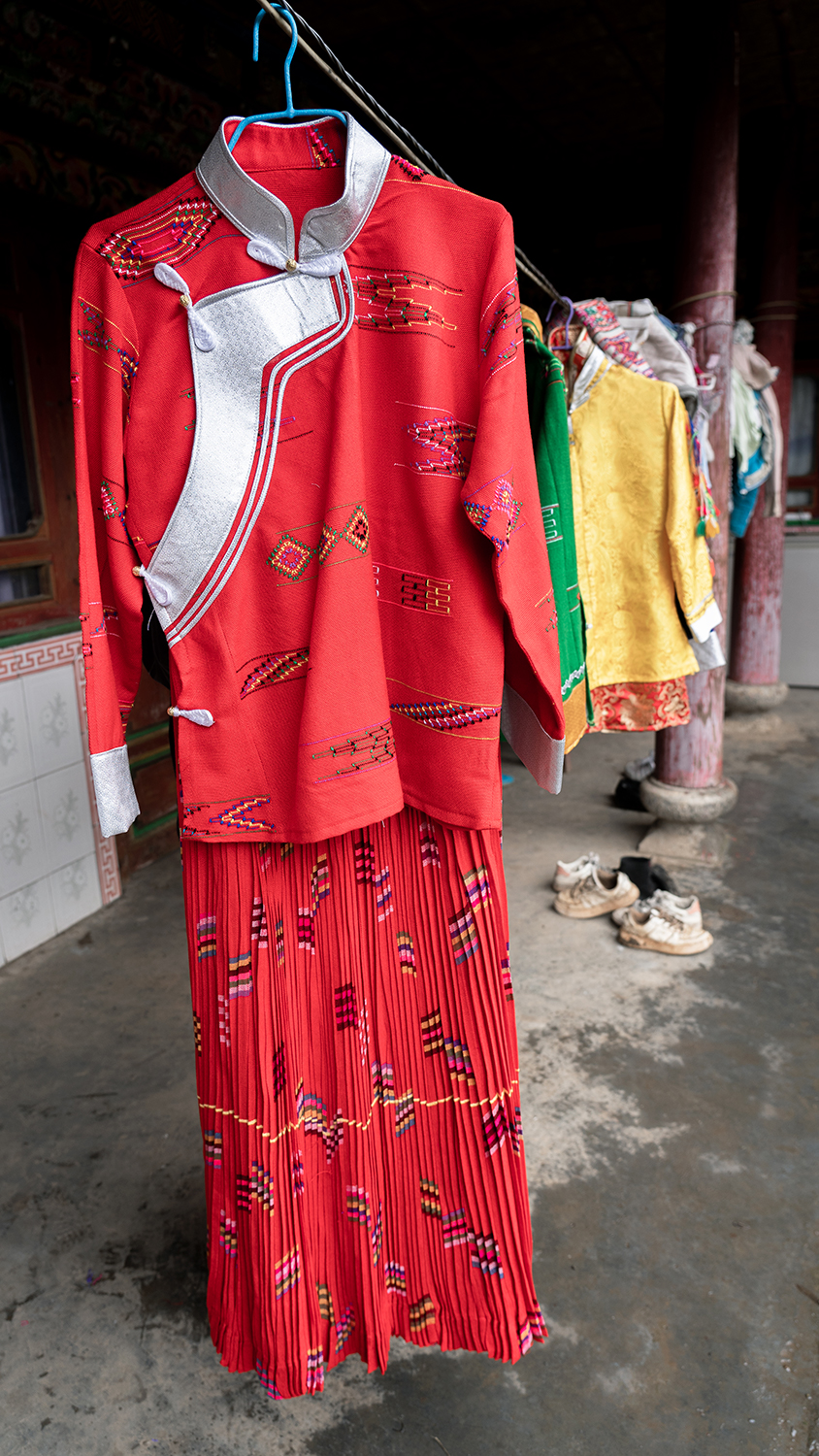
Material Culture – Mosuo Dress with Handwoven Mosuo Traditional Patterns

Text:

This dress is a traditional dress of the Mosuo people, handwoven by the Mosuo people.
The patterns on the dress are all traditional patterns with symbolic meanings to the Mosuo people.

This dress was made by my informant’s mother. Her name is Du Zhi Ma, a 60 years old Mosuo woman living in Lijiang, Yunnan’s Mosuo village. Du Zhi Ma is a provincial-level inheritor of the Mosuo traditional hand-weaving craft. Since 2003, Du Zhi Ma has transformed her home into a workshop studio, leading local Mosuo women in hand-weaving.

Over time, according to the informant, the growing tourist economy around Lugu Lake made machine-made textiles a lucrative commodity at tourist sites. Many Mosuo textile makers struggled to compete and lost income. Du Zhi Ma continued to lead women in Lugu Lake in weaving and making embroidery through her workshops, hoping that this tradition would not completely fade away.

Context:

The informant is the son of Du Zhi Ma. He learned about the story behind this dress from his mother, who made the dress and is a Mosuo person. The informant shared with me this picture as he told me about the Mosuo traditional handweaving as a cultural preserver—he is a local Mosuo museum owner, who specializes in the Mosuo culture (culture specific to the Mosuo ethnic group). The informant thinks of Mosuo traditional weaving as a precious technique that should be preserved, and he is personally very proud of this.

Analysis:

This Mosuo traditional dress is more than just a physical dress—it embodies the Mosuo culture, their artistic expertise, and traditional patterns which capture their cultural beliefs. It represents how material culture acts as a living tradition of the Mosuo.

Du Zhi Ma’s role as a provincial-level inheritor makes this culture endure in a special way. As society become modernized, machine-made clothes have created economic pressure that threatens to hollow out the living craft tradition. Du Zhi Ma’s workshops and her role as a provincial-level inheritor make room for this material culture to be preserved and promoted over time.