
Tag Archives: Material

Origami Cranes

Informant: “I learned origami as a child in my home. My siblings were the ones to teach me. My parents had bought instructional books for my older brother and sister and before I could read, they were teaching me to fold paper cranes and frogs. At school, I would habitually fold scrap paper into birds and other creatures and sometimes gift them to friends or teachers. If asked, I would happily show my friends how to make origami creations of their own, as my siblings had for me.”

Context: Informant is a 23 year old Japanese American USC student who grew up in Lancaster, CA. He also recalls how often other classmates would make things out of paper in his elementary school. Fortune tellers, paper airplanes, and other origami animals were among the many things he learned to make when he was younger, usually taught by family.

analysis: Origami is a classic example of material folklore. This material folklore tradition may have a deeper meaning to the informant’s family due to his Japanese cultural heritage, because origami originated in Japan and has been taught across multiple generations. It’s interesting how the origin of this folklore has adapted and changed over time. Although the original teachings of Origami may have required someone to physically be there to teach you, it has been more commercialized due to its instructions being published and spread in kids books across the world. Also, being able to make Origami swans in school is a way for children to socially collaborate and interact with one another. Its a living tradition amongst children, and is still shared even today.
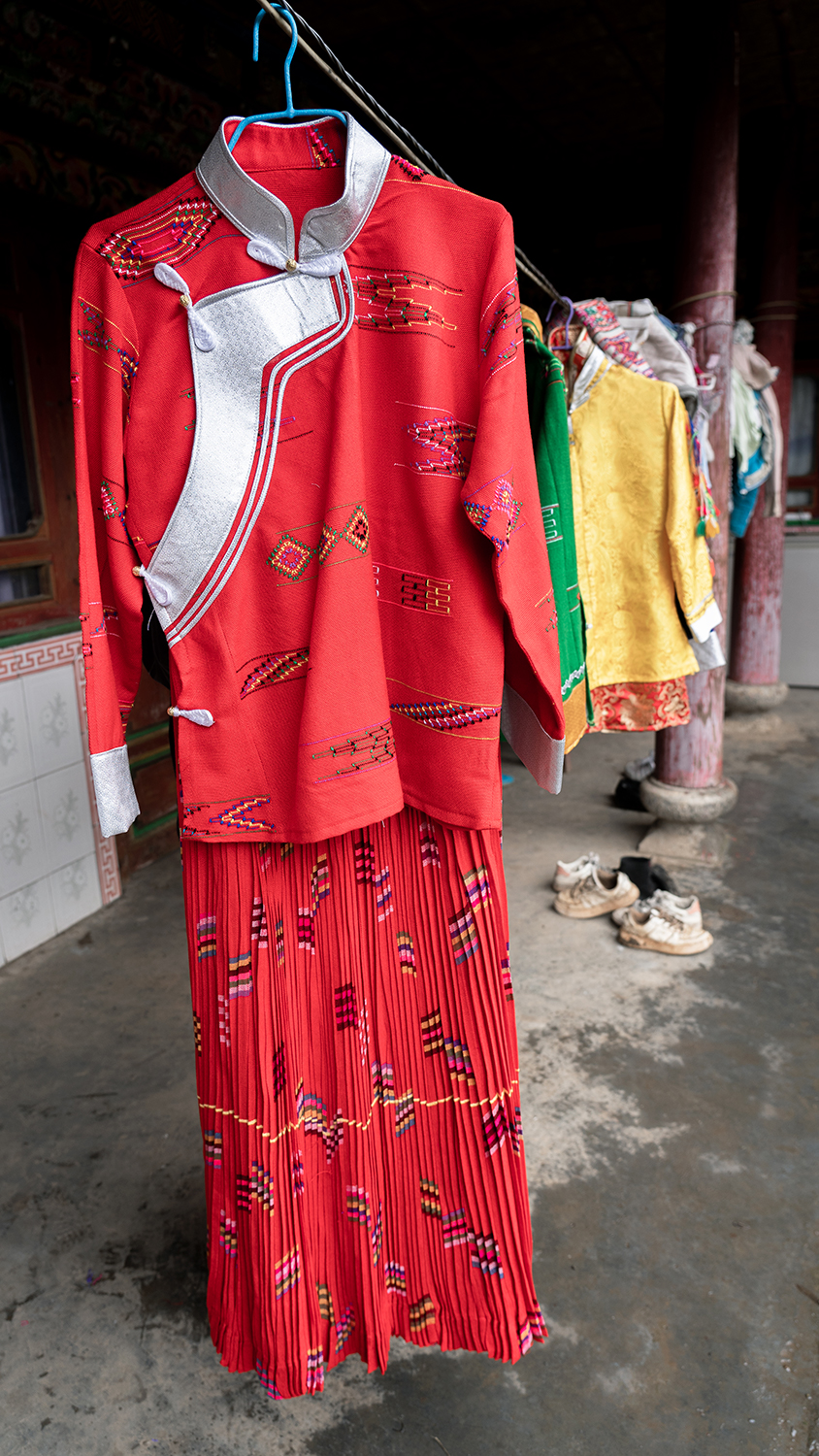
Material Culture – Mosuo Dress with Handwoven Mosuo Traditional Patterns

Text:

This dress is a traditional dress of the Mosuo people, handwoven by the Mosuo people.
The patterns on the dress are all traditional patterns with symbolic meanings to the Mosuo people.

This dress was made by my informant’s mother. Her name is Du Zhi Ma, a 60 years old Mosuo woman living in Lijiang, Yunnan’s Mosuo village. Du Zhi Ma is a provincial-level inheritor of the Mosuo traditional hand-weaving craft. Since 2003, Du Zhi Ma has transformed her home into a workshop studio, leading local Mosuo women in hand-weaving.

Over time, according to the informant, the growing tourist economy around Lugu Lake made machine-made textiles a lucrative commodity at tourist sites. Many Mosuo textile makers struggled to compete and lost income. Du Zhi Ma continued to lead women in Lugu Lake in weaving and making embroidery through her workshops, hoping that this tradition would not completely fade away.

Context:

The informant is the son of Du Zhi Ma. He learned about the story behind this dress from his mother, who made the dress and is a Mosuo person. The informant shared with me this picture as he told me about the Mosuo traditional handweaving as a cultural preserver—he is a local Mosuo museum owner, who specializes in the Mosuo culture (culture specific to the Mosuo ethnic group). The informant thinks of Mosuo traditional weaving as a precious technique that should be preserved, and he is personally very proud of this.

Analysis:

This Mosuo traditional dress is more than just a physical dress—it embodies the Mosuo culture, their artistic expertise, and traditional patterns which capture their cultural beliefs. It represents how material culture acts as a living tradition of the Mosuo.

Du Zhi Ma’s role as a provincial-level inheritor makes this culture endure in a special way. As society become modernized, machine-made clothes have created economic pressure that threatens to hollow out the living craft tradition. Du Zhi Ma’s workshops and her role as a provincial-level inheritor make room for this material culture to be preserved and promoted over time.

Secrets of the Lanyard

Nationality: American
Age: 19
Occupation: Student
Residence: Los Angeles, California
Performance Date: April 19th, 2021
Primary Language: English
Language: N/A

Main Piece:

Informant: I know how to start a lanyard– I was the girl everyone went to.

Collector (Me): Could you explain how to start a lanyard?

Informant: Okay. So it’s so simple you just get the two pieces of string and you lay them in like, a cross, like, so like the middles intersect, and then you more or less just do the normal lanyard pattern, like over the little cross where they intersect. And then when you pull it you’ve started the lanyard and you can just keep going. 

Collector: That’s so inspirational. 

Informant: (laughing) I was a hero at my summer camp.

Background: 

My informant is one of my friends, a sophomore at USC. She went to summer camps when she was a child, and a popular craft activity there would be making box stitch lanyards out of colorful plastic strings. Usually most girls at the camp would know how to weave the strings together into a lanyard, but the difficult part was knowing how to start it. Another girl would be the one to start it. My informant, however, did know how to begin a lanyard, and as a result she was the one that other girls went to when they needed help working on lanyards at summer camp, and in the eyes of her peers, was seen as higher status.

Context: 

This piece came up when my informant, another participant, and I were talking about the various activities we used to do during summer camps. We discussed jump rope games and songs, then moved onto crafts— specifically lanyards, and if anyone knew how they were started in the first place.

My thoughts: 

I liked this piece because it reminded me of my own memories of summer camp when I was a child and also struggled to start lanyards. I remember having to find someone who knew how to start them, but what struck me as I listened to my informant was that while I knew of people who could start lanyards, the instructions were always kept secret. In fact, the notion of secrets plays a significant role in children’s folklore. For children, who should be seen as their own cultural group (a repressed minority) when being studied, secrets are akin to obtaining status and power. Secrets solidify groups within the larger peer group of children, and withholding knowledge from others can elevate a child’s status in the hierarchy. This is seen through what my informant told me: by knowing how to start a lanyard, she was viewed with high esteem by the other girls at summer camp. She also mentioned the same status applied if you knew how to do a variation of the lanyard pattern, meaning that the skills of making lanyards were also valued in the peer group. 

Rocks on Gravestones

Nationality: Israeli
Age: 24
Occupation: Student
Residence: California
Performance Date: 4/21/19
Primary Language: Hebrew
Language: English

Context:

The subject is from Israel, and is a freshman at USC. Throughout my time of knowing him he has shared many jokes and proverbs that are specific to his home country. For this reason, I decided to interview him for the database.


Piece:

Subject: Something else, which I’m not sure is tied just to Jews or not, is we put rocks on gravestones. So instead of flowers, or chocolates, I don’t know, we put rocks there, like a pebble or a bigger one.

Interviewer: That’s really interesting, do you know why?

Subject: I think it’s just a symbol of strength and firmness, and that’s what we want our relationship with the person to be remembered as.


Analysis:

Upon further research, I’ve found that this is quite a common practice, although different cultures have different explanations as to why they carry it out. For thousands of years, people would place rocks on tombs in order to stop scavengers, or keep evil spirits out of the world. In addition, it would also be to stop the deceased from rising up.

In Jewish cultures, placing a stone or a pebble is customary, as a form of respect for the deceased, and to let them know that you have visited.

A Poor Chinese Communist’s Guide to Cooking

Nationality: Chinese-American
Age: 20
Occupation: Student
Residence: La Crescenta, CA
Performance Date: 3/13/17
Primary Language: English

Context: I collected this from a high school friend when we were on a camping trip together over Spring Break.

Background: My friend is Chinese on his mother’s side, and she grew up in a poorer part of Communist China.

The Cooking Method: Because of the lack of proper food that poor Chinese people had to eat, they adopted a method of cooking that involved simply throwing whatever was edible and available together “in ways that made it taste good.” Over time the method became just the natural way of cooking to the people, even once regular food and ingredients became available.

Analysis: I like that the originator of this method of cooking is merely the will to survive, rather than simply a single person who decided to start cooking things a certain way. It’s also interesting to point out that these are folk recipes that emerged from a certain socioeconomic climate, a product of a generally difficult time period for the proletariat Chinese. More ties to folklore and the history of a culture.