Tag Archives: dress

First Communion

Age: 21

Text:
“For my First Communion, we had to wear these pretty white dresses, and I actually wore my mom’s from when she got her First Communion. At that point, it was over 30 years old. We all went to the church, and I was with all my friends from elementary school. I think we were in first grade at the time, and we received our 1st communion. I felt so cute. My mom let me pick out my headband from a really cute First Communion store. And then we went to dinner and we saw Lady Gaga, and it was the best day ever.”

Context:
A catholic girl from NYC who had her First Communion, a coming of age ritual in Catholicism, in the first grade.

Analysis:
Her description of her First Communion demonstrates passing of tradition, the foundation of folklore. This coming of age event that she was excited to experience because it represented a huge milestone in her life. By wearing the same dress her mother did during her First Communion, she was able to connect with her and the celebration even deeper.

First Communion

Age: 22

Text:
“At my First Communion, they took us up to the practice ceremony with all of our parents upstairs in the church. We had to practice eating the communion, representing the body of christ, and drinking the wine, representing the blood of christ, and we drank the wine. I remember saying, this is so gross really loudly, and my parents got so mad at me. The actual day was really fun. We got to wear our dresses and take pictures outside the church. It meant that I was growing up, and it was a really important milestone for my religion.

Context:
A Catholic girl from Phoenix discussing her First Communion, a coming of age ritual in Catholicism, and what it meant to her.

Analysis:
Her First Communion Served as a signifying moment in her religion, marking the moment that she’s growing up. It took preparation and practice because of how significant it is. She remembers the act vividly, specifically noting that wearing a pretty dress was an exciting part of the event. It’s also interesting how children remember moments of stress, even over moments of pure excitement.

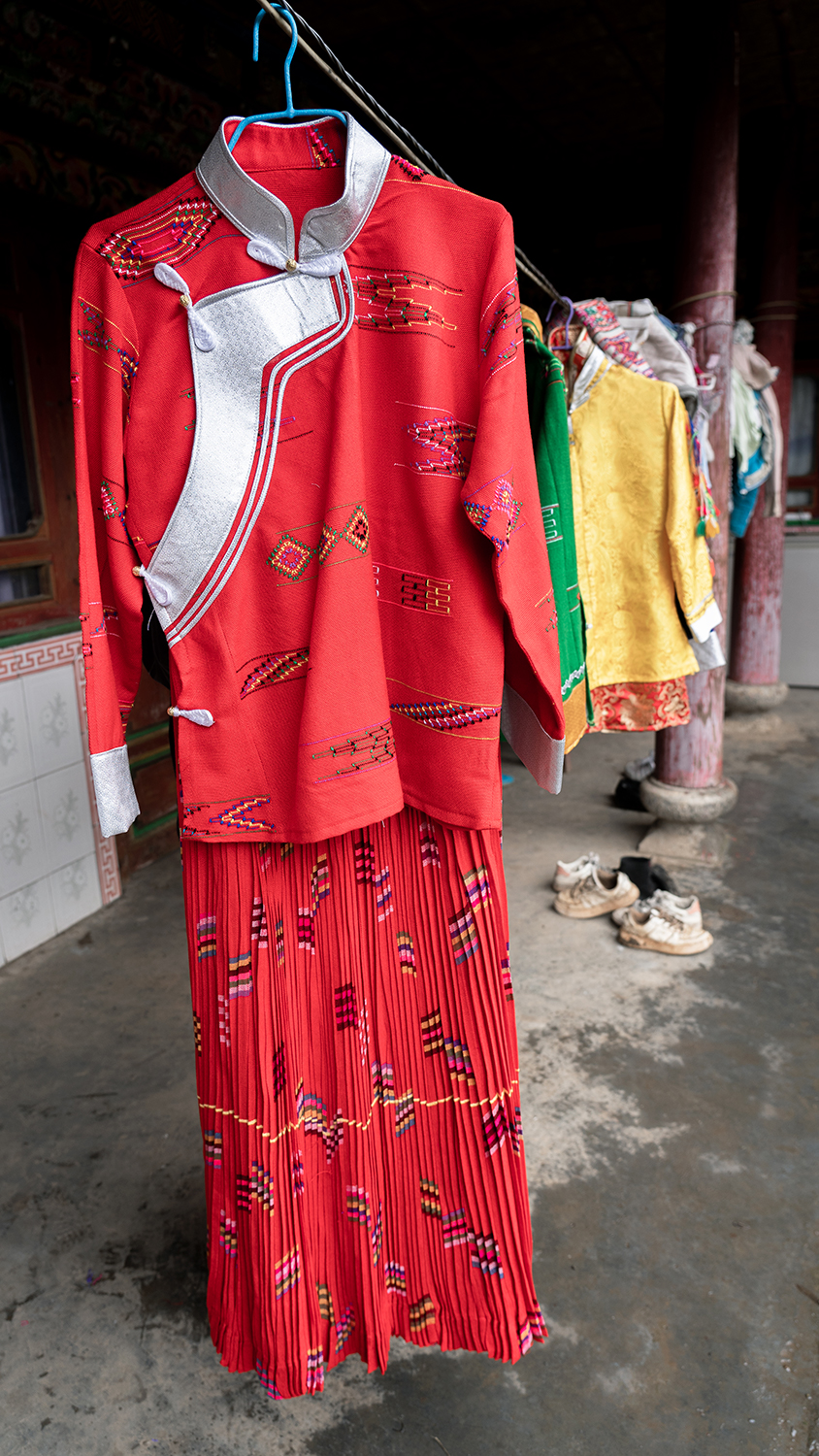
Material Culture – Mosuo Dress with Handwoven Mosuo Traditional Patterns

Text:

This dress is a traditional dress of the Mosuo people, handwoven by the Mosuo people.
The patterns on the dress are all traditional patterns with symbolic meanings to the Mosuo people.

This dress was made by my informant’s mother. Her name is Du Zhi Ma, a 60 years old Mosuo woman living in Lijiang, Yunnan’s Mosuo village. Du Zhi Ma is a provincial-level inheritor of the Mosuo traditional hand-weaving craft. Since 2003, Du Zhi Ma has transformed her home into a workshop studio, leading local Mosuo women in hand-weaving.

Over time, according to the informant, the growing tourist economy around Lugu Lake made machine-made textiles a lucrative commodity at tourist sites. Many Mosuo textile makers struggled to compete and lost income. Du Zhi Ma continued to lead women in Lugu Lake in weaving and making embroidery through her workshops, hoping that this tradition would not completely fade away.

Context:

The informant is the son of Du Zhi Ma. He learned about the story behind this dress from his mother, who made the dress and is a Mosuo person. The informant shared with me this picture as he told me about the Mosuo traditional handweaving as a cultural preserver—he is a local Mosuo museum owner, who specializes in the Mosuo culture (culture specific to the Mosuo ethnic group). The informant thinks of Mosuo traditional weaving as a precious technique that should be preserved, and he is personally very proud of this.

Analysis:

This Mosuo traditional dress is more than just a physical dress—it embodies the Mosuo culture, their artistic expertise, and traditional patterns which capture their cultural beliefs. It represents how material culture acts as a living tradition of the Mosuo.

Du Zhi Ma’s role as a provincial-level inheritor makes this culture endure in a special way. As society become modernized, machine-made clothes have created economic pressure that threatens to hollow out the living craft tradition. Du Zhi Ma’s workshops and her role as a provincial-level inheritor make room for this material culture to be preserved and promoted over time.

“It’s snowing in the south”

Nationality: American
Age: 52
Occupation: Clerical
Language: English

Folk metaphor: “It’s snowing in the south”

“When my sister and I were younger, uh, probably around middle school age on her part, so around 5th or 6th grade for my part- so, anytime you went out to church, or out to dinner, or anytime you had to dress up, you know you’d be wearing a dress; you’d be wearing a slip. Because you wanted to make sure nothing showed through. You didn’t want the sun shining through your dress. Or your skirt. Anyway. The problem is slips can.. Slip down a little bit sometimes, depending on the length of your skirt, depending on how tight the slip is. Anyway, if you noticed each other’s slip was starting to show underneath the bottom of their dress, you’d kind of just come up next to her or she’d come up next to me and mutter under our breath, “ Hey, um it’s snowing in the south”. And so, that was- you knew your slip was showing and you’d need to go excuse yourself and go fix it.”

Analysis: This folk metaphor seems to stem from perceptions of femininity and modesty and marks a subtle way to tell someone their slip is showing. While it would be inappropriate to declare that the slip has fallen in the middle of a social event, using the folk metaphor avoids tabooistic language and allows the individual to retain their dignity and fix the issue privately. The fact that this was mostly between the informant and her sister may mean that for this individual, this phrase was entirely or at least predominantly used by other women. It likely existed within their vocabulary not only as avoidance of a general taboo, but as a gesture of respect for the other woman and as a means to not draw men’s attention to the issue. The fact that this was muttered or spoken under the breath furthers the emphasis on privacy and dignity, allowing one to compose themselves away from judgement.

The Ghost of Her Grandmother at Death

Nationality: USA
Age: 18
Occupation: Student
Residence: Seattle
Performance Date: October 26, 2020
Primary Language: English

Main Transcription:

Collector: Hello JS, so I know that you have mentioned before that there are ghost stories and interactions in your family. I would really appreciate it if maybe you could share some of your experiences.

Informant: Okay so when I was little my family had like a lot of encounters with ghosts and spirits; it’s happened for me a lot. I will share a story that happened with my mom and myself. I think it’s like the craziest experience. So when I was little I was looking out our window just like looking outside like anyone would do, I was maybe 10 and I saw this person walking down the street and we lived in a pretty small neighborhood so everybody pretty much knew everyone.  I saw this person walking down the street and I’d never seen them before, so I called to my mom who was in the kitchen and said, “Mom, who’s the pretty girl walking down the street?” My mom was doing something and could not see out the window, so I yelled to her explaining what she looks like. I said “she’s in this red dress with flowers on it, she had long brown hair and she’s really pretty.” At that moment my mom walked over and looked out the window and was like “Oh my God that’s exactly what my mom, your grandma, wore when she died”.  I supposedly had seen my grandma that I’ve never met before in the clothes that she died in.  I find this really creepy and my mom tells that story all the time that it looked like real life and we thought it’s a real life person that we could touch, but no one else in our family had had any other encounters with our grandmother.

Collector: Do you think are any reasons in particular why your Grandmother showed herself to you and your mother?

Informant: Well I think that my mom and my Grandma are really similar and my mom talks about my Grandma as like she is her Guardian Angel. My mom attributes small occurrences to her mom.  Little super random stuff like if something like drops in our house or sometimes like come up in her dream. My mom can connect those things, but my mom also sees auras around people.  The auras are the colors that you associate with people and it allows my mom the extraordinary power to know how someone is feeling or if something’s wrong.

Collector: Does she think this ability comes from her grandma? 

Informant: No, I think she thinks that she has like this connection with her, but I don’t think she got it from her.

Collector: Have there been other times where you have experienced other sorts of supernatural events?

Yeah, my sister and I often have the same dream and wake up seeing figures of old people standing in the corner. This makes me sound actually insane, but more often than not, my sister sees the person and I could like feel the spirit. I think it’s crazy and not a coincidence that both encounter similar things at the same time. Okay, that sums up most of it.

Collector: Would you be willing to share any more of your experiences?

Informant: Ummm, for the most part I have told you the interesting parts.

Collector: Well, thank you so much more sharing and I really appreciate you taking the time to tell your story.

Context and Relation:

JS grew up in a small town outside of Chicago. She later moved to Seattle for high school. There are pieces of her story that are from her time in Seattle, but the first encounter about seeing her grandmother took place in a small suburb outside of Chicago. She remembers this story because of the abnormality of the situation. It was extremely strange for JS to see an accurate image of someone that she had never met before. JS is a caucasian teenage girl who is attending an American university.

Personal Reflection:

Personally, I have never had an experience quite like JS’s with seeing a dead grandparent or parent or experiencing a spirit. I found it interesting in JS’s story that her Grandmother was wearing the clothes that she died in and that the grandmother took the body of a younger girl, similar to her age. I don’t know exactly what this detail means, but it is definitely worth mentioning. I agree with JS that these events are scary, but I find it really interesting how nobody else in her family has connected with her Grandmother except JS and her mother. Personally, it would make sense to me if other family members came in contact with the Grandmother ghost being from the same family, especially if her sister has had visions of figures from dreams. In conclusion, JS had an amazing encounter with a ghost of her grandmother that she will never forget.