Category Archives: Folk Beliefs

Writing on public spaces

Text: Writing the word “Compton” on public spaces such as bathrooms, buses, street signs, houses, city buildings, gas stations, or sidewalks in Compton, California.

Context: This informant was born and raised in Compton, California from the 1970s to the 1990s. Everywhere he went in that city, he would see “Compton” graffitied. It was just a known thing that people would write this, so he got this idea from visibly seeing it and growing up doing it with friends. When I asked him “what does it mean?”, his response was “it meant that you are from Compton”.

Analysis: I see this as a way to “mark territory” or to show a sense of community. The city of Compton has a reputation of being dangerous or “ghetto” which I think has some sort of connection to this. I would never see this happening in the city where I am from—Chino Hills, California. I feel like other cities with a similar reputation also do something like this.

Chin Flick

Text: When someone does something that makes you extremely upset, you would flick your chin with the back of your hand.

Context: The informant got this from the movie “Greece”. He rarely uses it, but an example would be when he is driving and someone almost hits him. He said it means “fuck off” to the person you do it towards. He said he thinks it originated in either France or Italy.

Analysis: I would say this is the equivalent of flipping off your middle finger to someone (meaning “f*** you”), but it is not used as commonly. I am not sure if it is known as well as using the middle finger. When I was younger my friends and I used to do this to each other jokingly and innocently. We used to think it was sign language for the same meaning.

Hu Lu – Folk Object

Text: 

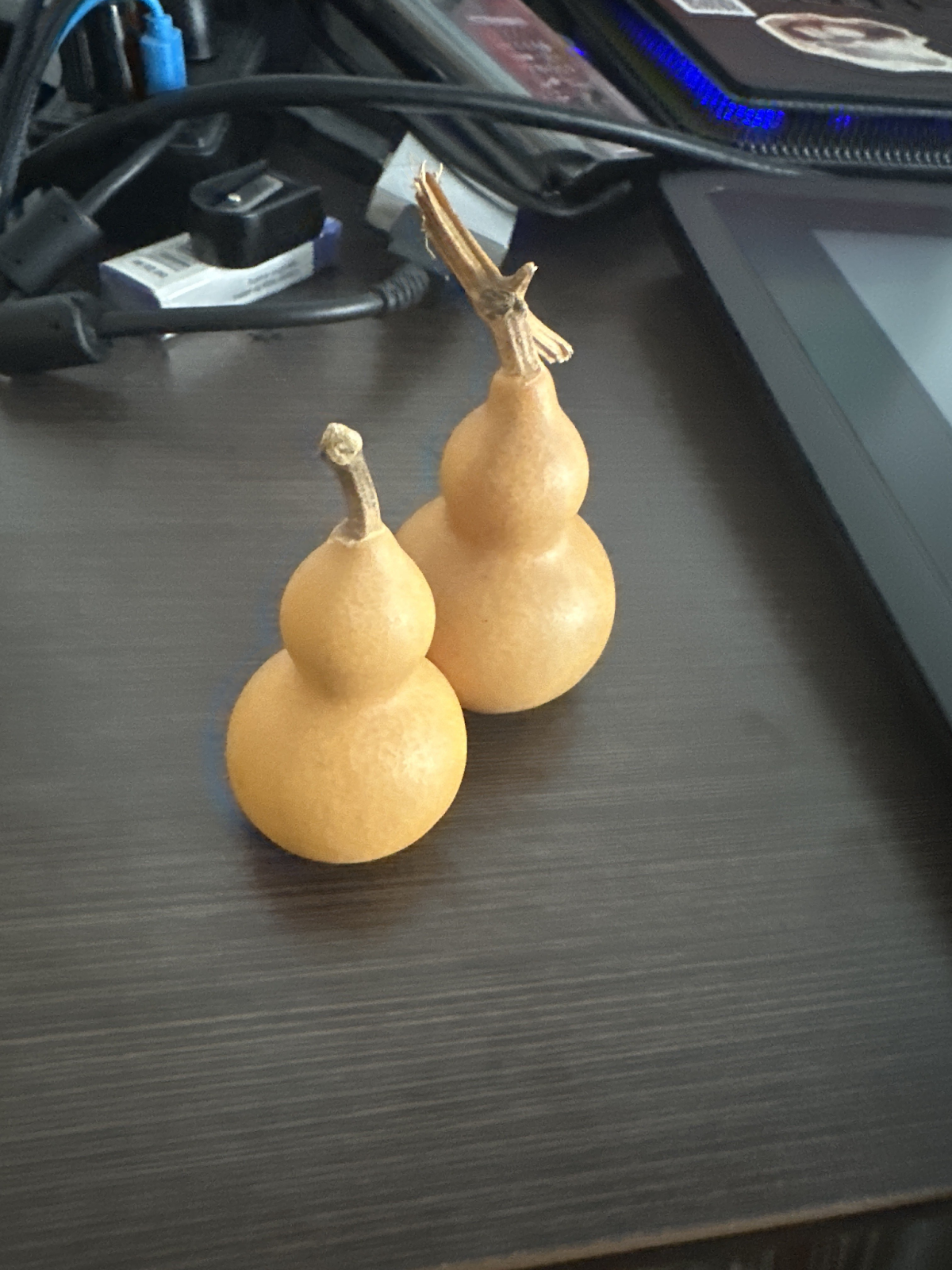
“So my dad got me two hulu because it’s like a lucky charm, and they’re like very round. I’m not really sure why they’re lucky, but I know there’s a show called Hu Lu Wa, and like there’s little guys who come out of the hulu and beat evil people up. Yeah, so my dad was like these two things are very, like, brings you luck and safety, security, whatever… good stuff.”

Context:

The teller is a first-generation Chinese American raised in the Bay Area of Northern California. She received the two hulu, or calabash gourds, as a gift from her father, who purchased the items while visiting a riverside ancient city area in China. The teller’s family is from Shanghai, but she notes that the hulu is a common symbol found throughout the country. 

Analysis: 

Within Chinese culture, the calabash is a common charm for luck, fertility, and protection, charms associated with it due to its shape and also historic use as containers for items like medicine. It is interesting to note that while the teller confesses she doesn’t truly understand the meaning behind the calabash, she is able to find personal meaning through the association of the gourds with the show Hu Lu Wa, or Calabash Brothers. Hu Lu Wa is a popular Chinese animated cartoon in which seven brothers born from a set of rainbow calabash gourds must protect their home from two demons, and it remains a common cultural experience for many in the Chinese diaspora of the current generation*. The teller’s association of this folk object with the show  points to how popular culture and media in the modern age influences how folklore is passed on and communicated, particularly to members of a diaspora and those who have a certain degree of separation from the culture and may not organically learn of specific meanings otherwise. 
*Note from the collector: I as a Chinese person raised in the US have bonded with many First-Generation Chinese Americans and Chinese immigrants over knowledge of Hu Lu Wa and other Chinese animations like it. Based on personal observation, I think it is common for Chinese parents born in the 70s to show these to their children as a way to connect our childhood to their own, which explains the popularity of the show amongst Chinese people of my generation in spite of the chronological distance between the 80s and the 2000s. Hu Lu Wa and other shows made by Shanghai Animation Film Studios occupy a similar role in Chinese pop culture that classic Disney movies have in American pop culture.

Mami Wata

Nationality: Nigerian/British

Primary Language: English

Age: 20

Occupation: Student

Residence: Los Angeles

Date: 2/19/2024

Text: 

S.I.- “I heard about the spirit Mami Wata when I was younger, I don’t remember by who, but they were trying to give examples of Nigerian culture-specifically in some villages.” 

Me: “What were the spirits qualities? And why did people call for her?”

S.I.- “They believe that she attracts money and good fortune. If I remember correctly people from villages usually call for her in order to protect their sick.”

Me: “Have you ever seen an experience where someone has called for her help or used her as a household name?”

Sarien: “No, I haven’t. But it definitely is common for people in rural areas of the country to believe in it and many other spirits and deities.”

Context:

The participant doesn’t remember directly who told her about this spirit, but assumes it was one of her family members that opened the discussion of other’s cultures within the country. She is also from a city and not a rural part of Nigeria, geographically within the country there are many different beliefs and traditions. 

Analysis:

SZThis interview provided valuable information about the cultural fabric of Nigeria, especially within rural areas. Although the participant’s memory was vague on who told her about the spirit it makes a strong case how cultural transmission of Mami Wata is oral, and how her spirit lives through knowledge passed down within families/communities. This method of cultural transmission helps preserve traditions/beliefs across generations, even if the details become blurred over time. It was also made clear that there is a huge difference between urban and rural perspectives and beliefs within the country. However, the belief in spirits like Mami Wata in rural areas highlights the resilience of traditional practices and their efforts to save or help their loved ones.

To not see the soul

Nationality: Ethiopian/Italian

Primary Language: English

Age: 21

Occupation: Student

Residence: Los Angeles

Date: 2/20/2024

Text: “In Ethiopian culture, people are generally wary of foreigners and the lower class, believing many of them invoking the power of buda or demons to curse others. As such it is rude for these people to sustain eye contact, and they generally take effort to sustain eye contact with them as an attempt to curse them. They also believe these demon-invoking people to be capable of changing into hyenas and thus also avoid making eye contact with wild hyenas”

Context: This was told to him at a young age by his family and is a cultural aspect with spiritual components. He clarifies though that it is not something he participates in and personally believes in. Especially with the fact that he was mainly raised in the United States and it is not a social norm that is practiced.

 Analysis: This was an example of how heavily they believe in signs of misfortune and curses, even on a smaller scale not involving magic. I was able to draw parallels between the “tabooistic” belief of the evil eye, that by holding eye contact they can be inflicted with misfortune. Both stem from glaring and believe that one who is jealous, or in this case lower in stationary, they can evoke a curse to lessen your fortune.