
Category Archives: Foodways

Dayenu, a Passover song

Nationality: American but Persian
Age: 19
Occupation: student
Residence: Beverly Hills
Performance Date: April 26, 2020
Primary Language: English

The following is transcribed from text exchanges between my informant, A, and myself, M.

Main piece:

A: On passover, there’s this tradition that Persian Jews have, and somehow only us. There’s this song called Dayenu that you sing as part of the Passover seder, which is like what we call the food and tradition we do.

A: Passover is about Jews being slaves in Egypt and Passover is specifically about when the Jews were freed, and that’s basically the whole thing. But this song is part of it, and its about thanking God for each specific thing He did in the story. And for Persian Jews, while we sing the song we hit each other with green onions because they symbolize the whips from slavemasters. We get pretty agressive, and it looks really stupid.

M: Why just Persians?

A: I don’t know how it started or why it never made it to any other ethnic Jewish group. I didn’t even know it was a Persian thing until like late into my life, so when I talked about it with my white friends, they thought I was insane.

She later texted me that her parents told her Italian Jews do it as well.

Background: My friend is Persian Jewish from Beverly Hills. Judaism has played a large role in her life, having gone to Jewish high school and been an active participant in the community since birth.

Context: She and I were texting casually, and I asked if I could collect from her.

Thoughts:

Food is a way of communicating, and from what I have learned about the Passover ritual is that it is a very active one, almost like a play. Also that food is heavily involved. I am left curious as to why Persians specifically do this part.
The Feast of the Seven Fishes (Italian)

Nationality: Italian-American
Age: 54
Occupation: entrepreneur
Residence: Los Angeles
Performance Date: April 27 2020
Primary Language: English

The following was told to me by my informant.

Main piece:

“It’s called the feast of the seven fishes, it is an Italian tradition. A lot of my friends do it too, but there’s a lot of variations depending on what region you are from. Every Christmas Eve, we did this and it was led by my grandparents at their house in Pittsburgh. Basically, it’s a big fish feast, and you had to have 7 kinds of fishes. Usually there were mainstays, like calamari, bakala…it could switch around a bit, but there were always seven fish. We always made a special fried bread with mashed potatoes in it that we called rispelli. Then, the tradition came to our house, and I was more involved then, going to the fish market and helping cook starting in the morning. The entire family helped out, and we would have fun, and drink wine, then enjoy the dinner feast. Nobody’s sure what it symbolizes– Seven sacraments maybe? It’s an important number in the Bible. My dad’s family did it when he was little too. It felt special because we only ate that food at Christmas Eve, and when we were kids, we didn’t really like it. But by the time you grow up, you really like it and enjoy the food.”

Context: This was told to me when my informant came over to my house.

Background: My informant is Italian-American from the East Coast. She is from a big, close extended family who enjoys their Italian heritage. Her grandparents were immigrants from Calabria.

Thoughts:
I participate in this every year, too. I love this tradition, and I find it very true that the food really does not taste good but because you associate it with happy memories you learn to love it.

Ebleskivers

Nationality: American
Age: 19
Performance Date: April 2
Primary Language: English

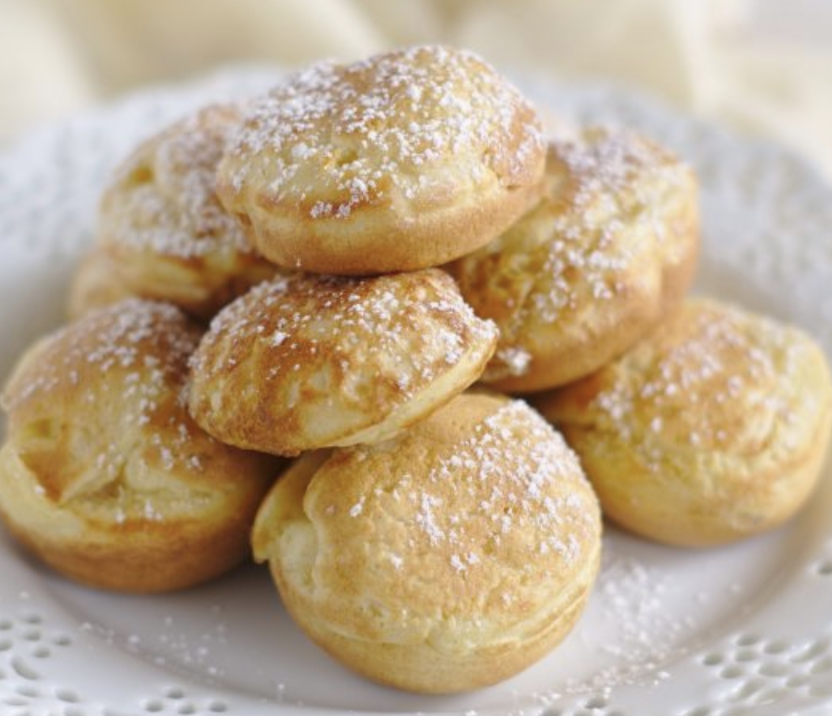
Ebleskivers are a folk object and food that originates from Denmark. They are very similar to pancakes and are a breakfast item. They are spherical and cooked with another folk object, an ebleskiver pan. This is a cast iron pan with round holes in it to cook the batter. This pan is used exclusively for this food, so it is a very important folk object to food culture in Denmark. They are typically served with jam or other breakfast condiments, but the informant eats them with butter and powdered sugar. There is yet another folk object used, which is a porcelain bowl filled with butter placed in a rack over a candle. It is similar to an object used to melt butter for shellfish like crab and lobster.

            The informant learned this practice from her mother. The initial recipe goes back to the informant’s great, great grandparents and she still uses the same pan passed down by the family members. The great great grandmother is from Aabenraa, Denmark. The informant only has it with family members and the combination of butter and powdered sugar seems to be a family-specific thing.

            Upon further research, it seems that this food is rarely prepared by restaurants. Instead, it is typically only made in family gatherings and by street vendors in Denmark. Because of this, it seems to me that the food is more authentic and less likely to have a standardized recipe and in doing so, is not found in much-authored literature. The folk objects only add to the culture and lore around it as these are food-specific, something not often found in many cuisines.

Apple/Pear Cobbler Recipe

Nationality: American
Age: 54
Occupation: Film
Residence: Los Angeles
Performance Date: 3/15/20
Primary Language: English

Main Piece:

Ingredients:

CobblerToppingWhipped Cream
– Butter or Crisco for Baking Dish
– 2 1/2 cups peeled, and sliced Granny Smith Apples
– 2 1/2 cups peeled, and sliced Bosc/Asian Pears
– 3/4 cup of Brown Sugar
– 2 tablespoons of All-Purpose Flour
– 1 tablespoon of Vanilla Extract
– 1/2 teaspoon of Cinnamon
– 1/2 teaspoon of Allspice
– 1/4 teaspoon of Salt
-4 tablespoons of Unsalted Butter
– 1/2 cup of Self-Rising Flour
– 1/2 cup of Sugar
– 1/4 teaspoon of Salt
– 2 tablespoons of Unsalted Butter (softened)
– 1 cup of Heavy Whipping Cream
– 1/2 cup of Sugar (Powdered Sugar is best)
– 1/2 teaspoon of Cinnamon

Instructions:

  1. Preheat the oven to 350 degrees (Fahrenheit). Prepare a 9×9 inch baking dish.
  2. Toss the apples, pears, sugar, flour, vanilla, cinnamon, allspice, salt, and 2 tablespoons of the butter together in a large bowl. Add to the baking dish and dot with the remaining 2 tablespoons of butter. 
  3. In a separate bowl, combine the self-rising flour, sugar, salt, and egg. With a spoon, drop the topping onto the apples/pears and top with pats of butter. Bake until the topping is golden and the fruit is tender (about 40 to 45 minutes).
  4. Serve with special whipped cream!

Background: The informant is a 54 woman who loves to cook, as she often serves this apple cobbler at Thanksgiving. She originally came across this recipe from her mother, who used to cook the same dish for the holiday as well. She claims the recipe has been passed down generations, and because of that holds a special place in her heart. She will continue to cook the dish, and plans to pass the recipe down to her daughter when the time comes.  

Context: The informant showed me the recipe in person when I was at her house. 

My Thoughts: Although this recipe is nothing special, the fact that it has been passed along throughout the informant’s family makes it special to them. It is something they, as a family share with one another, and serves as a unique way for her to always remember her mom and grandma. They’ve all experienced cooking the same dish for Thanksgiving and having to deal with the pressure of it meeting their families expectation. In addition, I find it interesting to see if any of them made small changes to the recipe. The informant claims to have not. However, she did share with me that her mom added the whipped cream aspect to the dish. The dish has been served for over 60 years within the informants family, making it quite the staple for their Thanks Giving celebration!

Lutefisk

Nationality: American
Age: 52
Occupation: Communications Manager
Residence: Woodinville, WA
Performance Date: 4/29/20
Primary Language: English

Informant: I grew up in a family that was part German, on my mother’s side, and part Swedish and Norwegian on my dad’s side. My great-grandparents had traveled to the United States, and my grandparents were born in the United States, but there were still a lot of family traditions from Scandinavia and Germany and… the ones that really stand out in my mind are the Scandinavian side of things, more Sweden and Norway. My dad especially was pretty connected to those kinds of traditions. One I remember vividly – because it was always brought up as a threat – was the idea of eating lutefisk. Lutefisk is a dried fish, except it isn’t dried, it’s kind of… gelatinous, in a really disgusting way. And it’s a fermented fish, so it gets steeped in lye, which is also not something you think should be ingested, and yet it’s a delicacy! And even better, it’s such a delicacy that it’s saved for the holidays! So, you know, bringing out the Christmas lutefisk was something that was supposed to be revered, but I could never get into it. And then it became a running thing in my family that you’d be made to eat lutefisk if you weren’t behaving to anticipation, or what people were expecting of you. 

Background/Thoughts:
The informant is the interviewer’s mother, who grew up in the suburbs of Seattle, Washington. As described in the piece above, the informant’s family adhered to many Scandinavian and German traditions, some of which have been in our family for generations. Lutefisk has remained a threat as the years went on, and I have the same opinions as the informant does. I personally don’t understand the appeal of the dish, but I recognize that many members of my extended family in both America and Scandinavia love it. Even though I’m not personally a fan of the recipe, I do appreciate that it keeps my family in touch more with our traditions and history from Scandinavia.