
Category Archives: Legends

Narratives about belief.

The Bloody Pit

Text/Context

RG – This place is called “the bloody pit.” It’s the Hoosac train tunnel in North Adams (Massachusetts), and it’s called that because it took the lives of hundreds of construction workers while being built because it was a nightmare of a tunnel to build. It’s really long, and looking in it’s just black. We went to check it out. It was the same summer we did a bunch of other stuff (like visiting graveyards or other supposedly haunted places at night) because we were really attracted to death for some reason. C was just staring into the tunnel as if he were in a trance. I tried getting his attention, snapping, saying his name, getting in front of him and waving, etc. Suddenly he got really angry, pushed me aside and started walking in. He eventually snapped out of it but it was all really uncharacteristic of him.
The tunnel is still an active freight route. It’s 4.75 miles long, and when you go a decent amount in and turn around, it’s just a pinprick of light. And it’s a mess in there. The walls are pretty decrepit and leaking, and it sounds really ominous and wet in there.
We knew the history of the tunnel. It’s called the bloody pit for a reason. But we went in anyway. And C acted all weird when we were heading in. But we weren’t super freaked out until on our way out we all noticed, quite at the same time, a penny lying heads up on the rail. We hadn’t noticed it going in. And it freaked us out because a penny lying heads up is a symbol of good luck. But right before one of us picked it up we all realized, again at the same time: ehhhh don’t touch that. It’s like if you think about an angler fish, there’s something so tempting and shiny in front of a great dark maw. We didn’t want any type of luck that tunnel had to offer, if that makes sense. We didn’t really think about what-ifs, we just knew not to touch it.

Analysis

The informant enjoys telling the stories of their various adventures each time we speak. This time was about one summer where the informant went to graveyards, haunted construction sites, and The Bloody Pit. It takes a certain kind of person to knowingly go into a place named so threateningly. The informant has had several encounters with ghosts. They are not the most nor the least superstitious out of the group they went with, but all of them agreed there was something not right with the location, in a way that they could not logically explain away. This story combines ideas of haunting, historical events, and the non-localized folk belief of finding a penny lying heads-up being good luck.
Jealousy and Forgiveness

Story: George, my great great grandfather, had a neighbor was jealous of him. The neighbor was very poor, and my great great grandfather would give him bread and water. He was so jealous that one day he just shot him – right through the forehead. According to my grandfather- but I should really ask my Yaiya who knows the story better- after he shot George, he felt so much remorse for killing a kind man – he begged my great, great grandmother for her forgiveness, and she did forgive him- and he became so depressed that he never left his home and spent the rest of his life looking out across the road at George’s house.

Format: The informant told these to me in person, and I recorded them to better transcribe them later.

Context: The informant was told these stories by their father, who was handed down these stories from his father, who was told some of these stories by his father. They are stories about the informant’s great great grandfather, George, and the village he is from. The informant feels as if this story is bittersweet, and did not have much else to say about it.

Analysis: I believe that this legend shows the immense capacity for kindness that the informant’s ancestors had and show what someone is capable of when they truly care about others, but in the same story you hear about the worst that humanity can do, and where their minds are capable of going. It feels like a cautionary tale.

Work in the Tavern

Story: One story I remember, that was told to me my my father, that was told to him by my grandfather by one of his uncles, is that when George was about 10 years old and working at the tavern and he was so tired – I mean he was ten – that he sat at one of the tables one night at the very back of the tavern – so his legs were up like this so it looked like he was awake *demonstrates* – and put his head down on his arms and fell asleep. His boss found out, and sprinkled red pepper on his arm – right here *mimes* – right under his nose. When he inhaled, he inhaled the pepper which burnt the inside of his nostrils and woke him up in tears. Needless to say, he never fell asleep at work again!

Context: The informant was told these stories as bedtime stories by his father, who was handed down these stories from his father, who was told some of these stories by his father. They are stories about the informant’s great great grandfather, George, and the village he is from. The informant told these to me in person, and I recorded them to better transcribe them later.

Thoughts: When asked what this story means to them, the informant shrugs, and said they were told this story as a child, and even back then it made them want to work harder and be more like George. “He must’ve been exhausted from working so hard, right? I mean, what was I doing at ten years old?”

Analysis: Listening to this story, I was a bit shocked. My family doesn’t have any stories about our ancestors, and this informant had several! (Not all are included.) However, this struck me as folklore for the lesson that has become imbedded into it throughout the years and generations who have told them. This particular story, never put your guard down or show weakness.

The Emperor

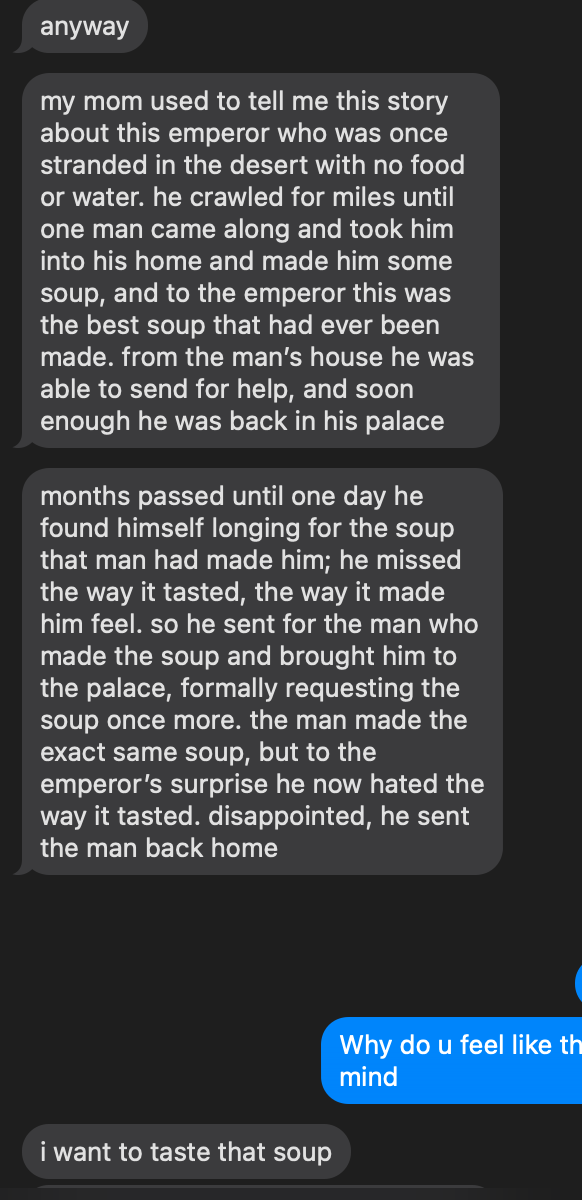
Story: An emperor was once stranded in the desert with no food or water. He crawled for miles until one man came along and took him into his home and made him some soup, and to the emperor this was the best soup that had ever been made. From the man’s house he was able to send for help, and soon enough he was back in his palace. Months passed until one day he found himself longing for the soup that man had made him; he missed the way it tasted, the way it made him feel. so he sent for the man who made the soup and brought him to the palace, formally requesting the soup once more. The man made the exact same soup, but to the emperor’s surprise he now hated the way it tasted. Disappointed, he sent the man back home.

Thoughts: When asked about why the story stuck in his mind so much, the informant said that he “want[s] to taste that soup,” and that it “was a really fun lesson about relativity”. His mother used to tell him the story before bed, and it holds a special place in their heart.

Context: The informant told this to me over text as they were unable to FaceTime for a recording.

Analysis: My thoughts about this legend are complicated. I do not believe it is a real story, but it realistically could be. The metaphor of the story is very intriguing, in the sense that a memory will never be the same as reality. Chasing a memory is to chase a kind of perfection that is not real in our world, since our brains paint the past through rose colored glasses. Trying to attain that same feeling – like the life-saving relief the emperor experiences in the story- is impossible. Because it wasn’t the soup that gave him that feeling, it was the situation.

Do you know who I am?

Story: There was a story I heard about a student at a school- I forgot which one- who took a beginning class their freshman year in one of those big lecture halls with around, like, 500 students. During the final, they had an hour to finish, but when the hour was up, this student still wasn’t done. Everyone else left and turned in their tests, and they were still working. They finally walked up to the front, but the professor told them that their test couldn’t be accepted since they hadn’t finished in time. The student then yells at him: “DO YOU KNOW WHO I AM!?” the professor, “What?”, the student, “DO YOU KNOW WHO I AM!”, “NO!” said the professor. “Good!” the student said and he then slipped their test into the middle of the stack and ran out of the classroom.

Context: The informant told me this story over the phone, recalling it from writing their own folklore collection.

Thoughts: The informant wasn’t even sure if they had recalled the story correctly, however they thought it was hilarious and wished they had gotten the chance to do something like it during school.

Analysis: I think this folklore is really interesting as a legend, and I feel as if I have also heard this, or some version of this story before. It is interesting hearing folklore about classes and school, since this was the only example of school-based folklore I was able to collect.