
Baba Yaga

Main Text

CS: “The myth of Baba Yaga, some people have heard of it, it’s like a Russian folktale. It’s like generally Eastern European, but um, the myth there is, as I’ve read through picture books and stuff, is there’s this like evil baba, baba is the Bulgarian word for grandma. So there’s this evil baba that lives out in the forest, and she lives in this hut that sometimes has chicken legs and sometime doesn’t, you know depends on like the retelling. And she flies around in a pot, like a cauldron, uh, and has a broom, flies around with a broom too. That’s how she, I don’t know, pushes the air or something, whatever. But she’s like really mean and, um, she like beats the kids that she kidnaps, she kidnaps the disobedient children so people always say like, uh, ‘You gotta listen to your baba, because she’s better than Baba Yaga, like, if you don’t listen to your baba then Baba Yaga is gonna come get you.”

Background

CS is a 21 year old Bulgarian American from California and is a third year student studying Computer Science: Games at USC. CS first heard about Baba Yaga from his own baba as a tool to make sure he listened to her when in public. He never really believed in Baba Yaga and suspected, as a child, that his grandmother did not either as she always brought it up very coyly, but he understood what the stories were implying and so would always listen to what his baba said.

Context

This story was told in CS’s household, and in other’s he says usually by a maternal figure to younger more impressionable children in order to keep them in line and listening to their grandmothers. The story supposedly only works as a deterrent if the children believe in and are afraid of Baba Yaga, but it had the same effect on CS even though he did not believe.

Interviewer Analysis

Baba Yaga follows a larger folkloric trend of children’s stories designed to instruct them by preying on their fear of the unknown, or upon instilling that fear. By using a story like Baba Yaga, parents are able to use a terrifying fictional character to make sure their children behave well. This story is told with good intentions by Eastern European parents and grandparents alike and is effective at achieving its goal, but this interviewer wonders if using fear of the unknown to keep children obedient has detrimental consequences in the long run.

For a deeper dive into the Baba Yaga story and story type, read Andreas Johns’ 2004 book Baba Yaga: The Ambiguous Mother and Witch of the Russian Folktale.
Baba Marta

Main Text

CS: “So the next one I was thinking of was the tradition of Baba Marta, which is like the first day of spring for Bulgarians. It’s like the first of March and you hang up these white and red like crochet, or like knitted things, like yarn and they sometimes look like people, sometimes they’re just abstract shapes. I don’t really remember what the shape is. But people always wish each other ‘Chestita Baba Marta’ or like happy first day of spring and Baba Marta is like baba of spring. I guess somewhat similar to the Baba Yaga story, there’s this grandma who is the incarnation of spring and shes just like a joyous type I guess.”

Background

CS is a 21 year old Bulgarian American from California and is a third year student studying Computer Science: Games at USC. CS describes the Baba Marta holiday like Christmas, you do not remember your first one but it is an ever-present time in your life. CS loved Baba Marta as a holiday because he could look forward to seeing his family and having an excuse to eat. His father, aunt, and grandmother all celebrate it with him every year.

Context

Baba Marta is a spring time festival celebrated in Bulgaria on March 1st. Confusingly it is also the name of a physical embodiment of springtime that comes to people as a joyous old woman.

Interviewer Analysis

Festivals celebrating the end of winter and the coming of a sweeter season are a very common phenomenon especially in eastern European countries with Slavic influences, even though Bulgaria’s geographical placement further south in Europe means that its winters would not have been as harsh as say countries like Lithuania. Lithuania’s Užgavėnės festival however is a very similar celebration, in that it celebrates the end of winter and the beginning of a more fertile season.

Šokių Šventė, Traditional Dance Clothing

Main Text

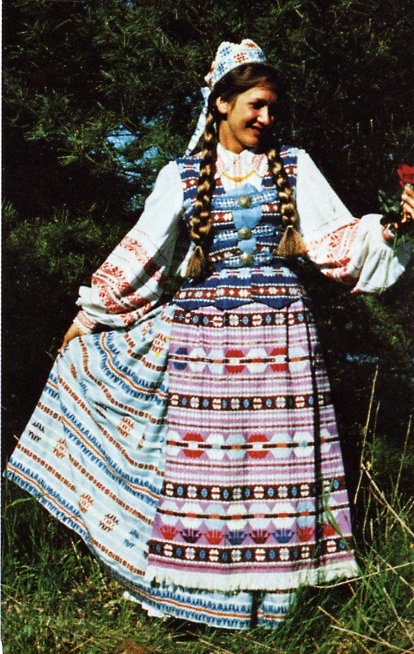
GD: “Šokių Šventė is the International Lithuanian Folk Dance Festival that happens once every four years, and what it is, it’s a folk celebration. So everyone dresses up in their tautiniais drabuziais which is their traditional clothing and does their hair, does their makeup. So everything is made out of wool and linen, the women traditionally wore like long skirts with aprons, obviously not floor-length as you have to go work, shirts with poofy sleeves which often had red embroidery around the wrist and a vest that matches the skirt. There are a lot of patterns in Lithuanian culture, in terms of vest and the skirt, and they would mainly distinguish where you are from.”

Background

D is a 19 year old Lithuanian-American second year student at USC studying Theatre and Classics. Her mother was born in Lithuania and moved to a Lithuanian community in New Jersey, where GD attended Lithuanian school and church. She is excited to attend Šokių Šventė for the very first time as it is being hosted in Philadelphia this year.

Context

This traditional clothing was once everyday wear for people living in Lithuania, but has now been relegated to special wear for high profile cultural events like Šokių Šventė. It is also worn at weddings and other folk celebrations.

Interviewer Analysis

JThe phenomenon of once widespread folk dances being raised up as a symbol of a culture and then relegated only to manufactured displays of “Folk Culture” is a very common occurrence. Dance trends change, especially in our modern and more global times. Taking a cultural snapshot of dance and placing it into a category of folk importance may ensure that the dance lives on, but not that it will continue being the preferred style by the people. This has happened not only with the dances performed at Šokių Šventė, but also the clothing worn to the festival.

German Proverb: Cats in the Night

Background: My friend, ZK, comes from a German family and is bilingual in English and German. I asked her if she knew any German proverbs, and this was her response:

ZK: “Another proverb I know is In der Nacht sind alle Katzen grau, and that translates to ‘in the night all the cats are grey’ which means at night people are no longer individuals because they all look the same.”

Analysis: This proverb is interesting because I think it speaks a lot to a collectivist identity. Similar to the themes of the other proverbs about anti-materiality and delayed gratification, it appears that German proverbs shoot for the long-term goals–in the end, most of what you’re currently doing will be irrelevant, and so constantly having a sense of the big picture appears to be important here, and these proverbs are intended to prevent people from losing focus here.

German Proverb: Bandaid is Sand

Background: My friend, ZK, comes from a German family and is bilingual in English and German. I asked her if she knew any German proverbs, and this was her response:

ZK: “The last proverb I can come up with is Unter dem Pflaster liegt der Strand, which translates to ‘under the bandaid is the sand,’ so like under the hard things there is something better but you can’t get to it.”

Analysis: As is the theme with all of the German proverbs my friend told me about, there’s a highly prevalent degree of delayed gratification here, a prioritization of hard work, sacrifice, and eventual payoff (hopefully). It’s also interesting how most of these proverbs fall under a pessimistic mentality–if the goal is to if not inspire, at least offer wisdom for future generations, that wisdom appears to be coming out of some incredibly jaded mouths. Which, once again, would make sense given Germany’s history.