
The Emperor

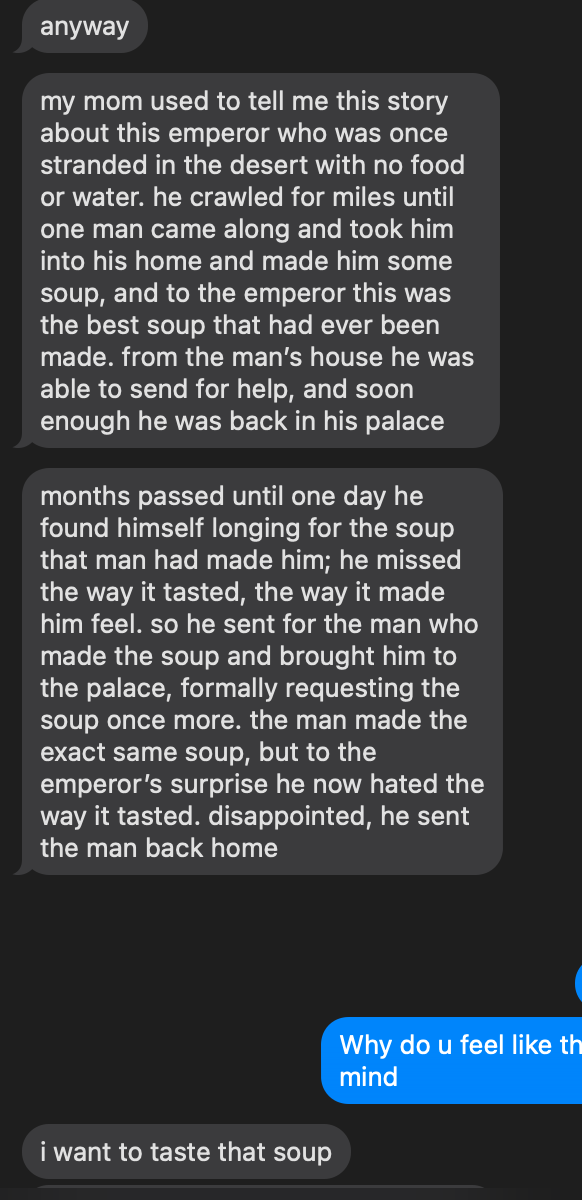
Story: An emperor was once stranded in the desert with no food or water. He crawled for miles until one man came along and took him into his home and made him some soup, and to the emperor this was the best soup that had ever been made. From the man’s house he was able to send for help, and soon enough he was back in his palace. Months passed until one day he found himself longing for the soup that man had made him; he missed the way it tasted, the way it made him feel. so he sent for the man who made the soup and brought him to the palace, formally requesting the soup once more. The man made the exact same soup, but to the emperor’s surprise he now hated the way it tasted. Disappointed, he sent the man back home.

Thoughts: When asked about why the story stuck in his mind so much, the informant said that he “want[s] to taste that soup,” and that it “was a really fun lesson about relativity”. His mother used to tell him the story before bed, and it holds a special place in their heart.

Context: The informant told this to me over text as they were unable to FaceTime for a recording.

Analysis: My thoughts about this legend are complicated. I do not believe it is a real story, but it realistically could be. The metaphor of the story is very intriguing, in the sense that a memory will never be the same as reality. Chasing a memory is to chase a kind of perfection that is not real in our world, since our brains paint the past through rose colored glasses. Trying to attain that same feeling – like the life-saving relief the emperor experiences in the story- is impossible. Because it wasn’t the soup that gave him that feeling, it was the situation.

Lickey Doo

Story: My family on my dad’s side, they have passed down a tradition called lickey doo-n i don’t know how it’s spelled… I don’t know if I’m allowed to tell you or not… You can only learn it Christmas eve by candlelight and you can only learn it from the matriarch of your family because our family is Jewish so we go by the matriarchs are the boss. When my great grandma taught my father how to do it, it was christmas eve, and she was giving him instruction on how to do lickey doo because someone in the family was sick. They wanted to take care of that person…I … I don’t know all the details of how it’s learned because I haven’t had my session yet… I think how it’s done is you need a bowl of water, you need to do a blessing with oil in the water, um, you need to in some way anoint someone with that oil, um, there’s a prayer that you sing, you CLAP! Your hands together(informant claps) you rub them really fast like this (informant rubs hands together) and you pretty much – lay hands (demonstrates) on someone to administer the magic. I’m a chronic migraine sufferer, and when I was a kid my father would do lickey doo on my head to make it feel better!

Context: The context of this interview was in person in a sculpture yard. The informant watched as I made something with my hands, and in return told me their folklore.

Thoughts: When asked why this is significant to her, the informant says that finding magic in the world around them has been really important to them throughout their life. They also appreciate the matriarchal tradition to pass down the ritual. She learned all of this from her dad, who apparently only remembered a good bit of it because a celebrity on TV said it during an interview while he happened to be watching it.

Analysis: Despite this, I could not find anything about lickey doo on the internet. However, I found some ancient mesopotamian hand rubbing magic that echoed the informant’s. They read, “‘Where have you turned to?’—you recite over the oil [and you anoint yourself?]. 4 [The incantation] ‘To loosen [evil muscle]’—you recite three times over the salve….The incantation ‘Head disease, star, like in heaven’—you rub his temples…. The incantation ‘I recite the incantation for the trial of all gods’—you sprinkle water on the sick person”(Barbara). The links between the material usage is apparent, and the text goes on to instruct the spellcaster to rub nearly every part of the ill person’s body. Despite the informant’s Dutch and Jewish roots, I still believe this connection is important and possibly shows influences from other cultures to create this home remedy for illness.

Bibliography:

Barbara B Ö CK, Consejo Superior De Investigaciones Cient … https://digital.csic.es/bitstream/10261/125130/1/Ritual_of_Rubbing_2003.pdf.

Obamaprism

Story: Well it all started rather harmless. A friend, A, introduced us to an instructional video on the different possible obamium shapes. From there we got deeper into the lore, engrossing ourselves into online communities such as Reddit to find like minded believers. I even went so far as to create my own media, using vfx to bring obamaprism to life in Los Angeles. A created a shrine in his living room one day consisting of a table with a candle in each of the corners and a triangle create by laying out approximately 8 paper obamaprisms out and a large image of Obamamium printed in a piece of paper hung over the shrine. We would play the sacralicious music and pray to our shrine. It’s all mostly still available on YouTube but I’ve since moved to worshipping the geico gecko.

Context: I was told this story over text, as the informant has COVID and was unable to meet in person, and also did not want to call or FaceTime. A little bit about this particular informant – while I knew these were great examples of folklore, which is why I included them, I do not believe they took the topic seriously. As a result, they told the stories in a very theatrical way, which might not be a terrible thing in the context of folklore, however it may make it hard to understand.

Thoughts: When asked about why this stuck in his head, the informant says that it was the best times he had goofing around with the friend group. His friend, A, ended up leaving after the semester that this happened, and he hasn’t seen him since.

Analysis: My interpretation of the story is that these friends got comically into the Obamamium meme, which was a meme that started on Reddit and ended up showing up on many other platforms. It was basically just a picture of Obama’s face on a pyramid and people called it Obamamium. I am also into memes, and hearing the story made me much more fascinated by meme folklore and how things escalate in folk groups.

Playground Game

Story: There was this one game- I used to go with my parents to these health and biotech conventions and at one of them I got this comic book that was like.. Basically to explain this biological process where these cells attacked and shot at cancerous tumors. After I read that I went back home and told my friends at school about it. On the playground we would pretend to be parts of the immune system and we would have battles. One of the roles was commander of the immune system, who would call other cells to attack a bacterium (another kid). All of the cells would then chase the bacterium down and, like, make sure that they couldn’t further infect the body (by tagging them).

Context: I was told this story by the informant in person, and recorded them so that I could better transcribe later on.

Thoughts: The informant talks about it as one of the first times where they and their friends used creativity to actually build something. “There were like 10 kids playing this game that was a cool melding of education and play, and it made me wanna learn more”.

Analysis: I thought this game was really cute, and an interesting example of folklore. Starting with a from of media that is in fact written down, and transferring it to a playground game that constantly evolves, shifts, and allows for new players and ideas is a great concept. Especially one so complex as this, with the amount of actually relevant information. Overall, a great way to learn and a very creative idea!

Tiger and the Fox

Story: This story is about a uh… a fox who happens to stumble upon a tiger. The tiger caught the fox, and before the tiger could eat him, the fox lies and tells the tiger to wait, because he is sent to the earth as the king of animals. Well, the tiger doesn’t believe him until he saw that the fox isn’t scared, so he asks the fox to prove it. So the fox… Um. Oh, yeh the fox takes him for a walk and tells the tiger to walk behind him since everyone that saw him would be scared. So every animal they saw runs away in fear, obviously because of the tiger, but the tiger doesn’t even know that. According to the tiger all the animals are scared of the fox(raises hands slightly, fingers outstretched)! He realizes the fox must be right, and runs away as well. That’s it.

Context: I took this interview in person and recorded it so I could transcribe it later.

Thoughts: When asked about how this story was significant to them, they tell about how this was told to them by their mother when they were a child as a bedtime story. They didn’t completely understand what time meant back then, other than “foxes are scary”, but now they think of it differently. The informant feels that now, after reflecting on the story, they realize how it is not only a lesson about being clever, it is a lesson about confidence.

Analysis: I also agree that it is a lesson about confidence. It is a lesson on tactful confidence and manipulation, to get out of a dire situation. The lesson in this tale is clear: you don’t have to be the strongest person in the room if you are the smartest. This can apply to a lot of situations in my adult life, and I’m sure for everyone else’s too.