
Category Archives: Folk Beliefs

How many…

Nationality: Canadian
Age: 22
Occupation: Film Student (Sound, Producing)
Residence: Los Angeles
Performance Date: 4/13/12
Primary Language: English

Informant Bio/Context

The following series of jokes was told on the set of a USC student music video. My informant was helping out as a grip (crew member who works setting up lights and moving equipment).  She is currently a film student at USC and often works in the sound department, but like most USC film students she has held positions in other departments as well.

Jokes

How many actors does it take to change a lightbulb? One – they change it and the world revolves around them.
How many writers does it take to change a lightbulb? Do we have to change it?
How many producers does it take to change a lightbulb? Does it have to be a lightbulb?
How many electrics does it take to change a lightbulb? It’s not a lightbulb, it’s a “globe.”

Analysis

This series of jokes is best heard all together as my informant told them because it makes clear the comparison between the departments. My informant liked them because she herself has functioned in each of the roles mentioned above on a film set, and has noticed that her perspective on a particular task or issue does change with each job.

The joke plays on stereotypes of each role, but also simply their function as part of the collaborative process of making the film. Actors are viewed as vain and egotistical, however it is also true that all of the work done on a film set “revolves around” them, as its their actions that drive the movie. Writers are portrayed as those whose visions are trampled on by the changes asked of them by directors and producers, but they are also here seen to be defensive of the integrity of their work. The implication about producers here is that they will always look for an easier, and more cost effective solution than what it written, and it always shows them to be people who think outside the box. Electrics (film crew in charge of all electrical equipment on a set, including lighting) are portrayed here to have a specific way of viewing their equipment, and special terms for it, that differs from most others’ perception. The joke says that electrics are an exclusive group on-set, welcoming only to those who understand their methods, equipment, and terminology.

My informant felt that these implications about each department, both positive and negative, were accurate. Because of her experiences in these departments she enjoyed that the jokes clearly separate each department from one another, showing that no one on a film set is going to look at something the same way as anyone else will, because every department is in charge of considering different things. With actors its the performance, writers the story, producers the money, and electrics the gear.

I think the jokes also show that each department views their interpretation of the object as the one that makes the most sense and is most important to the making of the film. The humor in the joke comes from this separation of points of view.

Nightmare

Nationality: Caucasian American
Age: 31
Occupation: Office Technician and Administrator
Residence: Los Angeles
Performance Date: 4/24/12
Primary Language: English

Informant Bio

My informant is an office manager living in Hollywood, California. He grew up in the midwestern United States and moved to Los Angeles to attend USC’s graduate program in film production. He now does media work in an office at USC, and in his spare time stays active with creative endeavors like creating web videos and writing a web comic that updates twice weekly. He completes the daily crossword puzzle at lunch every day, and is the type of person who probably always wins Trivial Pursuit.

The Cauchemar

I was chatting with my informant (my boss) at our office – near the water cooler, yes,  it actually happens – and he told me a strange story about his roommate who had recently attempted astral projection (magical transportation of her consciousness to another place) by putting herself into a meditative state. Though her attempt was not successful, she did descend deep enough into her meditation that she had a dreamlike vision of a small, humanoid creature sitting in darkness. She asked it, “what are you doing?” It replied, “waiting.” Frightened by the image, she quickly snapped herself out of her meditative state.

My boss thought the creature sounded like a cauchemar. The cauchemar, he explained, is a demon-like creature whose name means “nightmare” in French. He had first learned of it from a friend who lived in Louisiana, though he suspected stories about the creature had been brought to Louisiana by the French because the myth “seems European.”

According to my informant, the cauchemar is an evil creature, that chooses its victims at random. It sits on your chest while you sleep and either: rides your sleeping body where ever it likes, or sucks the breath out of you, killing you slowly while you sleep. My informant thought that the cauchemar sounded like an explanation someone might have given for conditions that cause sleepers to wake in the middle of the night feeling pressure on their bodies, like sleep apnea.

Because the cauchemar does not discriminate when it chooses a victim, it seems to me to be a simple personification of nightmares. Its impossible to control whether or not one will have a nightmare, and that lack of control, especially while vulnerable (unconscious), is frightening. Giving them a face makes nightmares easier or us to understand, and even if depicted as a hideous, malicious creature, this is comforting.

Authored Forms

This painting of the creature from the 1700s  by Swiss painter Johann Heinrich Fussili supports my informant’s suspicion that the mythological creature may have been brought to the United States from Europe. It depicts an impish creature with large ears and fur covering its body, sitting on the chest of a woman in white. In spite of its comical appearance, the distressed pose of the sleeping woman, and the alarmed face of her horse suggest that this is indeed a creature to be feared.

Cited

Image found at: “Cauchemar.” Wikipedia. Wikimedia Foundation, Inc., 4 Mar. 2012. Web. 24 Apr. 2012. <http://fr.wikipedia.org/wiki/Cauchemar>.

Assistant Directors Make No Friends

Nationality: Canadian
Age: 21
Occupation: Film Student (Sound technician, producer)
Residence: Los Angeles
Performance Date: 4/13/12
Primary Language: English

Informant Bio and Context

The following joke was told on the set of a USC student music video. My informant was a grip (crew member working in the lighting department) who told the joke to the assistant director (or AD: production manager who keeps track of time) of the set. My informant is currently a film student at USC and often works in the sound department, but who like most USC film students has held positions in other departments as well. She has also worked as an assistant director and producer, for instance. On this set my informant knew the assistant director from classes and by reputation, and likely felt that the joke would amuse the AD who works as an assistant director almost exclusively.

Transcript

Hey, so why are ADs bad in bed? Because they think two minutes is a really long time.

Analysis and Background:

Understanding of an assistant director’s job sheds light on the reason for this malicious sounding joke.

In the United States, the assistant director (AD) belongs to a film’s “production” department, meaning that they work for the director and producers in a non-creative capacity. Their job is to “run the set” so that the crew is able to capture every shot planned for that day. The AD is responsible for scheduling the order of the shots taken that day for maximum efficiency, communicating with every department so that they know what they need to prepare for as the day moves along, and keeping track of the time. This can mean that the assistant director needs to make decisions that place higher priority on one department’s work over another. For example, if the crew is running thirty minutes behind schedule, the AD may need to talk to the director about cutting a shot, or to the art department about spending less time dressing a part of the set, or to the director of photography about making the lighting on the actress’ face a little less perfect than he wants. Anything to save time. Because assistant directors serve the big picture, they are often viewed as the enemy of the individual departments.

This joke belittles the sexual prowess of the assistant director by using the AD’s primary function as the set’s time-keeper against him. The intention of this is clear – while the joke itself does not undermine the authority of the assistant director on the set, it separates him from the rest of the crew, and depicts him as being the same as, even less than, everyone else in other aspects of his life. The joke tells the crew that while the AD’s watch has power on the set, off of it, it would make him look like a fool.

My subject felt that the joke was humorous simply because it is, in her words, “accurate.” Assistant directors are always keeping track of the time, but off-set in many situations this trait is often inappropriate. In this way the joke also comments on another aspect of life within in the film industry, which is the necessary separation of one’s life in film production, from their home life or social life. The long, fast-paced, stress-heavy hours of film production work are often compared to being at war. One’s mental, emotional – and as this joke implies, sexual – health can only be maintained by a clear separation between life on the set, and life off of it.

Notice too that the joke seems to imply that the assistant director is a man. (Jokes revolving around the premise of climaxing too quickly during a sexual act are typically aimed at men.) This assumption within the joke is not entirely inaccurate as the majority of crew positions in the film industry have historically be held by men. In this particular case the joke was told to a female assistant director, who laughed in spite of her position.

Hiccups Cure – Sugar Under the Tongue

Nationality: Chinese
Age: 53
Occupation: CEO of an electronics company
Residence: Newport Beach, CA
Performance Date: April 8, 2012
Primary Language: Chinese
Language: English, Vietnamese, Cantonese

“If you ever have the hiccups, just put some sugar under your tongue to get rid of them.”

My informant told me this one day when I had a severe cases of the hiccups.  I was just telling him that I had tried many other folk remedies (holding my breath, gulping water, etc.) but none of them worked.  He then told me that one of his friends at work had told him that putting sugar under the tongue can eliminate hiccups.  He also told me that he had tried it before, and it really worked for him.  So, I proceeded to put sugar under my tongue, and sure enough, all my hiccups went away.

I think this remedy probably originated from somebody who was experimenting methods to get rid of hiccups.  While this method works for me, I am still somewhat skeptical if the act of putting sugar under your tongue really is a cure for hiccups.  Part of me believes that this whole thing is probably just a placebo effect.  My informant told me that he also believes that it is a placebo effect.  Despite this, he still tells other people about this cure when they have the hiccups

擲筊 – Fortunetelling Blocks

Nationality: Taiwanese
Age: 43
Occupation: President of an electronics company
Residence: Newport Beach, CA
Performance Date: April 14, 2012
Primary Language: Chinese
Language: English, Taiwanese

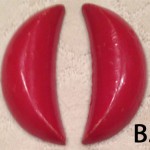
擲筊 (Bwa Bwei) Blocks and the Different Responses擲筊 (Bwa Bwei) is an ancient from of fortune telling. My informant, a Buddhist, uses these wooden blocks as a way to ask Buddha questions. Bwa Bwei comes in the form of two curved red blocks; one side of the block is flat and the other is round. The blocks are thrown onto the ground and the way they land represent different answers. In figure A, one lands on the flat side and the other lands on its round side. This represents a "yes" answer. Both figures B and C represent "no" answers, but have different meanings. For figure B, Buddha is angry at the question being asked. For figure C, Buddha is laughing at the question. The blocks have to be thrown three times and get the same answer all three times in order to be a confirmed answer.

My informant told me about this ritual when we were visiting a Hsi Lai Temple, a Buddhist worshiping center.  She told me she had learned this from a monk when she was little girl attending Temple.  She uses this method to answer a lot of personal and financial question.  An example of questions that she was ask are “Will this business deal be good for the company?” and “Will my daughter get into college?”  I asked her if she truly believed that Bwa Bweis revealed the best answers and possibly, the future.  My informant replied that for her, they have never been wrong.

I think that this form of fortune telling is a way to emphasize and support the idea of destiny.  Since the questions asked tend to be ones that reveal what will happen in the future, the answers seem to suggest that the future is set in stone and is just waiting to happen.  At the same time, I also view this practice as a stress reliever of sorts since the questions are usually associated with stress-inducing topics.  By getting an answer, the person no longer has to really worry anymore since the result is inevitable.