
Category Archives: Folk speech

The Emperor

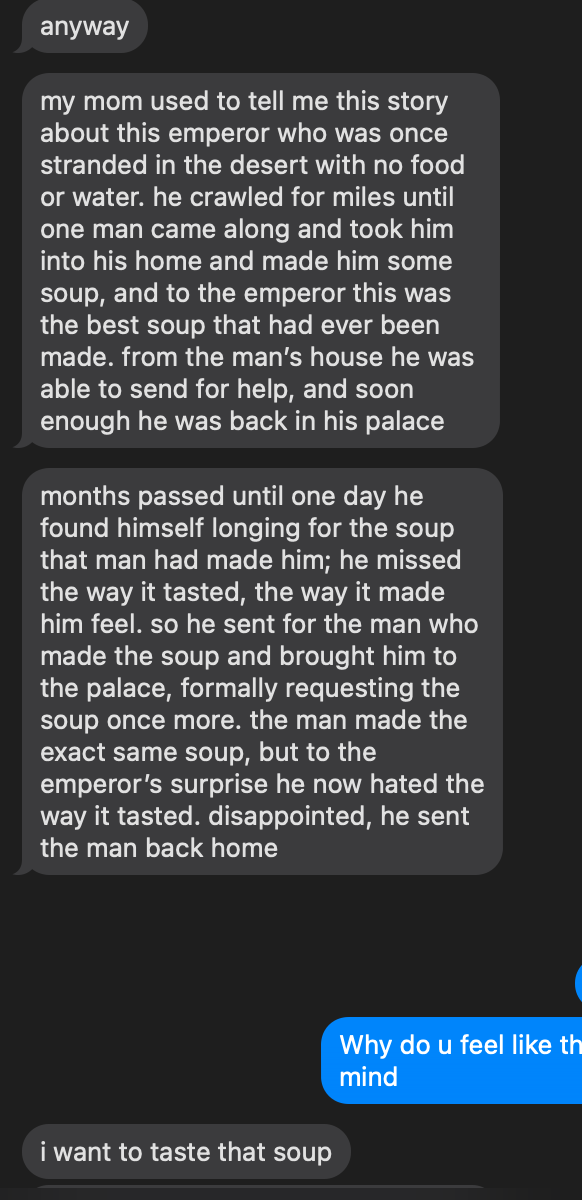
Story: An emperor was once stranded in the desert with no food or water. He crawled for miles until one man came along and took him into his home and made him some soup, and to the emperor this was the best soup that had ever been made. From the man’s house he was able to send for help, and soon enough he was back in his palace. Months passed until one day he found himself longing for the soup that man had made him; he missed the way it tasted, the way it made him feel. so he sent for the man who made the soup and brought him to the palace, formally requesting the soup once more. The man made the exact same soup, but to the emperor’s surprise he now hated the way it tasted. Disappointed, he sent the man back home.

Thoughts: When asked about why the story stuck in his mind so much, the informant said that he “want[s] to taste that soup,” and that it “was a really fun lesson about relativity”. His mother used to tell him the story before bed, and it holds a special place in their heart.

Context: The informant told this to me over text as they were unable to FaceTime for a recording.

Analysis: My thoughts about this legend are complicated. I do not believe it is a real story, but it realistically could be. The metaphor of the story is very intriguing, in the sense that a memory will never be the same as reality. Chasing a memory is to chase a kind of perfection that is not real in our world, since our brains paint the past through rose colored glasses. Trying to attain that same feeling – like the life-saving relief the emperor experiences in the story- is impossible. Because it wasn’t the soup that gave him that feeling, it was the situation.

The Nail that Sticks Out Shall Be Hammered Down

Original Script: 出る釘は打たれる

Romanization: Delu kugi wa u-ita relu

Transliteration: To be out the nail hit is to be.

Translation: The nail that sticks out shall be hammered down.

Genre: Japanese proverb. 

Context: My maternal grandmother told me this proverb over the phone the summer before I started college, as I had complained to her that I had been bullied throughout high school. This was true– I had grown up in an environment whose values differed significantly from my own, and as such, I always felt ‘persecuted’ in a way, as I did not mesh well with my classmates. This was her way of giving me advice to make college a little bit easier. 

Analysis: At first, I disregarded this as some sort of victim blaming, as my maternal grandmother did have a way of making all calamities the fault of the victim. I realized later on that this was her way of maintaining agency over a dark, cruel world and the thought that misfortune randomly befell undeserving individuals was too much to bear. Regardless, I knew that this was common in Japan, and I just filed it away as a ‘cultural difference’ without realizing how miserable it made me in school. I was already different enough – being Asian, an immigrant, and so forth – that broadly claiming my opinion that I knew would be at odds with those of my peers would understandably result in bullying. I didn’t compromise my values, but I was being unique just for the sake of visibility.. I knew I was right (according to my own belief system), but I was choosing to make a POINT of being right. I was making my own nail stick out as far as possible, and then was wondering why I was hammered down!

“Step on a Crack…”

Background information: My brother is currently a sophomore in high school. He recalled some sayings and games he remembers playing when he was younger.

Brother: I think this is a, like, just a folklore saying? Or kinda a game. But we used to say “Step on a crack, break your back, step on a line, break your spine.” Something like that. So you can’t step on any cracks in the sidewalk or step on any of the lines on the sidewalk or on the roads either. Otherwise something bad might happen to you.

Me: How did you hear about this? Do you believe it yourself?

Brother: It’s just a kid thing that I remember hearing with my friends when we would walk around after school or during recess. It’s a saying and a kinda superstitious thing but then it can also become a game if you actually try not to step on anything. I think I probably took it seriously at one point, but not anymore.

This saying was interesting to me because I remember it differently in my own childhood, and many of my friend do too. I remember it as “Step on a crack, break your mama’s back.” However, my brother and I do have a somewhat large age gap between us, and maybe in that time the saying slowly changed, as many playground games do. I think this is something that a lot of children take seriously when they’re young, because of the threat of something bad occurring, and not only something bad, but something very specific. For another version of this saying, see https://journeys.dartmouth.edu/folklorearchive/spring-2020/southern-superstitions/step-on-a-crack-break-your-mommas-back/.

The Hole in One

Nationality: American
Age: 74
Occupation: Retired
Residence: North Carolina
Performance Date: 4/29/22
Primary Language: English

Context: The subject of the interview is an older man who grew up in southern California 

Text:

“When I was in high school at some point, I turned to my dad one morning and asked “hey dad is there something you could teach me to cook”. He said that he doesn’t cook much but he could teach me how to cook a hole in one. And I said no I didn’t say anything about golf, I said cook. He said I know, it’s called a hole in one. I asked, what’s that? So he said he’d teach me. He said get that piece of bread and butter it up on both sides. He said now take a little knife and make a circle in the bread. And so you’re cutting around the circle in the bread. Now take that little circle out of the bread. Now go over and put a pan on the burner and turn the burner on and put the piece of bread in the pan. It will start to cook. So what’s next? So now get an egg out and crack the egg into the hole. When you crack the egg and the egg starts to come out the shell, make sure it goes in the hole. All of a sudden it starts to cook and within about five minutes it starts to look done. Now take a spatula and you’re done. And finally, as my dad would say, yokes on you”. 

Analysis: 

This piece of folklore is an example of folklore that is passed down through culinary activities. This genre of folklore in particular is greatly rooted in cultural and familial practices. It is usually in a familial setting that someone would be cooking, and food usually has ties to a greater culture. 

Oh Shame

Nationality: South African
Age: 20
Occupation: Student
Residence: Los Angeles
Performance Date: May 29, 2022
Primary Language: English

Context: A is a sophomore in university. He grew up in South Africa in a christian family and community. He speaks a mix of Afrikaans and English with his family when he is home.

A: “This is also something said in my extended family.”Foeitog siestog arme kind, môre voel jy beter.” It means like kinda like ‘oh shame’ it means that you feel bad for someone and ‘tomorrow you will feel better’. It’s like a joking semi-aggressive thing if someone is complaining. For minor inconveniences. My grandma would say this to me when I was annoyed. This was spread between my extended family and family friends.”

Reflection: This is a great example of quips and sayings that families will often use among themselves. That is not to say that these sayings are unique to the family, but they are often inherited and spread amongst the family.