
Tag Archives: Buddhism

The Kitchen God and Chuang Mu

Nationality: Taiwanese
Age: 17
Occupation: Student
Residence: California
Performance Date: March 21, 2013
Primary Language: Chinese
Language: English

This story was told during the daytime at a friend’s home. Sitting in front of the shrine her family keeps to honor the ancestors and the deities of Buddhism, it was told in order to explain the reasoning behind some of the rituals done on specific Buddhist holidays. She learned about these beliefs from her parents, who are strong Buddhists, and they are part of her self-identification. To her, they are fully real and are the reasons why luck and fortune come and go out of people’s lives. They are also why she believes that honoring the dead and the deities are so important and can never be neglected without severe consequences. Having lived this way her entire life, it also means her way of living to her as well.

The Kitchen God and Chuang Mu are said to keep you safe from evil spirits and misfortune. As deities of the house and home, they take care of the inhabitants if they are respected. As his name implies, the Kitchen God’s domain is the kitchen, but kitchen is very important in meaning to a house. Chuang Mu means the Mother of Beds, and she is the spirit that sits on beds and watches over you to make sure bad dreams and misfortune stays away. Their protection, however, is only bestowed if they are pleased with you and your family. If you anger them through disrespect or neglect, then they will withdraw their protection from your household. As a result, in order to show that you are respecting them and that you have not forgotten about them, you have to burn incense and give offering to the Kitchen God and Chuang Mu every few months.

This piece of folklore shows how much religion is a part of daily life, which is remarkable. It emphasizes respect for the dead and for the gods which is definitively part of Asian culture. It also shows how real religion can be to individuals and how deeply it can be associated with someone’s identity.
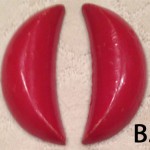
 

擲筊 – Fortunetelling Blocks

Nationality: Taiwanese
Age: 43
Occupation: President of an electronics company
Residence: Newport Beach, CA
Performance Date: April 14, 2012
Primary Language: Chinese
Language: English, Taiwanese

擲筊 (Bwa Bwei) Blocks and the Different Responses擲筊 (Bwa Bwei) is an ancient from of fortune telling. My informant, a Buddhist, uses these wooden blocks as a way to ask Buddha questions. Bwa Bwei comes in the form of two curved red blocks; one side of the block is flat and the other is round. The blocks are thrown onto the ground and the way they land represent different answers. In figure A, one lands on the flat side and the other lands on its round side. This represents a "yes" answer. Both figures B and C represent "no" answers, but have different meanings. For figure B, Buddha is angry at the question being asked. For figure C, Buddha is laughing at the question. The blocks have to be thrown three times and get the same answer all three times in order to be a confirmed answer.

My informant told me about this ritual when we were visiting a Hsi Lai Temple, a Buddhist worshiping center.  She told me she had learned this from a monk when she was little girl attending Temple.  She uses this method to answer a lot of personal and financial question.  An example of questions that she was ask are “Will this business deal be good for the company?” and “Will my daughter get into college?”  I asked her if she truly believed that Bwa Bweis revealed the best answers and possibly, the future.  My informant replied that for her, they have never been wrong.

I think that this form of fortune telling is a way to emphasize and support the idea of destiny.  Since the questions asked tend to be ones that reveal what will happen in the future, the answers seem to suggest that the future is set in stone and is just waiting to happen.  At the same time, I also view this practice as a stress reliever of sorts since the questions are usually associated with stress-inducing topics.  By getting an answer, the person no longer has to really worry anymore since the result is inevitable.

Buddhist Proverb- “All lust is grief”

Nationality: American
Age: 20
Occupation: Student
Residence: New York City
Performance Date: 3/14/12
Primary Language: English

This is a Buddhist proverb and my informant doesn’t remember where he heard it. It means all lust leads to sorrow. My informant likes it because it reminds us that our spiritual well-being is often more important to our happiness than our physical world; he takes lust to mean want in general rather than only sexual want. Buddhism says that attachment is what leads to suffering, so detaching oneself from desires in the physical world will lead one away from suffering.

Humans are often said to feel a sadness after an orgasm, perhaps because it is a let down; the ecstasy is just suddenly gone. The French call it le petite mort, meaning little death. In this way, lust does directly lead to grief. On a larger scale, though, all sexual and romantic attachment usually leads to grief due to human drama and the breaking apart of relationships. And on a scale larger than that, all human wants, which the word lust could be used to represent, lead to grief because having our desires in the physical world fulfilled doesn’t bring us lasting happiness. We get what we want and then that’s it; there will be a void again afterwards. Beyond that, everything is ephemeral, so it may not even be important that we got what we wanted, be it reaching a goal or acquiring a physical object. Buddhism recognizes this and communicates it via this concise proverb.

Thai folk belief: Butterflies carry souls

Nationality: Thai-American
Age: 18
Occupation: Student (Fine Arts)
Residence: Northridge, CA
Performance Date: April 2012
Primary Language: English
Language: Thai

My informant had a personal experience with this folk belief while attending her grandmother’s funeral in Thailand. She and the other funeral-goers were kneeling in prayer in front of the Buddhist temple where the funeral was being held, when she noticed a black butterfly fly over her grandmother’s coffin as the monks chanted a sutra to help the soul pass on.

When my informant mentioned the butterfly to an aunt afterwards, the aunt told her that butterflies are containers for souls, and that they carry souls away. The timing of the butterfly’s flight, as well as the fact that she’d never seen a butterfly in Thailand before, convinced my informant of the validity of this folk belief.

My informant suggested that it may be comforting to someone mourning a death to equate their loved one, and maybe death itself, with a butterfly, which is almost universally considered to be beautiful and graceful.

The main religion in Thailand is Buddhism, which rejects the idea of an unchanging self or soul, and so the soul’s flight in the butterfly could be considered the luminal stage between death in one body and reincarnation in the next. Also, while human/alive, we can’t fly—it could be exciting to think that in death, we are able to rise beyond the limitations of our past human bodies.

Thai custom: First menstruation

Nationality: Thai-American
Age: 18
Occupation: Student (Fine Arts)
Residence: Northridge, CA
Performance Date: April 2012
Primary Language: English
Language: Thai

The first time my informant got her period, her mother told her to go to the stairs, hold her breath, and walk down the number of steps she wanted her period to last for. For example, my informant decided that she wanted her periods from then on to last for three days, so she went down three steps while holding her breath. According to my informant, it worked for her; her periods now last three days.

I asked her why she didn’t just go down one step, and she said, “because it wouldn’t be possible, biologically, so to keep the legend true, you have to go down at least three or four.” This response suggests that there’s an element of conscious self-delusion for every girl who performs this custom, and that the belief is important more for its own sake than for the fact that it works.

My informant proposed that going down the stairs represents that the performer is taking the steps to becoming a woman. The girl holds her breath because Buddhism (the main religion of Thailand) encourages believers to endure suffering. Not breathing also symbolizes the pain of menstruation.

I agree with her assessment. A girl’s first menstruation is, biologically, the marker of her transformation from girl to woman. Taking physical steps represents that she is crossing that threshold.

Annotation: This folk custom appears in the 2001 Thai movie The Legend of Suriyothai. http://www.imdb.com/title/tt0290879/