
Tag Archives: food

Day of the Dead Ritual

Nationality: American, Pakistani
Age: 17
Occupation: Student
Residence: 11048 Washington Blvd Apt 306
Performance Date: 04/26/2020
Primary Language: English
Language: Urdu

Context: The following is an account from the informant, my younger sister. She told me this from one of her conversations with a friend at school.

Background: The informant was relating to the annual Day of the Dead rituals her Mexican friend and her family performed. Although they didn’t necessarily believe in everything, such as the dead actually eating food, they still performed the ritual without fail.

Main piece: 

Friend: Every year on Día de Muertos, my family makes pan de muerto, which is just normal bread with decorations like bones on it. We always make a lot of it, and although we eat most of it, we always leave some for my grandmother also.

Informant: Did she –

Friend: Yeah, she’s dead. So we usually just leave it out overnight along with the things that she liked.

Informant: Like what?

Friend: Oh… things like some stuff she knitted, I guess? That’s all I really remember right now.

Informant: What do you do with the bread the next day?

Friend: We just throw it out. But we eat the rest of it ourselves though. I don’t think my parents really believe in the whole thing, but we always leave it out anyways.

Analysis: Looking at how the friend describes pan de muerto as “normal” bread, I’m led to believe she may be from Oaxaca as it seems that fits the description for the area. It’s interesting to see that she and her family appear to be participating in this festival perhaps due to a mix of social festivities and nostalgia rather than due to actual belief that it is the Day of the Dead.
Dayenu, a Passover song

Nationality: American but Persian
Age: 19
Occupation: student
Residence: Beverly Hills
Performance Date: April 26, 2020
Primary Language: English

The following is transcribed from text exchanges between my informant, A, and myself, M.

Main piece:

A: On passover, there’s this tradition that Persian Jews have, and somehow only us. There’s this song called Dayenu that you sing as part of the Passover seder, which is like what we call the food and tradition we do.

A: Passover is about Jews being slaves in Egypt and Passover is specifically about when the Jews were freed, and that’s basically the whole thing. But this song is part of it, and its about thanking God for each specific thing He did in the story. And for Persian Jews, while we sing the song we hit each other with green onions because they symbolize the whips from slavemasters. We get pretty agressive, and it looks really stupid.

M: Why just Persians?

A: I don’t know how it started or why it never made it to any other ethnic Jewish group. I didn’t even know it was a Persian thing until like late into my life, so when I talked about it with my white friends, they thought I was insane.

She later texted me that her parents told her Italian Jews do it as well.

Background: My friend is Persian Jewish from Beverly Hills. Judaism has played a large role in her life, having gone to Jewish high school and been an active participant in the community since birth.

Context: She and I were texting casually, and I asked if I could collect from her.

Thoughts:

Food is a way of communicating, and from what I have learned about the Passover ritual is that it is a very active one, almost like a play. Also that food is heavily involved. I am left curious as to why Persians specifically do this part.

The Feast of the Seven Fishes (Italian)

Nationality: Italian-American
Age: 54
Occupation: entrepreneur
Residence: Los Angeles
Performance Date: April 27 2020
Primary Language: English

The following was told to me by my informant.

Main piece:

“It’s called the feast of the seven fishes, it is an Italian tradition. A lot of my friends do it too, but there’s a lot of variations depending on what region you are from. Every Christmas Eve, we did this and it was led by my grandparents at their house in Pittsburgh. Basically, it’s a big fish feast, and you had to have 7 kinds of fishes. Usually there were mainstays, like calamari, bakala…it could switch around a bit, but there were always seven fish. We always made a special fried bread with mashed potatoes in it that we called rispelli. Then, the tradition came to our house, and I was more involved then, going to the fish market and helping cook starting in the morning. The entire family helped out, and we would have fun, and drink wine, then enjoy the dinner feast. Nobody’s sure what it symbolizes– Seven sacraments maybe? It’s an important number in the Bible. My dad’s family did it when he was little too. It felt special because we only ate that food at Christmas Eve, and when we were kids, we didn’t really like it. But by the time you grow up, you really like it and enjoy the food.”

Context: This was told to me when my informant came over to my house.

Background: My informant is Italian-American from the East Coast. She is from a big, close extended family who enjoys their Italian heritage. Her grandparents were immigrants from Calabria.

Thoughts:
I participate in this every year, too. I love this tradition, and I find it very true that the food really does not taste good but because you associate it with happy memories you learn to love it.

Not Eating the Last Bit: An American Superstition

Nationality: American
Age: 61
Occupation: Dog Trainer
Residence: San Diego, CA
Performance Date: 4/24/20
Primary Language: English

Background: The informant is my mother, who is a third generation Irish immigrant from Bridgeport, CT. She learned the superstition from her mother and has vehemently abided by it ever since. 

Context: The following piece was collected in a casual, in-person interview at the informant’s home in San Diego, CA. 

Piece: 

Informant: “I can’t eat or drink the last bit or piece of anything.”

Collector: “Why?”

Informant: “Because then I will become an old maid.”

Collector: “I don’t know why that’s just the way it is you know that’s what my mother taught me.”

Analysis: I grew up hearing my mother refuse the last drop of wine or last piece of food at nearly every meal. I believe that it is entrenched in American gender roles and concepts of femininity from the mid 20th century. The words “old maid” imply that the practice is gendered, although it is worth noting I have witnessed my uncle practice this superstition. I interpret the piece as perpetuating the idea that women should be selfless and thus offer the last of their food to others and not consume it themselves. Throughout my life, I questioned my mother’s practice and particularly what was implied by the words “old maid.” Continuously, my mother interpreted becoming an “old maid” as dying old and alone. This is particularly dire to her as she grew up in 1960s America, a time in which a woman’s self-worth was still largely tied to her relationship status and the wealth of her husband. Although this concept has been largely contested in American culture today, my mother and her mother who value family and marriage considered being old and alone a fate worse than death, the ultimate symbol of being unwanted and unloved. By controlling the tangible, they attempt to control and quell these fears.

Ebleskivers

Nationality: American
Age: 19
Performance Date: April 2
Primary Language: English

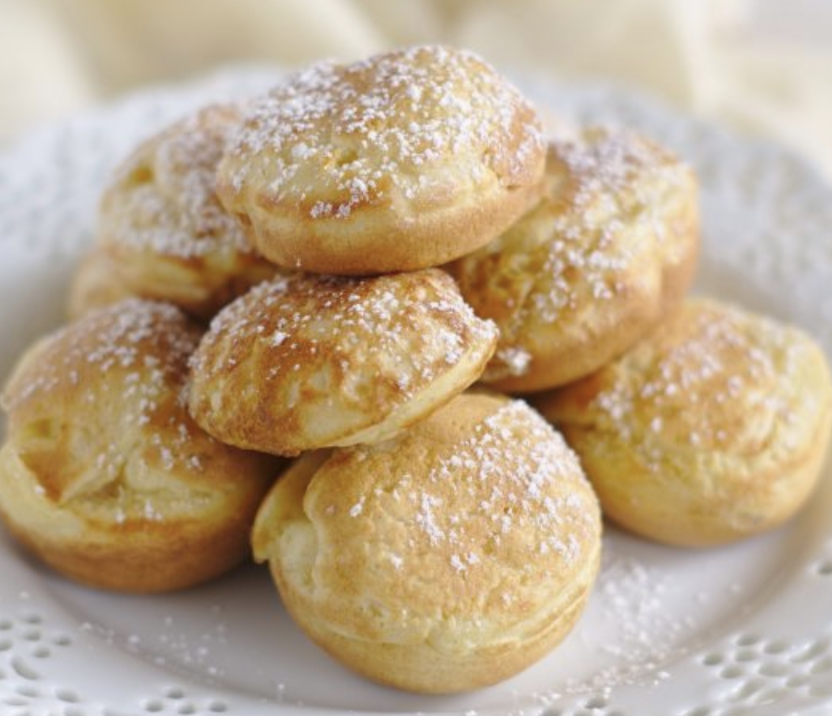
Ebleskivers are a folk object and food that originates from Denmark. They are very similar to pancakes and are a breakfast item. They are spherical and cooked with another folk object, an ebleskiver pan. This is a cast iron pan with round holes in it to cook the batter. This pan is used exclusively for this food, so it is a very important folk object to food culture in Denmark. They are typically served with jam or other breakfast condiments, but the informant eats them with butter and powdered sugar. There is yet another folk object used, which is a porcelain bowl filled with butter placed in a rack over a candle. It is similar to an object used to melt butter for shellfish like crab and lobster.

            The informant learned this practice from her mother. The initial recipe goes back to the informant’s great, great grandparents and she still uses the same pan passed down by the family members. The great great grandmother is from Aabenraa, Denmark. The informant only has it with family members and the combination of butter and powdered sugar seems to be a family-specific thing.

            Upon further research, it seems that this food is rarely prepared by restaurants. Instead, it is typically only made in family gatherings and by street vendors in Denmark. Because of this, it seems to me that the food is more authentic and less likely to have a standardized recipe and in doing so, is not found in much-authored literature. The folk objects only add to the culture and lore around it as these are food-specific, something not often found in many cuisines.