Tag Archives: Hand Gesture

Telephone Gesture

Nationality: American
Age: 19
Occupation: college student
Residence: USC
Performance Date: 2/23/2023
Primary Language: English

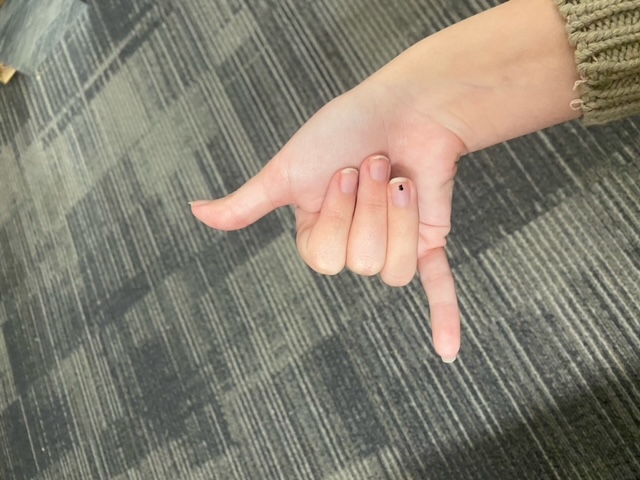
M is a 19 year old college student. She shares a gesture that she learned from her mother in Colorado Springs when she was a toddler playing pretend.

“When you mention you’re calling someone, you put your pinky out as the receptor and the thumb as the transmitter to motion you’re calling someone. When playing with my mom I’d pretend to be calling someone and my mom would answer with her “phone” that was actually her hand.” 

This gesture is particularly interesting because it is rapidly fading out. Now, if you ask a toddler or a child to show you them making a phone call, they’ll put their whole hand flat to their ear, replicating a cell phone. The informant and I are nearly the last generation to learn the gesture of a telephone using our fingers. The gesture is terminus post quem the invention of the dial telephone, and terminus ante quem the generation raised with cell phones. This shows how rapidly folklore changes, and how easy it is to lose folklore. My generation will be the last ones to use the finger gesture, and eventually it will entirely die out when kids barely remember what old phones used to look like. As technology rapidly changes, folklore is changing at an even faster rate than ever before. We have no clue what folklore might look like for children in 20 years. It will be interesting to see what folklore says, and which is phased out. 

L.A. Hand Sign

Nationality: American
Age: 19
Occupation: Student
Residence: San Diego, California, United States
Performance Date: 2-23-2023
Primary Language: English

Text:

Context:

The informant learned this at a summer camp in San Diego from some girls from Los Angelos (L.A.).

Analysis:

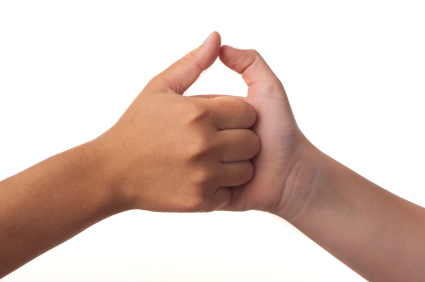
The gesture is representative of an “L” and an “A.” As the initials of the city of Los Angeles, these two letters are an easy connection to the city. While this sign could be a gesture used to identify with other citizens of Los Angeles, the arrangement of the hands does not seem intuitive enough to me to align with this. Instead, I think this gesture is connected with experimentation on what shapes one’s hands can create. Like the hand llama this gesture could be used in a variety of ways and it stretches the traditional uses of hands.

Thumb War Masturbation Joke

Nationality: Puerto Rican
Age: 21
Occupation: Student
Residence: Los Angeles, CA
Performance Date: February 16, 2023
Primary Language: English

Text

“One, two, three, four,

I declare a thumb war.

Five, six, seven, eight,

I use this hand to masturbate.”

The joke is performed in the context of a traditional “thumb war,” in which two opponents hold hands and attempt to press down the other person’s thumb.

Context

AD is a college student from New Jersey. He first heard this joke in middle school, around sixth or seventh grade. “It was right in the beginning of puberty,” he explained. “So nobody really knew what was going on.”

Thumb war tournaments at recess and lunchtime were already a big thing at AD’s school, and there was one boy who would perform the joke. “He was always the kid that would say that kind of stuff… Everybody was scared to say that word, but he would say it,” AD explained. “Everybody would get around him and wait for him to get somebody new. We would go up to the younger kids and do it, too.”

“If you didn’t know, you would freak out the first time you heard it.” The trick is that you are holding hands when the ‘punchline’ drops. “That’s the fun part,” AD said.

AD noted that the joke was exclusively performed among boys.

“It’s stupid now, but back then it was the funniest thing.”

Analysis

AD’s joke stood out to me largely because I had never heard of it before. Another male-identifying friend of mine from California had an experience almost identical to that of AD, even from across the country. As someone who has been socially conditioned as a woman, it made me curious about the differences between boys’ and girls’ experience of the social construction of their sexuality.

It is not surprising that such a joke was popular as AD and his peers entered puberty. Jokes have a normalizing function, providing a safe space for pubescent boys to explore their sexuality.

However, the boys’ self-policing contained the joke within their gender, and I am unaware of an equivalent masturbation joke for girls at this age. I see this discrepancy as deeply reflective of the differences in the social construction of boys’ and girls’ sexuality during puberty. Masturbation is an action — an act of agency over one’s body and sexuality. That the normalization of this action is denied to girls of the same age thus denies them a form of agency over their sexuality.

In a larger context, the deficit of sexual jokes of any nature among pubescent girls may contribute to a lack of knowledge about their sexuality, and feelings of shame due to missing out on the normalizing function of such jokes. This can lead to misinformation or shame about sex and sexual development, rendering teenage girls vulnerable to sexual abuse. 

I would argue that folklore in the form of sexual jokes can function as a form of sex education and that pubescent girls may benefit from sharing this folklore amongst each other — especially with relatively harmful jokes, such as this one. (Note how AD now finds the joke “stupid.”)

Lastly I would comment on the adult policing of pubescent sexuality. It really stood out to me that only one boy was bold enough to say the word ‘masturbation’ in a public context, under the potential surveillance of teachers. Such jokes are seen as taboo and ‘dirty’ even as they can have a positive function. I am curious how the awareness of adult policing of sexuality at this age may contribute to shame surrounding sexuality for both boys and girls equally.

The “Peace Sign” Gesture

Nationality: Filipino
Age: 24
Occupation: Unemployed
Residence: Washington State
Performance Date: 2/22/23
Primary Language: English
Language: Tagalog

Text

“There’s one gesture I do all the time,” the informant prefaced.

They lifted their hand to a position beside their face. Aside from the index and middle finger straightened out, the hand would’ve been in a fist. Initially, they posed with their palm faced-out and their extended fingers pointed towards their cheek. This sort of pose seemed to lead directly into them popping their hip out. Adjusting the pose slightly, they faced their palm toward themself, pulling in their elbow and having the extending fingers positioned parallel to their cheek. With this pose, they automatically popped out the other hip.

They shrugged. “It’s just something I always do.”

Context

RELATIONSHIP –
The informant has a deep relationship with this gesture. It’s something they say they do instinctually– like waving at someone you know from afar or looking up when you’re in deep thought.

WHERE THEY SAW IT –
This gesture couldn’t be pinpointed to a specific point of origin for them. From what they know, the “peace sign” gesture was brought to them as a culmination of exposure to it from an assortment of friends and family.

USE OR INTERPRETATION –
They interpret it as a friendly, playful gesture that’s easy to do. Generally, it’s used as a pose when taking pictures or as a greeting pose towards friends.

Analysis

While I understand that different cultures have different meanings behind the “peace sign,” this particular use of it is something common in the culture I’m in. It’s a pose that can be adjusted in a variety of ways as was demonstrated to me by the informant. Regardless of the posture, it’s always used as a positive, cutesy gesture. The inclusion of it in a pose is usually rather flashy and attention-grabbing in some way or another.

Hand Lizard

Age: 22
Occupation: Student
Residence: Los Angeles
Performance Date: Feb 14 2023
Primary Language: English

This hand gesture is supposed to look like a snake or lizard. There are multiple variations, where the pinkies are used as a tongue vs used as a tail, but the main concept is that it looks like a reptile

My informant learned about it in elementary school. It was way to differentiate who was “in the know or who was not”, sort of as cool thing you could do with your hands. However, the hand gesture was not exclusive, in that if someone didn’t know how to do the gesture they would be taught.

I recognized this hand gesture as it was something I used to do in my childhood despite being us growing up 4 years apart and across the country. Much like my informant, for my childhood it was used as something cool you can do when you were bored and it wasn’t ever withheld from others.