Monthly Archives: May 2020

Eidee : Receiving Money for Nowruz

Nationality: American
Age: 20
Occupation: Student
Residence: Los Angeles, CA
Performance Date: 4/27/20
Primary Language: English
Language: Farsi

Background: The informant is a sophomore film student at USC. He learned the tradition from practicing it with his mother’s side of the family during his childhood in San Ramon, CA. His mother was born in the US to Iranian parents and moved back to Iran for a brief period of time before moving back to the US. It is worth noting that the informant prefers the term Persian rather than Iranian when discussing his cultural background.  

Context: The following is transcribed from an over-the-phone interview with the informant. The informant and I are well acquainted so the discussion was casual.

Piece: 

Informant: “The reason I’m saying Nowruz really weirdly is that I usually call it eid. So the money, the two dollar bills my grandma would give us that’s called eidee. Usually people don’t give gifts for eidee like eidee refers to a gift you’ve received because of new years but most people don’t give like a physical gift, most people give money. So like I might get like a twenty dollar or a five dollar, you know like it’s usually small. It’s very symbolic it’s sort of like I think Chinese New Year, you get like the little red envelope. So it’s like a similar thing. I don’t think I’ve ever gotten a physical thing as a gift for eidee, maybe my mom just gives me chocolates, you know. It’s just a small little gesture.

Collector: “Is it usually family members who give it to you?”

Informant: “In my experience, the way my family we have the literal family but we also have like you know family friends who are essentially family who I would get eidee from. I mean it’s whoever comes to the [Nowruz/Eid] party. But like my mom would not give eidee to her sister, it’s really more of a thing for the kids. In my family it’s really just a thing for the kids. Maybe my grandma gives it to her daughters, but I doubt it.”

Analysis: Children are often seen as the future, the new/next generation. Because of this, many cultures celebrate the new year by dawning fortune upon children. I’ve heard of a very similar tradition for the Chinese New Year, as mentioned by the informant, in which children are given red envelopes filled with money. I was surprised to hear the informant refer to Nowruz as “Eid” because this is an Arabic, rather than Farsi, word for “festival, holiday.” Eidi is also a word used to refer to a gift given by elders to a child (usually money) usually for the Muslim holidays of Eid al-Fitr and Eid al-Adha. This practice is very similar to the one described by the informant based on what the gift is and who is giving and receiving it.The informant specified the spelling of “eidee” rather than eidi, but their similar pronunciation and practice is worth noting. In either case, the practice appears to be a way for the past generation (the elders) to invest in the future generation as liminal demarcations of time pass. 
UC Davis Haunted Lecture Hall

Nationality: American
Age: 24
Occupation: Actuary
Residence: San Diego, CA
Performance Date: 4/27/20
Primary Language: English

Background: The informant is an American UC Davis 2018 alumni who currently works as an actuary in San Diego, CA. He learned the tradition while attending university in Davis, CA, but never partook in it himself. 

Context: The following piece was collected in a brief, casual over-the-phone interview.

Piece: 

Collector: “Were there any haunted places on the UC Davis campus?”

Informant: “Yeah there was a lecture hall…People would say that it was haunted because um it was like a building made in the 1960s with a whole bunch of like narrow corridors and rooms that were really like close together. Um so pretty much like a nightmare. You would be pressed up against forty people trying to get into your classroom. 

Collector: “Why did people think it was haunted?”

Informant: “Um I think like the lights would flicker on and off. They weren’t super good. And then like the rooms on the bottom floor got really cold really fast. But like there were no rumors of people like haunting it at night just because it was such a used lecture hall building that there were always people walking around it.” 

Informant: “Do you remember the name of the lecture hall?”

Collector: “Yeah I do. I think it was called like Wellman.” 

Analysis: College campuses are often the setting of ghost stories and hauntings as they are liminal spaces in which students are often transitioning from adolescence to adulthood and are forming their own belief systems. I was surprised at how little explanation and description were offered surrounding why the building was haunted, although it is important to note that while the informant was familiar with the legend, he does not believe in ghosts nor any other supernatural entity. According to the perspective he offered, the haunting appears to not have been an intensive or detailed legend, but was merely a way to make a mundane space interesting. Coldness/chills are often associated with haunted places and was used as a sort of proof of hauntedness in this class. This association may be related to how the human body temperature lowers following death or could be associated with the sense of shock that cold temperatures procure. Ultimately, this legend doesn’t appear to have much stake in actually convincing people that the hall is haunted, but rather serves as a way to color the everyday and generate excitement.

UC Davis “Undie Run”

Nationality: American
Age: 24
Occupation: Actuary
Residence: San Diego, CA
Performance Date: 4/27/20
Primary Language: English

Background: The informant is an American UC Davis 2018 alumni who currently works as an actuary in San Diego, CA. He learned the tradition while attending university in Davis, CA, but never partook in it himself. 

Context: The following piece was collected in a brief, casual over-the-phone interview.

Piece: 

Informant: “So around finals, usually like the Wednesday of finals week every semester there was an ‘undie run.’ So everyone uh, if you were going to donate your clothes would just strip off whatever clothes you were going to donate, leave them there, and then just run around the campus in your underwear.” 

Collector: “Wait so there’s like a clothing drive?”

Informant: “Uh, there was at some portions er like at some of them like as I was going there it seemed like it was becoming less and less popular.”

Collector: “But people still took off their clothes and ran around in their underwear?”

Informant: “Yeah in like a big group, a big mob. They’d run through all the dorms, all the like cafeterias so you’d be like out getting cookies and there’d be a bunch of people just acting like drunk idiots.”

Collector: “Would they be drunk?”

Informant: “I’m sure some people were drunk but not most of them.”

Collector: “Was it during the day or at night?”

Informant “Mostly at night. Anyone who wants to go can it’s like a Facebook event.” 

Analysis: I have heard of a similar tradition at USC in which seniors run across campus half-naked and swim in each of the fountains before graduation. This tradition differs in that it is open to all UC Davis students and occurs more than once in an academic year. Finals week is a transitory period in which the results from a semester’s worth of classes is still largely undetermined. It is usually a very stressful time for students, so the undie run provides a brief liberation from traditional social expectations. It’s important that it happens in a group so that the act becomes more publicly acceptable. If it were just one individual, it is possible that they would get arrested for public nudity, whereas a larger group performance assures the unlikelihood that law enforcement would be able to punish every individual. It would be interesting to examine more colleges across the country to see how many have an underwear run tradition.

PLUR Handshake and the Exchanging of Kandi – Rave Culture

Nationality: American
Age: 22
Occupation: Unemployed
Residence: San Diego, CA
Performance Date: 4/24/20
Primary Language: English

Background: The informant is my twenty-two year old sister. She learned this piece from attending multiple raves and EDM music festivals in the southern California region. She is an avid metal and alternative music fan with a love of body modifications including tattoos and piercings as well as horror films. 

Context: The following was collected in a casual in-person interview in the informant’s home. 

Piece: 

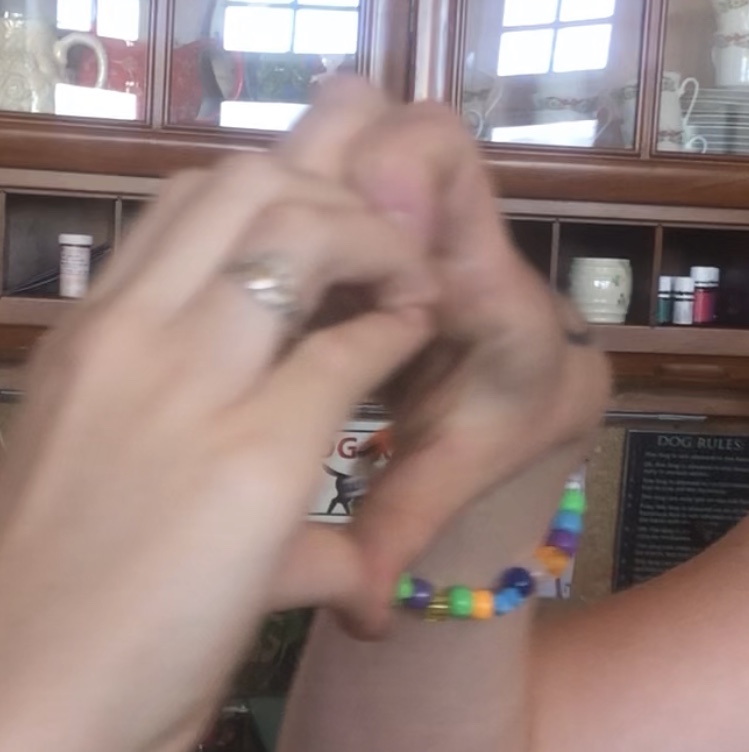
The following is a transcription of a conversation about the exchanging of Kandi (which are homemade bracelets often with colorful plastic beads) in EDM culture through the handshake dubbed “P.L.U.R.” 

Collector: What does PLUR mean?

Informant: “Peace, love, unity, respect. So basically to anybody it means coming together and sharing something with like another person. My favorite part about it is like if you’re really connecting with someone at like party or you know like a rave um I’ll look at somebody and I’ll be like okay you look like you’re a hella stoner so we’ll like talk about be like ‘Hey like what’s your name oh my god you’re so cool’ and maybe dance a little bit and then we’ll do like this thing. So it goes peace, love, unity, and respect. And I would bring it over and then you would look at what it says. And it says ‘Smoke weed everyday.’ 

Collector: Do all of the bracelets have words on them? 

Informant: “Um not all of them have words. So like some people will be like ‘Oh it’s my first rave blah blah blah’ and you could just give them whatever. But like, for me like why I enjoy it is like I’ve been lucky enough to have people who have given me stuff with words. And I like to spread ones with words because its like way more personal and shows that like you really connect with somebody.”

Collector: So you wouldn’t do it with someone you don’t really vibe with.

Informant: “No but um I mean I feel like you vibe with everybody at those events. Usually though like if I’m giving you one, you’re giving me one back. So like you would have one and we would both look at our things and be like oh this relates to you or this is cute or you’ll like this or I hate this one so. For people I don’t really vibe with I’ll give them my ugliest one.”

Images of the process are included here: 

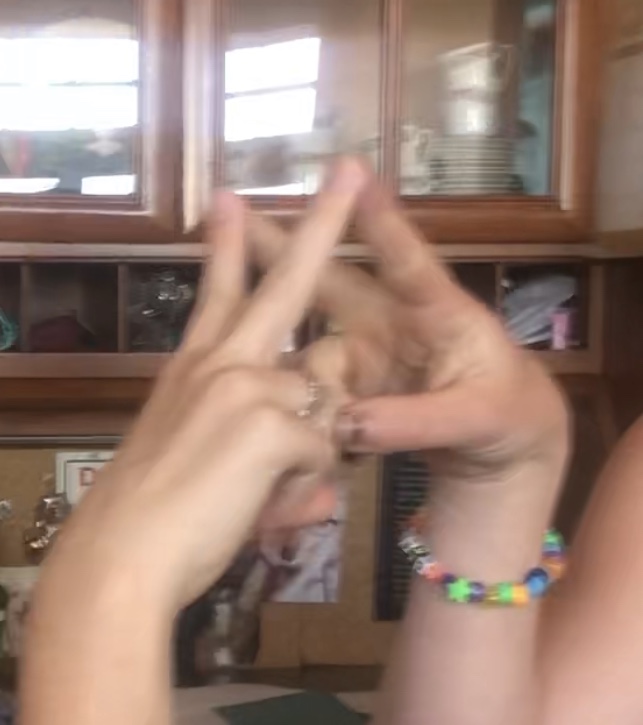
Peace is represented by the two participants touching their index and pointer fingers to each other, making peace signs. 
Love is represented by the two participants joining curved hands to form a heart. 
Unity is represented with two flat hands with the palms touching each other and thumbs wrapped around the opposite hand. 
Respect is represented with the interlacing of the two individuals’ fingers and the bracelet being drawn from the wrist of one individual to another. 

Analysis: The PLUR handshake is a fun and fast way of building a community and making friends at raves, parties, and even the beach. Kandi is a way to visibly identify those who participate in EDM culture and serves as a sort of invitation to others who participate in this culture to engage in conversation and even friendship. Historically, raves have been dangerous places with illicit drugs and little supervision. Woodstock 99, a 1999 music festival, ended in destructive riots and other festivals like Electric Daisy Carnival have had numerous deaths. Although raves and festivals are much safer today, with medical staff readily standing by, the PLUR and Kandi traditions began in 1990s underground rave culture when this wasn’t the case. I believe the ritual functions to reassure rave goers and build a network of accountability and trust. Since drugs like ecstasy and LSD are often consumed at these events, the handshake may also serve as a positive affirmation in order to assure that participants are having a “good trip.” Furthermore, EDM culture has historically been inclusive toward minority groups and LGBTQ. I believe this handshake is an extension of the welcoming and respectful undertones of EDM culture.

Not Eating the Last Bit: An American Superstition

Nationality: American
Age: 61
Occupation: Dog Trainer
Residence: San Diego, CA
Performance Date: 4/24/20
Primary Language: English

Background: The informant is my mother, who is a third generation Irish immigrant from Bridgeport, CT. She learned the superstition from her mother and has vehemently abided by it ever since. 

Context: The following piece was collected in a casual, in-person interview at the informant’s home in San Diego, CA. 

Piece: 

Informant: “I can’t eat or drink the last bit or piece of anything.”

Collector: “Why?”

Informant: “Because then I will become an old maid.”

Collector: “I don’t know why that’s just the way it is you know that’s what my mother taught me.”

Analysis: I grew up hearing my mother refuse the last drop of wine or last piece of food at nearly every meal. I believe that it is entrenched in American gender roles and concepts of femininity from the mid 20th century. The words “old maid” imply that the practice is gendered, although it is worth noting I have witnessed my uncle practice this superstition. I interpret the piece as perpetuating the idea that women should be selfless and thus offer the last of their food to others and not consume it themselves. Throughout my life, I questioned my mother’s practice and particularly what was implied by the words “old maid.” Continuously, my mother interpreted becoming an “old maid” as dying old and alone. This is particularly dire to her as she grew up in 1960s America, a time in which a woman’s self-worth was still largely tied to her relationship status and the wealth of her husband. Although this concept has been largely contested in American culture today, my mother and her mother who value family and marriage considered being old and alone a fate worse than death, the ultimate symbol of being unwanted and unloved. By controlling the tangible, they attempt to control and quell these fears.