Monthly Archives: April 2021

New Clothes – Persian New Year

Nationality: Persian-American
Age: 79
Occupation: Retired
Residence: San Ramon, CA
Performance Date: April 18, 2021
Primary Language: English
Language: Farsi

Description of Informant

PK (79) is a small, frail woman with dyed blonde hair and piercing eyes. PK was born and raised in Abadan, Iran in an “Oil Company Family.” OCFs were families whose primary income came from the large British oil company in Iran. They were well compensated and taken care of, living in western-style homes in protected communities. Many OCFs were secular or subscribed to a western religion in favor of Islam. PK immigrated to England in 1976 before coming to America (California) in 1978.

— 

Context of Interview

The informant, PK, is cooking a traditional Persian stew (khoresh) while describing the custom to the collector, BK, her grandson. Text spoken in Farsi is translated and italicized.

Interview

BK: So you were saying, in the morning when you wake up, all your clothes are new?

PK: Yes, from underwear and beyond— now they say everything should be new. Everything new. It’s with the new year, new clothing, new everything. Now frankly if it has any other meaning I don’t know. But from childhood we would wake up [in the new year] with so much joy and mirth and we’d all change our clothes, from underwear to undershirts, everything. They would sew new clothes, you know? [In Iran] it wasn’t like now where you’d go shopping… you had to have your clothes made. “Khayat,” you know, tailor. Then, everything was new. Even a ribbon for your hair was new. Everything new.

BK: What would happen to the old stuff?

PK: Nothing. It’s not like we threw it away! We just… wanted something new. Then, all dressed up, we’d go do “Aideedani” [visiting people during the new year].

Collector’s Reflection

With the strike of the new year, PK’s family would immediately change their clothes. Often, the clothing they changed into had been sewn specially for the occasion. It was not essential to change your entire wardrobe— that would be wasteful. But it was important to begin the new year fresh, and clothing was a part of this. You wouldn’t only wear a new t-shirt and shorts, though. Men would dress in tailored suits, women would adorn themselves in fresh jewels.

This tradition has evolved as the world has Westernized. Persian-Americans often go on a shopping spree on or prior to the new year to stock up on fresh clothing. The time aligns with the American tradition of “Spring Cleaning,” so while in Iran one wouldn’t toss their old garments, today it’s much more “out with the old, in with the new.” 

Eggs – Persian New Year

Nationality: Persian-American
Age: 79
Occupation: Retired
Residence: San Ramon, CA
Performance Date: April 18, 2021
Primary Language: English
Language: Farsi

Description of Informant

PK (79) is a small, frail woman with dyed blonde hair and piercing eyes. PK was born and raised in Abadan, Iran in an “Oil Company Family.” OCFs were families whose primary income came from the large British oil company in Iran. They were well compensated and taken care of, living in western-style homes in protected communities. Many OCFs were secular or subscribed to a western religion in favor of Islam. PK immigrated to England in 1976 before coming to America (California) in 1978.

— 

Context of Interview

The informant, PK, is cooking a traditional Persian stew (khoresh) while describing the custom to the collector, BK, her grandson. Text spoken in Farsi is translated and italicized.

Interview

PK: The one thing is, for the haft seen, we always boil the eggs for the number of people in the house. And after the… new year starts, the new year starts, we all… there are sweets, we eat sweets. One by one we eat eggs…

BK: Do you eat the egg for the haft seen or do you make a new egg?

PK: No, we make it— we eat the egg we made for the haft seen, because you cannot keep the egg, you know, the fresh boiling egg for 13 years [days] on the table! You just eat it, you know, it’s a custom. Because there’s no sin in it, but there’s some other meaning. Like rice. There’s some other meaning.

BK: What’s the meaning of the egg?

PK: Egg is like… lots of kids, for example.

BK: Like fertility?

PK: Yeah fertility for… kids.

BK: Why does it mean that?

PK: It means, for your home to always be full. You know? Iranians like for the family to be big and the home to be full. It’s these days that people don’t have kids or only have 1-2 kids, or none. But those days it was like that.

PK: We didn’t color it either. Just like that, white. But now everything is different.

BK: Why do people color their eggs now?

PK: These days it’s just showing off… vanity play. Back then, nobody colored their eggs. We boiled it and put it on the table. Now here [America] when you look at a haft seen table, it’s like a wedding table! It’s a lot different. For pictures, for sending [pictures], for parties, and this should be prettier than that and vice versa. In the old days [when your father was young] when I’d set up a haft seen I did a lot of work, but slowly over time I got sick of it.

BK: But when you were in Iran—

PK: It’s a simple sofre [table]. Whatever is needed.

BK: Why do you eat the egg? Because I never ate them growing up.

PK: Well here you keep the eggs [sitting on the table] for 13 days. In Iran, we wouldn’t keep the eggs out. We’d leave the sabzeeh [greens] and sheereeny [sweets] out. They didn’t have any cream. Like chickpeas, this type of thing. Those would sit out for 13 days, then you pack it up and toss the sabzeeh.

BK: So when do you make the eggs?

PK: That day. Right before new years, right before the haft seen [ritual]. Like one or two hours before the new year we’ll boil the egg, and right when the year changes we eat it. I don’t know why we eat it, but it doesn’t make sense to keep an egg. So we’d just eat it. I don’t think there’s any significant meaning. We didn’t want to waste it, it would stink and go bad.

Collector’s Reflection

PK’s experience with Persian New Year Eggs is simple: an hour or so before the new year, the family will boil eggs (one for each member of the household). When the new year begins, the eggs are eaten. There is no decoration or display involved in the process. The eggs stand for fertility and prosperity in the new year (fertility being the common theme of eggs across cultures). This aligns with historic, pre-Western influence Persian New Year traditions.

PK is one of my grandmothers. My other, NV, is only 4 years younger than PK, and was born and raised in the same city/community in Iran as PK. Their families were even friends! Yet, NV’s family practiced eggs the way I always have growing up: the eggs were prepared in advance of the new year, decorated by the children, and displayed as part of the haft seen, a table decorated with symbolic objects for the new year. NV’s family is much more westernized than PK’s; they often summered/vacationed in Europe, while PK remained in Iran. The practice of decorating and displaying eggs, then, seems to have originated from the modernized Western practice of Easter Egg decoration. Since the “westernized” eggs sat out, they would be thrown away, not eaten. This goes against the core of Iranian philosophy: never waste food! It was absolutely criminal to throw things out. Leftovers, no matter how small, are always kept. The idea of “wasting” an egg would be insulting to more traditional members of society.

Májusfa & the Május Fa Tánc

Nationality: Hungarian
Age: 45
Residence: Queens, New York
Performance Date: 04/13/2021
Primary Language: Hungarian
Language: English

Main Text: 

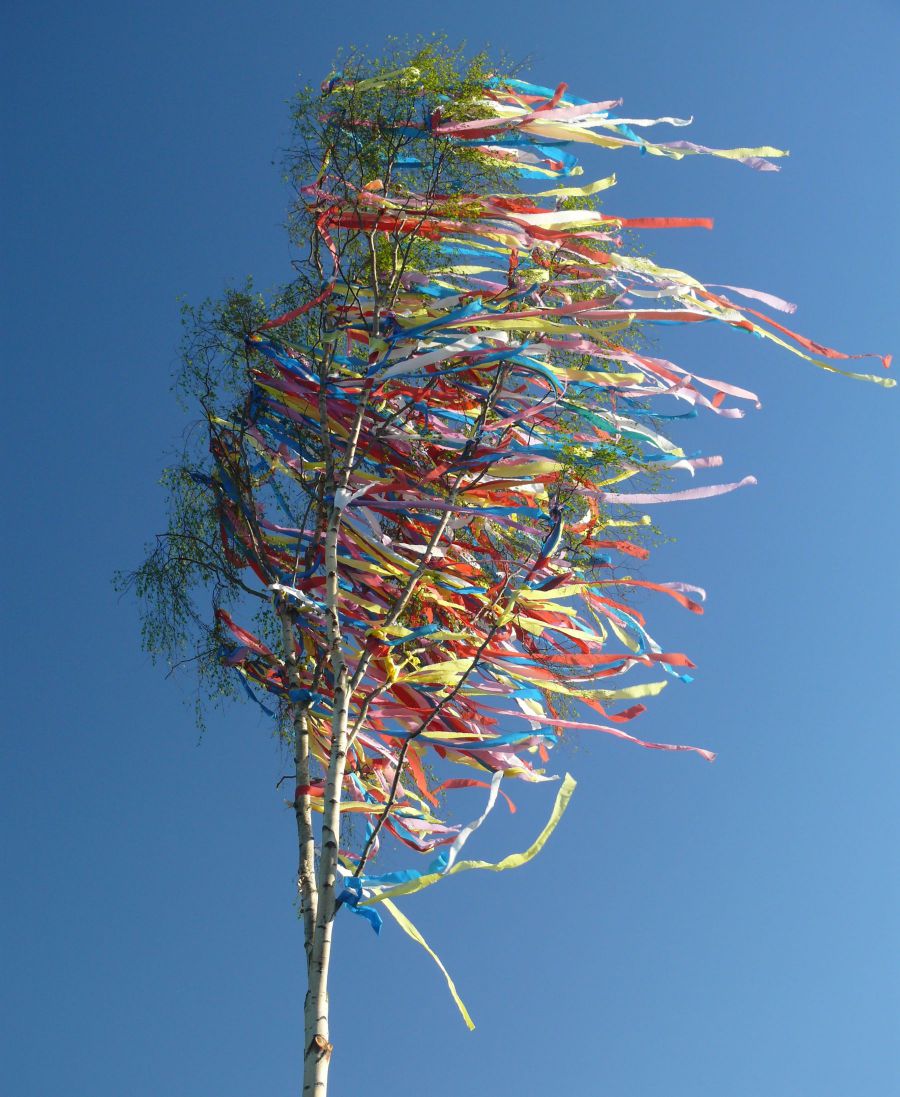
Májusfa & the Május Fa Tánc 

Background on Informant: 

She was born and raised in Hungary, but moved to the United States in 1997. She is knowledgable of her roots and has lots of wisdom to share about its’ cultural traditions. Growing up her family practiced the traditions of the May tree (Májusfa) and she has shared with me her experiences with it. 

Context: 

She explains: 

(Translated) 

“On the night of May 1st every year, the boys of the town would cut down a May tree from the forest and bring it to a girls house. Usually one boy would set up the plan for the girl he liked and get the help of his friends. 

The tree was sort of a symbol of renewal and also a token of love, it was a cute tradition.

They would decorate the tree with colored ribbons of all sorts of colors — because the trees are very thin it looks like a giant mesh of confetti. Sometimes they would tie a bottle on the top as well. The trees are also very tall and I could see the top of the tree with the beautiful ribbons from the top of my fourth floor apartment. 

When the decorating was done, the boys would stay out all night until the morning to call out the girl and serenade her and often give small gifts such as flowers, jewelry, and perfume. 

It was exciting to wake up in the morning and see which girl received a May tree. I got some and was always so happy to see them, wish we had the technology of today cause then I could have some pictures to look back on.

There was also a dance associated with the event. Girls who get a tree hosts the village with food and drink, and they usually do a traditional dance with music around the tree in celebration.

The tree stays up until the last night of May, and there’s a cute saying where whoever’s tree remains green, and does not wither, then their love will last forever. 

It was quite a public announcement of courtship I will say, but because I lived in an apartment, it was a little bit more rare to receive one as it was best to have it planted in the countryside. 

It was very fun and it was funny to see how the girls became competitive with who got the prettiest tree, and you had to look out cause enemies might ruin the tree as revenge. 

Another competition was climbing the thin tree, which the boys often attempted trying to win the bottle on the top of the tree. 

The tradition is one of my favorites and is the perfect introduction to spring into summer, although I don’t think it’s been practiced as much anymore.” 

Analysis/Thoughts: 

Before this interview, I had never even heard of this tradition and was absolutely entranced after learning about it. I love how it ties into the culture of Hungary and it is quite the adorable tradition practiced. Looking at reference photos, it is almost shocking at how tall those trees are and just how extravagant people got with the decoration. I love how wholesome it is in ushering in a new season and how it has little notions of wisdom in representing young love and fortune. 

The symbolism of the tree (of rebirth and nature) and the event as a total has a rich tradition and from researching I was able to learn about the development of it from generation to generation. It also goes hand in hand with religious traditions as the event is associated with St. James the Apostle and the tree is also referred to as the ‘James Tree’. It is said that the stick of Valburga, nailed to Saint James and Saint Philip, turned green and sprouted flowers indicating virginal purity, thus the symbolism associated with the tradition. 

It’s interesting to note how many of Hungary’s traditions are rooted in religion and how its’ continued to play a major role in culture and heritage. Overall, I enjoyed learning about this event and will be exploring more to understand its’ impact in Hungarian history. 

Annotations: 

For visual reference check out: 

https://i.szalas.hu/packages/1150397/original/706320.jpg

For more historical background: 

http://studyinhungary.hu/blog/colourful-springtime-tradition-in-hungary-the-may-tree

Mikulás Day

Nationality: Hungarian
Age: 45
Residence: Queens, New York
Performance Date: 04/13/2021
Primary Language: Hungarian
Language: English

Main Text: 

Mikulás Nap (Saint Nicholas Day) in Hungarian tradition is celebrated annually on December 6th. 

Background on Informant: 

She was born and raised in Hungary, but moved to the United States in 1997. She is knowledgable of her roots and has lots of wisdom to share about its’ cultural traditions. She grew up with the traditions of Mikulás Nap as a child and continued to practice it with her own children. 

Context: 

She explains: 

(Translated) 

“Mikulás is the Hungarian ’Santa Claus’ but it is also a reference to Saint Nicholas (Miklós or Mikulás). On every December 5th, children are told to put out shoes (boots usually) in front of their house, windows, or even in more modern times their rooms. 

Then by the next morning on December 6th, which is Mikulás Nap (Saint Nicholas Day), good children wake up to find chocolates, small toys, and sometimes even money in their shoes, while the bad children get “virgács” which is like twigs wrapped in red paper as their punishment (kind of looks like a small broom)— it’s supposed to be a reference to ‘Krampusz’ who is this devil-elf hybrid creature. But no one really ever gives their children it even if they deserve it. My mother always told me I would get it, but she never would, she got me the most delicious treats. 

No one really practices “virgács” anymore and ‘Krampusz’ is not associated with Hungarian Christmas culture anymore either. In more modern times, I usually use the American Christmas Stockings to place small chocolates and tiny presents for my children, and then the next celebration after this is our Christmas (‘Karácsony’) on December 24th.”

Analysis/Thoughts: 

I loved learning about the traditions of Mikulás Nap and understanding the origin of the holiday and how it has shifted from tradition customs to a more modern version. It’s interesting to see how Hungarian tradition as well as other Eastern European cultures have this precursor holiday ahead of Christmas. Having also grown up with practicing this mini-holiday in my own traditions, I learned a lot about ‘Krampusz’ who has played a large of role in the past, but has now become outdated in modern customs yet very much active in pop culture. I also had never heard of the “virgács” and assuringly most parents tend to treat their children with rewarding gifts rather than punishments on this day. 

As St. Nicholas is the patron saint of children, it is without a doubt that this ‘Father Christmas’ treats his children with blessings. I also love how this tradition hasn’t really spread far from Eastern Europe traditions and that it never caught on in the Western world as much as the other traditions such as ‘Santa Clause’ and Christmas as a whole. But overall, I was able to learn more about this tradition and the importance it continues to play in Hungarian culture, and its preservation that I would say will continue to last a long time. 

Annotations: 

For more information check out: 

https://search-proquest-com.libproxy2.usc.edu/legacydocview/EBC/1386985?accountid=14749

www.jstor.org/stable/10.1525/j.ctt1pnktx.8 

Colorado Tunnel Ghosts

Nationality: USA
Age: 21
Occupation: Student
Residence: Los Angeles
Performance Date: 4/15/21
Primary Language: English

Main Piece

JJ recently took a cross-country road trip with his girlfriend. While in Colorado Springs, they visited a friend of theirs from high school. As they drove to a hike, the road goes through many tunnels, one of which is allegedly haunted, according to his friend:

“It’s a super tight tunnel, one car wide. The road is super dusty, as you drive through you kick up a ton of dust.

100 years ago, 50 years ago, whatever–when buses were around, a tunnel collapsed on a school bus with elementary school kids on a trip up to the Rockies. If you drive through at night, or with your headlights off… you’ll have kid handprints in the dust on your car.”

The haunted tunnel (picture courtesy JJ)

Informant background

JJ is a student at the University of Southern California. He is from Newburyport, MA.

Performance context

This story was told during a folklore collection event that I set up with a diversity of members from the USC men’s Ultimate Frisbee team. We were in a classic folklore collection setting: sharing drinks around a campfire, in a free flowing conversation.

Analysis

JJ’s story, along with every scary story I collected for this project, professes to be a “true story.” While the plausibility of this is in question, the effect of even the plausibility of this story having happened causes an extra layer of fear and fascination for the story—especially since the story is almost always told while the listeners are actually at the site.