
Category Archives: Folk Dance

Bring The Bride!

Nationality: Lebanese
Age: 47
Occupation: Mother
Residence: Dubai, United Arab Emirates
Performance Date: February 21st, 2023
Primary Language: Arabic
Language: English

Original: “جلب العروس

Transliteration: Jalab El Aroos

Translation: “Bring the bride”

The informant is one of my family members who is married and has been raised in Lebanon for most of her life. She discusses instances in her childhood and moments with her family that are the most significant to her culture and upbringing

Context:

She states that “Lebanese heritage lies mostly within special occasions such as weddings, which is one of the most important moments of every Lebanese individual’s life as it brings most of the family together to practice passionate traditions that can only be done on these rare occasions” conveying the importance of culture within Lebanese Culture. She states that “This certain grand gesture is mostly practised by the Druze religion and is the process of claiming the bride from her family home” The Druze religion is the smallest religious group in Lebanon that have a certain manner in performing wedding ceremonies specifically. The process involves “driving from the groom to the brides home with a traditional Lebanese ‘Zaffe’ which includes a band and dancers dressed in traditional Druze wear” which the informant states have been done at her wedding in a vast manner. She ends with “The groom and family must dance and sing until they reach the bride to claim her from her parents and take her back to his home” The informant has specifically stated that this process is accurate at all Druze weddings and is a part of the ritual of their marriage.

Analysis:

The formal use of the title of the gesture highlights how sacred this element of the wedding is to the culture and religion. Although the Druze community is not the largest religious group in Lebanon, it is still indicated to be the country with the highest Druze population, therefore, having such a theatrical part of the ceremony allows them to celebrate their culture in a day with the entirety of the community. The dance is the main element of the gesture highlighting the culture that is taught into daily life in the ceremony so that every individual has the chance to celebrate and bring their culture to light at this heightened moment of celebration together. Incorporating the traditional outfits of the religion allows the community to be seen by the rest of the country as they are the smallest religious group. Although the ceremony may not have religious scripture or performance elements incorporated such as Christianity or Islam, this is how the Druze community incorporates their culture into formal celebrations and rituals. It also portrays the unity between the families as it is not an aggressive ‘claim’ but instead an agreement to allow the couple to continue to thrive in a joint manner in the Druze community.
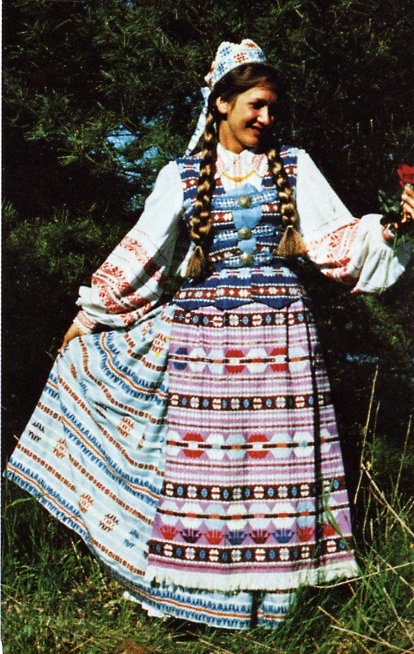
Šokių Šventė, Traditional Dance Clothing

Main Text

GD: “Šokių Šventė is the International Lithuanian Folk Dance Festival that happens once every four years, and what it is, it’s a folk celebration. So everyone dresses up in their tautiniais drabuziais which is their traditional clothing and does their hair, does their makeup. So everything is made out of wool and linen, the women traditionally wore like long skirts with aprons, obviously not floor-length as you have to go work, shirts with poofy sleeves which often had red embroidery around the wrist and a vest that matches the skirt. There are a lot of patterns in Lithuanian culture, in terms of vest and the skirt, and they would mainly distinguish where you are from.”

Background

D is a 19 year old Lithuanian-American second year student at USC studying Theatre and Classics. Her mother was born in Lithuania and moved to a Lithuanian community in New Jersey, where GD attended Lithuanian school and church. She is excited to attend Šokių Šventė for the very first time as it is being hosted in Philadelphia this year.

Context

This traditional clothing was once everyday wear for people living in Lithuania, but has now been relegated to special wear for high profile cultural events like Šokių Šventė. It is also worn at weddings and other folk celebrations.

Interviewer Analysis

JThe phenomenon of once widespread folk dances being raised up as a symbol of a culture and then relegated only to manufactured displays of “Folk Culture” is a very common occurrence. Dance trends change, especially in our modern and more global times. Taking a cultural snapshot of dance and placing it into a category of folk importance may ensure that the dance lives on, but not that it will continue being the preferred style by the people. This has happened not only with the dances performed at Šokių Šventė, but also the clothing worn to the festival.

Danza del Venado (the deer dance)

–Informant Info–

Nationality: Mexcian

Age: 31

Occupation: Lawyer

Residence: Los Angeles, California

Date of Performance/Collection: 2022

Primary Language: English

Other Language(s): Spanish

(Notes-The informant will be referred to DA as and the interviewer as K)

Background info: DA was born in Mexico and moved to the United States when he was 15. He would go back to Mexico to visit family, and while there saw the deer dance performed by various members of his community. While telling me about the dance, he would occasionally perform small parts of it.

K: So what’s the dance called, and what’s the context of the performance? Like when or under, uh what circumstances was it performed.

DA: Its called Danza del Venado, or the deer dance in English. There’s a few different reasons why it would be performed. After Catholicism mixed with Mexico, it was performed around Lent or Easter. When my people still hunted, it was performed before hunting to ensure success, or as a welcome to spring.

K: Ok, so whenever you’re uh…ready to tell me about it go ahead

DA: I already mentioned when it’s performed but I forget to say that it’s now, along with the easter practices, a means to communicate with the spirit world, in which deers’ spirit resides. The dance is simple; it consists of a few men who are dressed in a cloth wrapped around them like a skirt, held up with a belt made of deer hooves. He has more hooves tied to his ankles and holds dried uh…calabaza (gourds) filled with beans or rice to make large rattling sounds. They would also have deer skulls attached to their heads with red uh…Cintas (ribbon) tied around the horns. All of this is meant to sort of thank the deer and celebrate how hard it fought and ran not to be hunted. All the noise from the hooves and calabaza is like it running and us chasing, while the cinta is meant to represent flowers actually, like rebirth and growth from spring. The entire dance is a thank you to earth.

Interpretation:
This was the first folklore I had collected specifically on a dance and it was so interesting to read about. The change in the dance from how it originally was, it being dedicated to the hunt and directly to spring, to the version it became after Catholicism was introduced, with the dance now being dedicated to easter, was so interesting to hear. DA also showed me a video he had taken of his family performing the dance, so I got to see it actually be performed. It’s a beautiful dance full of color and culture. What DA did not mention is how much audience participation there is. In the video I was shown, the entire audience was chanting and singing along with the dancers, and young children were even at the front of the room dancing alongside them. People in the audience were also dressed in ribbons and a few even have a hoove or two with them.

Spanish Fruit Eating Dance

DESCRIPTION OF PERFORMANCE: Spanish music was playing. She was standing, swaying her hips back and forth. She took her right hands and gestured it upward as if grabbing something out of a tree. She twisted her hand like pulling it out and pretended to take a bite out of the imaginary object. She then pretended to wipe the object all over her body until she reached her left hip and then it a swift movement, pretended to throw the object onto the floor. 

INFORMANT DESCRIPTION: Female, 72, Spanish

CONTEXT: This dance is supposed to symbolize taking an apple or fruit from a tree, eating it and then throwing it away. She learned it in a dance bar in Spain growing up in the 50s. It was a somewhat known dance that she said was very sensual and attractive. It involved the hip movement of her culture’s dance and incorporated themes of Adam and Eve and the countryside. She always loved this dance and would do it constantly to different music. To her it represented femininity and her country’s beautiful dance culture. 

THOUGHTS: When I saw this dance in person I was mesmerized. I had never seen anything like it and it was interesting because I could immediately understand that she was picking a fruit from a tree, the movements were very clear yet melodic.

“Vibora de la Mar”- Mexican Wedding Dance

  1. “Vibora de la Mar”- Mexican Wedding Dance

Context: CL is a Mexican American student at USC. Her parents are from Michoacan, Mexico and her family currently resides near Bakersfield, California.

Transcript: 

CL: Okay so this is a game played at a wedding. Okay there’s two different ones: The bride gets on a chair… I’m trying to remember if it’s the bride and the groom both get on a chair, and then they carry the bride’s veil, the groom carries the bride’s veil so that people grab each other’s hands and then they go around in circles. First, it’s the women that are at the party, and then after they’re done, it’s the men that go. I think they’re objective is to try to knock down the bride and the groom… 

HV: That’s so silly goofy *laughs*. To try to knock down who?

CL: The bride and the groom. 

HV: Oh they’re praying on their downfall?

CL: Yeah, pretty much. 

HV: Is it all the single people?

CL: Yeah maybe!

HV: Why do you think they’re trying to knock down the bride and the groom? Do you think there’s a significance behind that? 

CL: *quietly* let me look it up… 

HV: That’s not fair! What do YOU think it means?

CL: I think it’s just… it could be one of two things. It could be like “oh we’re celebrating the union of you guys”. Maybe the chairs symbolize… it’s the beginning of a new era, you guys are so happy right now but eventually, it’s just gonna be like any common thing, being married, and if you fall, it’s like you’re joining us, welcome back to the real world. 

HV: Is there music?

CL: Oh yeah! There’s a song! The song is called “La vibora de la mar”?

HV: Screaming, it has the same name? 

CL: uh, yeah. 

HV: How does it go? Sing it for us. 

CL: “A la vibora, vibora, de la mar, de la mar, por aquí pueden pasar, los de adelante corren mucho, los de atras se quedaran”. 

(To the snake, snake, of the sea, of the sea, you can pass through here, the ones in the front run a lot, the ones in the back stay behind). 

HV: What is the translation of “vibora de la mar”? 

CL: Ooooo, snake of the sea? I think it’s “vibora” because the people are holding hands and they’re going in a snake motion. I’ve mainly seen it with adults because it can get kind of aggressive so I don’t think that they want children to get trampled. I think it’s aggressive because they’re trying to knock down the bride and groom. If the men were to go first, since they tend to be a little more aggressive, then the women wouldn’t be able to go. Cause then what if the groom falls or the bride falls or someone gets hurt. 

My Interpretation: The significance of this tradition to me seems like it’s a way of testing the newlyweds’ bond. By physically trying to knock down the couple, who are now connected, literally through the bride’s veil, and figuratively through marriage, the community is giving them their first test of endurance in this new chapter of the life cycle. It’s also interesting to me how segregated the tradition is by gender because it demonstrates how separate men and women are in the culture and how their roles in marriage will also be separate and distinct.