
Category Archives: Gestures

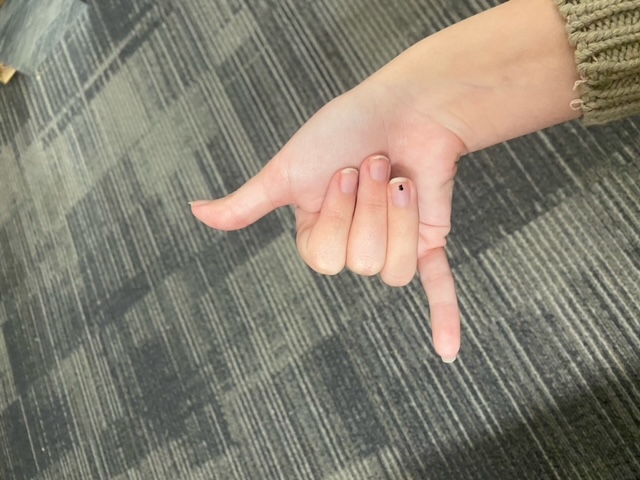
Telephone Gesture

Nationality: American
Age: 19
Occupation: college student
Residence: USC
Performance Date: 2/23/2023
Primary Language: English

M is a 19 year old college student. She shares a gesture that she learned from her mother in Colorado Springs when she was a toddler playing pretend.

“When you mention you’re calling someone, you put your pinky out as the receptor and the thumb as the transmitter to motion you’re calling someone. When playing with my mom I’d pretend to be calling someone and my mom would answer with her “phone” that was actually her hand.” 

This gesture is particularly interesting because it is rapidly fading out. Now, if you ask a toddler or a child to show you them making a phone call, they’ll put their whole hand flat to their ear, replicating a cell phone. The informant and I are nearly the last generation to learn the gesture of a telephone using our fingers. The gesture is terminus post quem the invention of the dial telephone, and terminus ante quem the generation raised with cell phones. This shows how rapidly folklore changes, and how easy it is to lose folklore. My generation will be the last ones to use the finger gesture, and eventually it will entirely die out when kids barely remember what old phones used to look like. As technology rapidly changes, folklore is changing at an even faster rate than ever before. We have no clue what folklore might look like for children in 20 years. It will be interesting to see what folklore says, and which is phased out. 

L.A. Hand Sign

Nationality: American
Age: 19
Occupation: Student
Residence: San Diego, California, United States
Performance Date: 2-23-2023
Primary Language: English

Text:

Context:

The informant learned this at a summer camp in San Diego from some girls from Los Angelos (L.A.).

Analysis:

The gesture is representative of an “L” and an “A.” As the initials of the city of Los Angeles, these two letters are an easy connection to the city. While this sign could be a gesture used to identify with other citizens of Los Angeles, the arrangement of the hands does not seem intuitive enough to me to align with this. Instead, I think this gesture is connected with experimentation on what shapes one’s hands can create. Like the hand llama this gesture could be used in a variety of ways and it stretches the traditional uses of hands.

Minor Genre: Folk-Gesture

Nationality: Puerto Rican/Dominican
Age: 18
Occupation: Student
Residence: USC
Performance Date: 2/20/23
Primary Language: English
Language: Spanish

*Cheek to cheek gesture*

Younger person to elder – “¡Bendición!”

Elder response – “Dios te bien diga”

Translation: – “good blessing or good health”

Context: This is a saying used to greet family, typically when you are greeting an elder in your family such as your grandparents. While saying these phrases you do a cheek to cheek greeting almost as if you are kissing each other on the cheek. The informant learned this growing up around their family and used it out of respect for their elders when greeting them. It has a connection to Christianity in the sense that you are giving them a blessing and it used very commonly in Latin households. The informant said this is a more formal way of greeting family however when you greet your friends, you just do the cheek to cheek gesture.

Analysis: Interestingly, this folk-gesture is similar to many European gestures for greeting but is different because you kiss both cheeks in Europe but only one cheek in this gesture displaying the difference in meaning/significance in the different cultures and groups of people. It is not a very common thing in American culture because there is not much of a cheek to cheek gesture, however, my grandparents tend to say things such as, “God bless you,” when saying goodbye, connecting back to Christianity shaping these gestures and greetings.

Korean Handgame

Performance Date: 2/22/23
Primary Language: English
Language: Korean

English translation: 

On the blue sky, Milky Way,

White boat

A tree of a tree and a rabbit 

It’s not a mast and there’s no sting.

It’s good to go to the west country. 

Cross the Milky Way to the cloud country. 

Where are you going after the cloud country.

Shining brightly from a distance

It’s a new star lamp. Find the way. 

First, you clap with two hands, then each other’s front of their hands touch, then clap together (all in a wave-like motion). Then clap again, then both mirror one hand above, one hand below, and clap together, then a final clap with both hands from each. This will continue until the song ends. 

The informant explains that the Korean hand game combines a Korean song with hand clapping that goes along with the rhythm. She was taught as a kid by her mother and quickly began to do it with her friends. The song is called Half Moon, and the lyrics seem to relate to the night sky and stars. The informant believes that it may have some tie to other Korean folklore but is not entirely sure. She explains that most if not all Korean children know this game.

The interesting thing about this hand-clapping game is that the game really is not a game. There is no winning in this game, and it simply ends when the song ends. There is no competition, and nothing to achieve other than the cultural aspect. I believe that because it is of Korean culture and origin, it has a more collectivist culture and thus its purpose is different.

Shaking Off the Luck

Nationality: American
Age: 18
Occupation: USC Student
Residence: Los Angeles
Performance Date: 2/21/23
Primary Language: English
Language: Cantonese

Text:

Shaking your leg at the dining table shakes off good fortune.

Context:

As a child, KF would unconsciously shake her leg up and down while sitting at the dining table. However, her mother would always tell her to “stop doing that because it basically means that, like–it’s thought to be that you’re shaking off your good luck and wealth.” After the interview, KF took to the Internet to see if this was a typical Chinese superstition or just something her family believed in. Based on her findings, this is a well-known Chinese belief, where leg shaking will result in a hard life trying to provide an income for yourself.

Analysis:

The meanings behind gestures go beyond surface level; they can be forms of communication or acts of summoning/getting rid of. Folk gestures often refer to performed gestures, such as a handshake or a secret code, but they can also involve gestures that are strictly avoided to banish bad luck. To some people, including myself, shaking your leg while sitting still is second nature. We often don’t think twice about its implications. However, for those who believe in its effects, there is a conscious awareness behind what their legs are doing. Shaking your leg is often associated with the idea of restlessness–perhaps it could be interpreted as feelings of anxiousness in the present, which hinders a successful future. Not only does verbal speech reflect the ideologies and superstitions of a particular group, but so does physical behavior or lack thereof. Our body is a vehicle that we rely on for life and prosperity–legs are our foundation, as they walk us through life’s path. Thus, in order to ensure a fulfilling life, we need our base to be sturdy. In broader terms, folklore that is reliant upon bodily functions may enable us to reflect on our sense of self and autonomy–in fact, we may have some control over how the course of our life unravels.