The following is transcribed from text exchanges between my informant, A, and myself, M.
Main piece:
A: On passover, there’s this tradition that Persian Jews have, and somehow only us. There’s this song called Dayenu that you sing as part of the Passover seder, which is like what we call the food and tradition we do.
A: Passover is about Jews being slaves in Egypt and Passover is specifically about when the Jews were freed, and that’s basically the whole thing. But this song is part of it, and its about thanking God for each specific thing He did in the story. And for Persian Jews, while we sing the song we hit each other with green onions because they symbolize the whips from slavemasters. We get pretty agressive, and it looks really stupid.
M: Why just Persians?
A: I don’t know how it started or why it never made it to any other ethnic Jewish group. I didn’t even know it was a Persian thing until like late into my life, so when I talked about it with my white friends, they thought I was insane.
She later texted me that her parents told her Italian Jews do it as well.
Background: My friend is Persian Jewish from Beverly Hills. Judaism has played a large role in her life, having gone to Jewish high school and been an active participant in the community since birth.
Context: She and I were texting casually, and I asked if I could collect from her.
Thoughts:
Food is a way of communicating, and from what I have learned about the Passover ritual is that it is a very active one, almost like a play. Also that food is heavily involved. I am left curious as to why Persians specifically do this part.
Grandma used to curl my hair with socks. They have to be nylon knee socks so that they can be crushed and tied, and you sleep in it. When your hair is just a tiny bit wet out of the shower, you stick all those socks in, and you wake up very curly. I think I did it to you, remember? I kept doing it, because it stayed so much better than regular curlers, it would stay for days. I would do it all the way until I got married. I don’t know anyone else who would do that. I learned it from grams.
Background and context: This was told to me by my mother, who is a white baby boomer. She is close with her mom, who is from the Great Generation. My mom grew up in Pittsburgh.
Thoughts: This is likely from before hair curlers’ existence. I have seen the style, and it looks more old-fashioned. I think this is people figuring out a way to curl before they had the technology, and it could be swapped out easily for another method.
“Okay, so, in USC Greek life there’s this thing called homecoming. Which is a tradition that goes back as long as anyone can remember. it coincides with the homecoming football game that is always at USC. A frat will ask a sorority to go with them to homecoming, and if the sorority says yes, then they do a week of activities together. They have something together every night– so it could be movie Monday, tequila and tacos on Tuesday, wine Wednesday, and it goes on until tailgating on Saturday.
It’s a big deal because it says a lot about what fraternities and sororities like each other at the time, and it’s probably the most high school thing in greek life. Sororities say no sometimes, and fraternities have elaborate ways to ask them in order to woo them. It causes tension and heirarchies. Last year, a frat asked a sorority with letters written in the sky by a plane, and the sorority said no.”
Context and Background: My informant is my brother, who was heavily involved with USC Greek life. He was in a fraternity and participated a lot in it socially, but he also played a major role in its governance first in his own frat then in the InterFraternity Council. He enjoyed it, but was always quick to point out the flaws in the Greek life system and its superficial tendencies. He told this to me as we sat together on the couch.
Thoughts:
Like its name, this tradition is very similar to high school promposals. I have seen it first hand, and I agree that it is quite elaborate.
Informant: I’m not sure where it came from but in all hip hop dance classes I’ve ever taken we refer to a “mark” as a run through of choreo that isn’t as full energy, something you use to remember new steps or different aspects of the choreography you want to focus on. A “full out” run is one that is full energy, full facial performance, full movements. That is a run that is going to be most close to what you’d see on stage as if we were performing right in that moment.
Context: The informant is a dancer on an international US dance team called V-Mo. She has been in dance clubs ever since high school. As a dancer who has attended various dance classes, she gets to experience all the nuances that come with the classes.
Thoughts: From what I’ve heard, practice and the actual performance are two very different things. This slang is very similar to athletes who practice as if they were in a game. The two types of run throughs show how dancers are precise with their leaning and are smart when it comes to the conservation of energy, especially since dancing is physically demanding just like any other sport.
Background: The informant is my twenty-two year old sister. She learned this piece from attending multiple raves and EDM music festivals in the southern California region. She is an avid metal and alternative music fan with a love of body modifications including tattoos and piercings as well as horror films.
Context: The following was collected in a casual in-person interview in the informant’s home.
Piece:
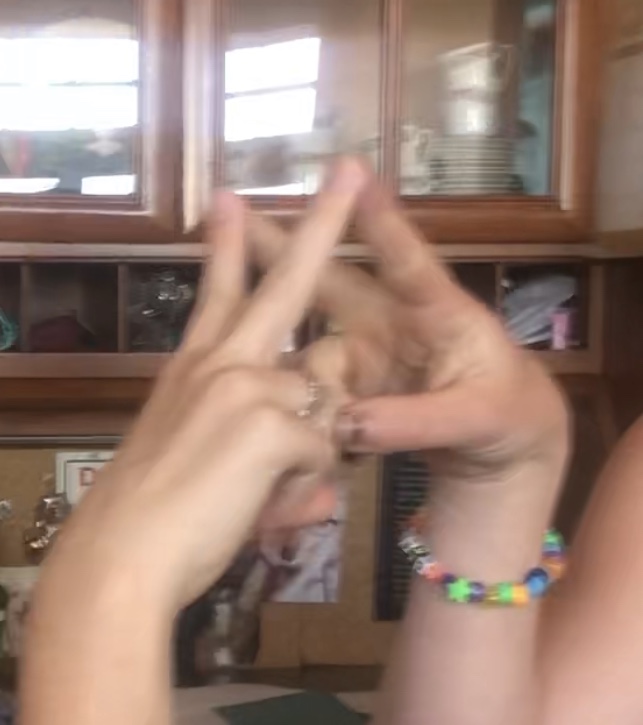
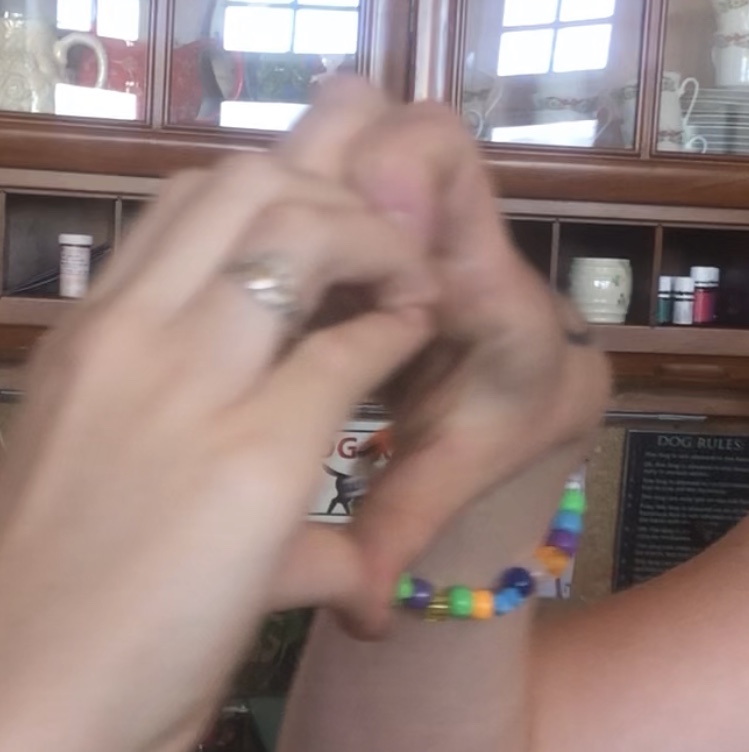
The following is a transcription of a conversation about the exchanging of Kandi (which are homemade bracelets often with colorful plastic beads) in EDM culture through the handshake dubbed “P.L.U.R.”
Collector: What does PLUR mean?
Informant: “Peace, love, unity, respect. So basically to anybody it means coming together and sharing something with like another person. My favorite part about it is like if you’re really connecting with someone at like party or you know like a rave um I’ll look at somebody and I’ll be like okay you look like you’re a hella stoner so we’ll like talk about be like ‘Hey like what’s your name oh my god you’re so cool’ and maybe dance a little bit and then we’ll do like this thing. So it goes peace, love, unity, and respect. And I would bring it over and then you would look at what it says. And it says ‘Smoke weed everyday.’
Collector: Do all of the bracelets have words on them?
Informant: “Um not all of them have words. So like some people will be like ‘Oh it’s my first rave blah blah blah’ and you could just give them whatever. But like, for me like why I enjoy it is like I’ve been lucky enough to have people who have given me stuff with words. And I like to spread ones with words because its like way more personal and shows that like you really connect with somebody.”
Collector: So you wouldn’t do it with someone you don’t really vibe with.
Informant: “No but um I mean I feel like you vibe with everybody at those events. Usually though like if I’m giving you one, you’re giving me one back. So like you would have one and we would both look at our things and be like oh this relates to you or this is cute or you’ll like this or I hate this one so. For people I don’t really vibe with I’ll give them my ugliest one.”
Images of the process are included here:
Peace is represented by the two participants touching their index and pointer fingers to each other, making peace signs. Love is represented by the two participants joining curved hands to form a heart. Unity is represented with two flat hands with the palms touching each other and thumbs wrapped around the opposite hand. Respect is represented with the interlacing of the two individuals’ fingers and the bracelet being drawn from the wrist of one individual to another.
Analysis: The PLUR handshake is a fun and fast way of building a community and making friends at raves, parties, and even the beach. Kandi is a way to visibly identify those who participate in EDM culture and serves as a sort of invitation to others who participate in this culture to engage in conversation and even friendship. Historically, raves have been dangerous places with illicit drugs and little supervision. Woodstock 99, a 1999 music festival, ended in destructive riots and other festivals like Electric Daisy Carnival have had numerous deaths. Although raves and festivals are much safer today, with medical staff readily standing by, the PLUR and Kandi traditions began in 1990s underground rave culture when this wasn’t the case. I believe the ritual functions to reassure rave goers and build a network of accountability and trust. Since drugs like ecstasy and LSD are often consumed at these events, the handshake may also serve as a positive affirmation in order to assure that participants are having a “good trip.” Furthermore, EDM culture has historically been inclusive toward minority groups and LGBTQ. I believe this handshake is an extension of the welcoming and respectful undertones of EDM culture.