
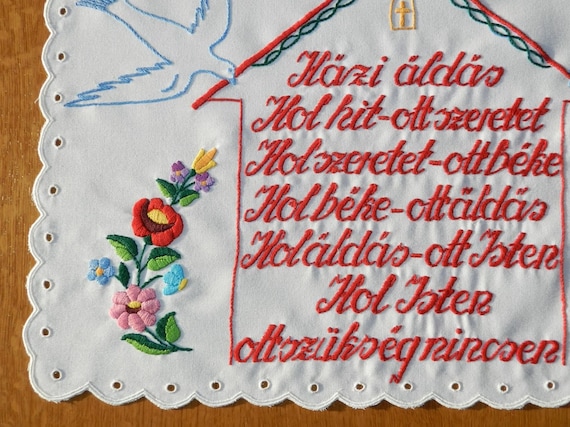
Házi Áldás

Nationality: Hungarian
Age: 45
Residence: Queens, New York
Performance Date: 04/13/2021
Primary Language: Hungarian
Language: English

Main Text:

Házi Áldás 

Hol hit, ott szeretet

Hol szeretet, ott béke

How béke, ott áldás

Hol áldás, ott Isten 

Hol Isten 

Ott szükség nincsen. 

Translation: 

House Blessing 

Where there is faith, there is love

Where there is love, there is peace

Where there is peace, there is blessing

Where there is blessing, there is God

Where there is God

There is no need. 

Background about Informant: 

She was born and raised in Hungary, but moved to the United States in 1997. She is knowledgable of her roots and has lots of wisdom to share about its’ cultural traditions. She comes from a religious background in Catholicism and is experienced with Hungary Catholic practices and beliefs. 

Context: 

She explains: 

(translated)

“In Hungary, entering a household is considered scared and thus its’ sacredness is embodied in the Házi Áldás (House Blessing). It is often seen in embroidery, carved in wood, and other traditional arts. 

In bonds with Hungarian Catholicism, it is meant to serve as a list of virtues to living a pious life under God’s blessings. 

It is also a statement of wisdom that reflects familial bonds and a connection to past cultural beliefs tied with religion. 

In the past, people would hang this on the wall to preserve their faith in God. It began only being used in civic houses, but eventually it even started appearing in peasant households and farmhouses. 

The power of the text allowed people to believe that God would bless the people in the house if the text was present. It is traditionally placed in kitchens. 

Lots of people still sell them today at craft fairs and mostly to tourists.

It’s not really used as much as it was in the past and today it’s used more for decoration, than for spiritual purposes.”

Analysis: 

In my research and interview, I was able to learn more about the history behind the Házi Áldás. Having Hungarian roots myself and a Házi Áldás in my own kitchen, I’ve always wondered what its’ purpose has been. Since my informant is religious and grew up in a Hungarian Catholic household, she was very knowledge about the context behind the Házi Áldás rich history. Hungary has a history of being religious and attributing to its’ history it was no surprise that people dealt a great deal of value to such texts, but it was interesting to learn about how it shifted from civic houses to the poorer population, because even so today most of the poorer population are the ones contributing to the religious life in Hungary. 

I also found the shift from the Házi Áldás as a sacred text to now a symbol of craft and tourist souvenirs. It highlights the disconnect between Hungary’s traditional past which suffered a lot because of its’ Communism past where a lot of these traditions are not practiced or valued because of its’ censorship under particular leaders. But overall, I was very ‘blessed’ to learn about the history behind the Házi Áldás and its’ shift from a valuable text of great importance to now being found in every gift shop available, a path that many of these relics are finding themselves headed towards, opening eyes to how Hungary is trying to preserve their past. 

Annotations:

For visual references and information visit:

https://farfringe.com/stj1043-szekely-aldas/

https://i.etsystatic.com/11885944/r/il/c54015/1478550723/il_570xN.1478550723_eb1w.jpg
Melon Heads

Nationality: American
Age: 19
Residence: Oxford, Connecticut
Performance Date: 04/23/2021
Primary Language: English

Main Text: 

Melon Heads 

Background on Informant: 

My informant is a current student who has shared with me his experiences of childhood folklore and traditions that he grew up with. In a series of interviews he has shared with me his knowledge. 

Context: 

He explains:

“Growing up in Connecticut, you hear legends and myths constantly especially when you’re young as the spread of information runs rampant among kids. The one I vividly remember is the legend of the Melon Heads. 

These melon heads are said to be these small humans with giant bulbous heads who hide out and attack people in the woods. Living in Southern Connecticut, where they are said to reside, always made me feel uneasy. 

I’d honestly rather take a ghost or witch than a melon head. But they are said to eat small animals and the flesh of teenagers (I know right how convenient). 

The story supposedly goes that there was this hospital or asylum (depends on who tells you the story), but it had a lot of criminally insane patients. Well in the 1960s, it burned down, resulting in the death of all of the workers and most of the patients, but a bunch escaped into the woods. In order to survive they resorted to cannibalism and inbreeding, which is the ‘melon head’ aspect of it due to deformities from the inbreeding. 

Every so often you hear the many stories of people seeing them. Like apparently in the 1980s, a group of girls from (I forget which high school) decided to drive around and look for melon heads, so they left their car and went into the woods. Then the engine of their car started and they ‘saw’ the melon heads drive off with the car. But there’s so many stories all over Southern Connecticut with people claiming to see and hear them. 

I’m not saying I believe they exist, but I’m also not saying they don’t. I don’t want to gamble with that. But it is interesting how you can’t escape Connecticut without hearing about the melon heads at least once in your life.” 

Analysis/Thoughts: 

As a believer of a many things, I can certainly say I too was left uneasy after hearing about the legend of the melon heads. I grew up hearing about them too but I was always too afraid to fully get to know the story but now I do. It’s fascinating to think how this story stays alive because of how elementary kids and high schoolers continue to tell it over and over again, even when it dates back to the 1960’s. It’s one of the few legends of Connecticut that has stayed alive and has thrived. I also love how there are so many different versions of the same story going around as it has evolved over the decades. Overall, I enjoyed learning more about this folklore of Connecticut, and observed that these stories go out as far as Ohio and Michigan, but next time I go for a drive I will definitely be on the lookout for any melon heads out there. 

Senior Night

Nationality: American
Age: 19
Residence: Oxford, Connecticut
Performance Date: 04/23/2021
Primary Language: English

Main Text: 

Senior Night 

Background on Informant: 

My informant is a current student who has shared with me his experiences of childhood folklore and traditions that he grew up with. In a series of interviews he has shared with me his knowledge. 

Context: 

He explains:

“So in high school I did a couple of sports, but the one I stuck with was track and field. There’s this tradition every year that at the end of the season, we celebrate this kind of ‘senior night’. Now it wasn’t just the track and field team, it was something that all the sports teams would do for their graduating seniors. 

We would have underclassmen make posters and cutouts, while each junior was assigned a senior they would make a speech for. 

For me it happened my last home meet, which is the last ‘game’ at the seniors’ home turf. So before the meet began, we would be lined up in a row, usually with our parents, and called one by one for recognition and a picture.  

A junior would give a speech to us and then we would receive a small gift, usually a basket of things like candy and snacks. Afterwards our coaches would say a few words, and then the meet would begin. 

After the meet ended, we went out to a restaurant to celebrate and it is a bittersweet moment. It’s a simple tradition but I always looked forward to it when I was an underclassmen and I think it’s cool that it’s a small way to send a token of appreciation for the seniors. A kind of final goodbye.” 

Analysis/Thoughts: 

Having had my own senior night, I understood very well what he was sharing with me. I love how it’s a tradition that has remained the core of high school sports for a very long time. It’s almost an initiation of seniors into the ‘real’ world before they part off and I think it’s a wonderful way to honor their hard work over the past year or years. Although I did not do track and field, I see similarities between my senior night and his and how each sport has developed its’ own culture and way of performing senior night. Overall, I think it’s a very important custom that is practiced in high school sports as a way to say goodbye and appreciate the seniors and the traditions that came before them. 

Korean New Year

Nationality: American; Korean
Age: 19
Occupation: Student
Residence: Fairfield, Connecticut
Performance Date: 04/25/2021
Primary Language: English
Language: Korean

Main Text: 

Korean New Year 

Background on Informant: 

Currently a student, my informant grew up in a Korean household and has shared with me the many traditions she grew up practicing and experienced throughout her life. 

Context: 

She explains:

“Korean New Year is based off the Korean calendar, and it is one of most important holidays we celebrate. 

It usually lasts for three days, the day before, the day itself, and the day after and begins either in January or February.

I know in South Korea it is of major importance to the point where businesses close for days and families honor their ancestors. 

Before we eat, we make sure to place offerings to our ancestors and then everyone in the family does deep bows as a sign of respect. 

For me, I usually gather with with family and friends and we do the traditional bow and we are given a ton of money. 

The traditional meal we eat is the Tteokguk, which is a soup with rice cakes, and symbolically once you eat it you are ‘one year older’. 

Technically we’re supposed to wear hanboks, which is our traditional clothing, but the tradition has evolved to the point where we just wear more westernized clothing. 

The feast is amazing, my mom makes so much food and leftovers usually last a week. 

While I do celebrate the Western New Year’s as well, I prefer the Korean one because we are spoiled with gifts and food.” 

Analysis/Thoughts: 

I learned so much from my informant about Korean traditional culture and practices and found myself wanting to learn more. I love how a common trend is the three day celebration and how unlike in the USA the celebration is continued for multiple days. I have also observed how food plays a major role in Korean heritage and customs, as well as the symbolism behind each meal. I love how Koreans retain their cultural identity with their connection to the past and of course honoring their ancestors. Koreans values and traditions are a huge part of connecting with the past and allowing future generations to continue these practices. 

Doljanchi

Nationality: American; Korean
Age: 19
Occupation: Student
Residence: Fairfield, Connecticut
Performance Date: 04/25/2021
Primary Language: English
Language: Korean

Main Text: 

Doljanchi

Background on Informant: 

Currently a student, my informant grew up in a Korean household and has shared with me the many traditions she grew up practicing and experienced throughout her life. 

Context: 

She explains: 

“In Korea, a baby’s first birthday is one of the most important birthdays they will ever celebrate. The first birthday party is called Doljanchi.

During this tradition, a child is placed in front of a various amount of objects which could include anything from: a soccer ball, stethoscope, money, wool, rice, a pencil, and others. These are objects that symbolize something about your destiny, career, and lifestyle. 

On my first birthday, I picked the money (hehe) which means that I’ll be rich in the profession I pursue. 

Children are also dressed in traditional Korean clothing, I wore a hanbok for mine. 

It’s a very important milestone in in childhood. It’s a tradition that I’ve appreciated and have watched my siblings have and family friends, so it is an integral part of Korean culture.”

Analysis/Thoughts: 

Learning about doljanchi, I was intrigued by the emphasis of identity and childhood placed upon it. I love how important it is for children to be celebrated and the emphasis on pre-destination of where the future is headed. Korean folklore and customs tie into family honor and bond and it is apparent in nearly every tradition that Koreans celebrate. I think it’s really cool how they make the first birthday special and valued and after researching brief history, I learned that it began as a major celebration due to infant mortality, the importance behind its’ legacy. The tradition stems from a long history of tragedy, yet in today’s modern day it has grown into a tradition of celebrating childhood. 

Annotations 

For more information visit: 

https://bestofkorea.com/doljanchi-korean-first-birthday/