
Text
“In middle school, my crush, like that I liked like a lot. He would make paper cranes.
And he would make them at like, every single class in the back of the classroom. And I remember being like one day like, “oh, you should, like, teach me how to make the paper cream, you know, whatever. And so I learned, but then he made one that was, like, really good and he’s like, no, you can have it.”
And so he gave it to me, and I still have it today. It’s on my, it’s on my shelf, in my home.
And like my home is kind of like a childhood, like my shelf is like a collection of my childhood. Like I have all these little things, but I still have that crane. And then I tried to make it just now, and it came out as a boat.
And I think I’m like halfway there. But like the memory’s in there. Like, my hands are kind of just doing stuff. That’s the story.”
Context
AI tells a story about learning how to make a paper crane from a boy that AI liked in middle school, as well as her memory of him giving them a paper crane that he made, which AI has kept to this day. In attempts to make a paper crane from memory, AI says that she doesn’t remember exactly how to do it, but still remembers bits and pieces of the process.
Analysis
Paper cranes are a form of material culture and folk art that carry a lot of meaning such as peace, healing, and hope. They’re also a form of origami/paper folding creations like paper airplanes and fortune tellers that are taught to kids as ways to play and be creative. In AI’s story, the meaning and value of a paper crane come from the physical representation of a strong memory she had with her crush, and the fact that she still has the same paper crane so many years later shows the power and value of this specific moment in her life, and how materials are able to carry memories and meanings. AI’s story highlights Witzling’s idea that handmade objects can communicate through form, materials, and social context. AI’s crush was able to teach and create an endearing moment through gifting the paper crane and paper cranes have embodied these childhood moments and feelings for AI ever since.
Tag Archives: Material Culture
Kumkum Sacred Powder
Context: This red powder, referred to as kumkum, holds religious significance to the informant. She recalls it being spread on her forehead after praying.
Text: The informant puts this red powder, kumkum, on her forehead to signify devotion and spirituality. Although her family buys it from a store, she believes it is made from combining turmeric, a prominent holy ingredient in Indian food, and lemon.
Analysis:
This practice involves material culture and customary folklore as kumkum is symbolically used to express religious identity. The application of kumkum on the forehead connects to Victor Turner’s two poles of symbolism, as the visible red mark indicates a sensory experience that reflects a larger idealogical, spiritual meaning tied to faith. The belief about its natural ingredients, even when store bought, shows how folklore holds vernacular significance and can impart sacred meaning onto everyday ingredients like turmeric.
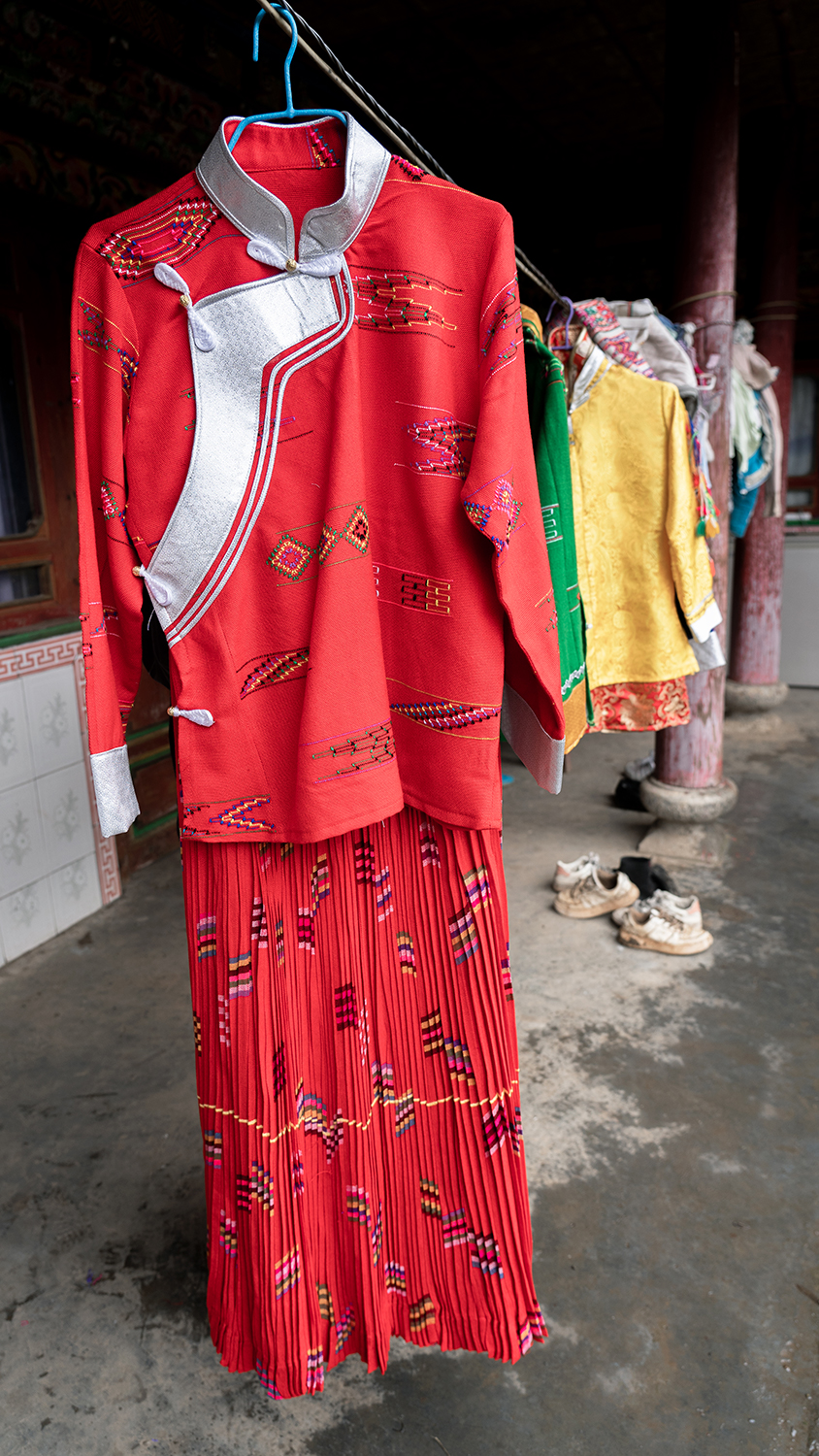
Material Culture – Mosuo Dress with Handwoven Mosuo Traditional Patterns
Text:
This dress is a traditional dress of the Mosuo people, handwoven by the Mosuo people.
The patterns on the dress are all traditional patterns with symbolic meanings to the Mosuo people.
This dress was made by my informant’s mother. Her name is Du Zhi Ma, a 60 years old Mosuo woman living in Lijiang, Yunnan’s Mosuo village. Du Zhi Ma is a provincial-level inheritor of the Mosuo traditional hand-weaving craft. Since 2003, Du Zhi Ma has transformed her home into a workshop studio, leading local Mosuo women in hand-weaving.
Over time, according to the informant, the growing tourist economy around Lugu Lake made machine-made textiles a lucrative commodity at tourist sites. Many Mosuo textile makers struggled to compete and lost income. Du Zhi Ma continued to lead women in Lugu Lake in weaving and making embroidery through her workshops, hoping that this tradition would not completely fade away.
Context:
The informant is the son of Du Zhi Ma. He learned about the story behind this dress from his mother, who made the dress and is a Mosuo person. The informant shared with me this picture as he told me about the Mosuo traditional handweaving as a cultural preserver—he is a local Mosuo museum owner, who specializes in the Mosuo culture (culture specific to the Mosuo ethnic group). The informant thinks of Mosuo traditional weaving as a precious technique that should be preserved, and he is personally very proud of this.
Analysis:
This Mosuo traditional dress is more than just a physical dress—it embodies the Mosuo culture, their artistic expertise, and traditional patterns which capture their cultural beliefs. It represents how material culture acts as a living tradition of the Mosuo.
Du Zhi Ma’s role as a provincial-level inheritor makes this culture endure in a special way. As society become modernized, machine-made clothes have created economic pressure that threatens to hollow out the living craft tradition. Du Zhi Ma’s workshops and her role as a provincial-level inheritor make room for this material culture to be preserved and promoted over time.
Paper ring chains
Text: Pieces of paper cut into long strips – those strips are taped or stapled into interlocking rings, creating a chain. The chain holds as many links as there are days until an event–a holiday, the end of school, etc–and every day, a ring is removed every day until the event occurs and the chain is gone.
Context: AB recalls making these chains with her friends in elementary school as a countdown to Christmas. They would use colored construction paper and hang them up in her friends’ houses as a fun activity to commemorate the season.
Analysis: This is a simple and fun activity to commemorate an upcoming holiday or event. It works well for children, as all that is recquired is cutting paper and either taping or stapling it together–it does not need much supervision or materials, but works well as a festive activity. AB mentions learning this at her friends’ houses, but this is also an easy enough craft to do in school, allowing for lots of decoration and chances for children to express their creativity.
Buñuelos
Text:

Context: A dessert RF would make with her family during Christmastime, which they call buñuelos. RF recalls the making of this food being an event–her great-grandmother was well-known in the family for making them and would use a specific cooking instrument (a kind of ornamental iron on the end of a long stick) that has since become a family heirloom. The recipe wasn’t written, only in her great-grandmother’s head, but it included some kind of whiskey or bourbon in the batter, and the buñuelos were to be fried in lard. The iron was dipped in the runny batter, then submerged in the hot oil–the batter would instantly begin to fry and fall off of the iron while maintaining shape (usually a snowflake or a pinwheel). Once cooked to a golden brown, the buñuelos would be placed onto a paper towel to drain excess oil, then placed into a large basin of cinnamon sugar. RF recalls being in charge of this step, when she was young, using a fork to roll and coat the buñuelos in the sugar. They would make multiple trays of them for the big family Christmas party, and everyone would take some home at the end of the night–with a reminder to keep them uncovered, as they would get stale otherwise.
Analysis: This is a Latin American dessert that obviously holds significance for this family and their culture. The act of making the food is, in and of itself, a big deal, and it was clearly important that there was more than enough in supply. I see it as a way to provide for the entire family, and a connecting kind of ritual of cooking, especially during the holidays.