
Tag Archives: craft

Paper Stars- Material Culture

Text:

Informant: “I learned how to make paper stars in middle school. You just need a long strip of paper and you create a knot with it, then fold the paper in a specific way following the edges of the knot. Eventually you run out of paper and tuck the end in, and then you puff up the star, which is the most fun part in my opinion. My friend taught me how to make them in my after-school Chinese school class, and she showed everyone there. I still make them occasionally in class or while watching a movie because it gives me something to do with my hands. They’re pretty easy to make and all you need is strips of paper, so it’s very accessible.”

Context: The informant learned how to make these paper stars from a friend during an after-school Chinese school class in middle school. The friend demonstrated the process to multiple students, and the technique spread informally among classmates.

Analysis:

Material folklore like paper stars are often learned and shared within a social group rather than created by a single individual. In this case, the informant learned how to make the stars from a friend in an after-school Chinese school class, and that friend taught the rest of the group as well. This shows how small crafts like this spread through communal creativity, where people learn by watching and teaching each other. The stars are also an example of bricolage, since they are made using simple materials that are already available. Because the craft is easy to learn, requires almost no materials, and can be done casually while sitting in class or watching a movie, it continues to circulate informally as people pass the skill along to others.

Paper Heart

Age: 20

Text:

Informant: “I’m used to doing this with gum wrappers mainly, that’s what we used to do in middle school. You take a rectangle and you first make it a square and then you fold it diagonally so it’s a triangle on each side. You do that twice. You bring one of the points of the outside to the middle and then you bring the other one to the other side. Instead of bringing it to the middle you bring it to the other side and the point in the middle of the triangle that you just made. Then you fold it up using the two points of the end of that trapezoid to bring it up into the middle. It looks sort of like a heart but not really. I was always taught you flip it around and make it look more heart like by rounding out the edges. It’s a heart. They look prettier when they’re made out of foil because they’re cute and tiny.”

Context:

The informant attended high school in America and learned how to make a handmade paper heart out of gum wrappers and paper. It’s a type of origami as there are many steps on how to properly form the paper to get the desired result. They were taught by their middle school friends and exchanged them with classmates.

Analysis:

Traditionally, children and teens make hearts out of gum wrappers. They fall under the material folklore as they’re a physical object and handmade. It can be made in class with resources that people often have on them. After they’re made, they’re typically traded amongst friends, acting as “gifts,” and multiple can be made. I think females are the primary producers of these fun, origami-like pieces that are traded with friends. This connects to my idea of it being a feminist approach because there’s an element of collaboration in making one for a friend and knowing that you will likely receive one. There’s also a process and method to making sure you’re following all the steps properly to produce the right result.

Origami Cranes

Informant: “I learned origami as a child in my home. My siblings were the ones to teach me. My parents had bought instructional books for my older brother and sister and before I could read, they were teaching me to fold paper cranes and frogs. At school, I would habitually fold scrap paper into birds and other creatures and sometimes gift them to friends or teachers. If asked, I would happily show my friends how to make origami creations of their own, as my siblings had for me.”

Context: Informant is a 23 year old Japanese American USC student who grew up in Lancaster, CA. He also recalls how often other classmates would make things out of paper in his elementary school. Fortune tellers, paper airplanes, and other origami animals were among the many things he learned to make when he was younger, usually taught by family.

analysis: Origami is a classic example of material folklore. This material folklore tradition may have a deeper meaning to the informant’s family due to his Japanese cultural heritage, because origami originated in Japan and has been taught across multiple generations. It’s interesting how the origin of this folklore has adapted and changed over time. Although the original teachings of Origami may have required someone to physically be there to teach you, it has been more commercialized due to its instructions being published and spread in kids books across the world. Also, being able to make Origami swans in school is a way for children to socially collaborate and interact with one another. Its a living tradition amongst children, and is still shared even today.

How to Make a Paper Plane

Context:

My informant is a college student from Arizona and learned how to make this paper plane in elementary school from one of her classmates.

Text:

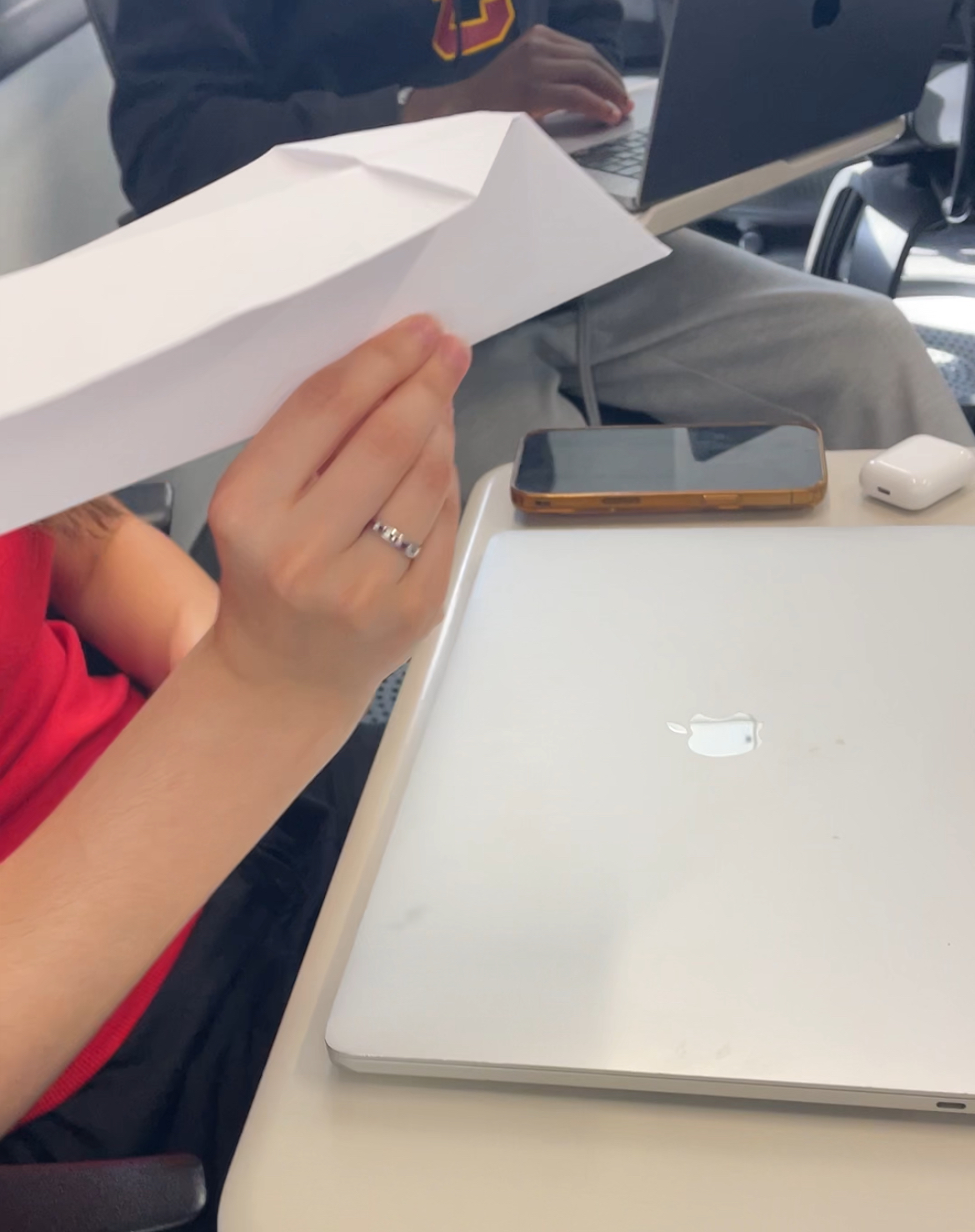
Take a loose-leaf piece of white paper and fold two corners of the top of the paper to the middle. Then fold the paper in half. Take one half and fold that in half again. Repeat to the other side. Now you have a simple paper airplane.

Analysis:

This is a common childhood craft that many children learn how to make when they are bored. People often learn different variations of the paper airplane. In this case, C learned how to make a simple version of the plane. Since this is such as simple craft, this piece of material folklore is easy to pass from person to person.

Paper ring chains

Text: Pieces of paper cut into long strips – those strips are taped or stapled into interlocking rings, creating a chain. The chain holds as many links as there are days until an event–a holiday, the end of school, etc–and every day, a ring is removed every day until the event occurs and the chain is gone.

Context: AB recalls making these chains with her friends in elementary school as a countdown to Christmas. They would use colored construction paper and hang them up in her friends’ houses as a fun activity to commemorate the season.

Analysis: This is a simple and fun activity to commemorate an upcoming holiday or event. It works well for children, as all that is recquired is cutting paper and either taping or stapling it together–it does not need much supervision or materials, but works well as a festive activity. AB mentions learning this at her friends’ houses, but this is also an easy enough craft to do in school, allowing for lots of decoration and chances for children to express their creativity.