Tag Archives: origami

Paper Stars- Material Culture

Text:

Informant: “I learned how to make paper stars in middle school. You just need a long strip of paper and you create a knot with it, then fold the paper in a specific way following the edges of the knot. Eventually you run out of paper and tuck the end in, and then you puff up the star, which is the most fun part in my opinion. My friend taught me how to make them in my after-school Chinese school class, and she showed everyone there. I still make them occasionally in class or while watching a movie because it gives me something to do with my hands. They’re pretty easy to make and all you need is strips of paper, so it’s very accessible.”

Context: The informant learned how to make these paper stars from a friend during an after-school Chinese school class in middle school. The friend demonstrated the process to multiple students, and the technique spread informally among classmates.

Analysis:

Material folklore like paper stars are often learned and shared within a social group rather than created by a single individual. In this case, the informant learned how to make the stars from a friend in an after-school Chinese school class, and that friend taught the rest of the group as well. This shows how small crafts like this spread through communal creativity, where people learn by watching and teaching each other. The stars are also an example of bricolage, since they are made using simple materials that are already available. Because the craft is easy to learn, requires almost no materials, and can be done casually while sitting in class or watching a movie, it continues to circulate informally as people pass the skill along to others.

Arctic Fox

The Story:

“When I was in third grade, I moved to a different part of the city and changed schools. The first book we read in class was The Fantastic Mr. Fox. Our teacher used an origami activity to tie into the book and taught us how to make origami foxes. In the class, we used orange origami paper, but since that class I have made the origami foxes out of whatever resources I had around- like i did in class on Thursday!”

Reflection:

Reflection:

The informant’s story was a good example of folk art when mixed with personal memory and communal creativity. The emphasis on the folk art being created with “whatever resources I had around” is an example of making do with whatever is at hand. This draws back to the importance of folk art, since it essentially is the presentation of messages or historical context via a multitude of mediums. Furthermore, the folk art and its prevalence in the informant’s life shows how the folk art, despite the material used to make it, will always carry the historical and contextual significance when being recreated and taught onto other individuals. The story exemplifies the folkloresque of the integration type. The origami fox activity is an attempt at a connection between book and another tangible media form, yet seems folkloric as it allows the opportunity for the children to form shared connected ideals and emotions of the origami.

Paper Heart

Age: 20

Text:

Informant: “I’m used to doing this with gum wrappers mainly, that’s what we used to do in middle school. You take a rectangle and you first make it a square and then you fold it diagonally so it’s a triangle on each side. You do that twice. You bring one of the points of the outside to the middle and then you bring the other one to the other side. Instead of bringing it to the middle you bring it to the other side and the point in the middle of the triangle that you just made. Then you fold it up using the two points of the end of that trapezoid to bring it up into the middle. It looks sort of like a heart but not really. I was always taught you flip it around and make it look more heart like by rounding out the edges. It’s a heart. They look prettier when they’re made out of foil because they’re cute and tiny.”

Context:

The informant attended high school in America and learned how to make a handmade paper heart out of gum wrappers and paper. It’s a type of origami as there are many steps on how to properly form the paper to get the desired result. They were taught by their middle school friends and exchanged them with classmates.

Analysis:

Traditionally, children and teens make hearts out of gum wrappers. They fall under the material folklore as they’re a physical object and handmade. It can be made in class with resources that people often have on them. After they’re made, they’re typically traded amongst friends, acting as “gifts,” and multiple can be made. I think females are the primary producers of these fun, origami-like pieces that are traded with friends. This connects to my idea of it being a feminist approach because there’s an element of collaboration in making one for a friend and knowing that you will likely receive one. There’s also a process and method to making sure you’re following all the steps properly to produce the right result.

Folded Paper Football

Age: 20

Collection Date: 04/09/2026

Context:

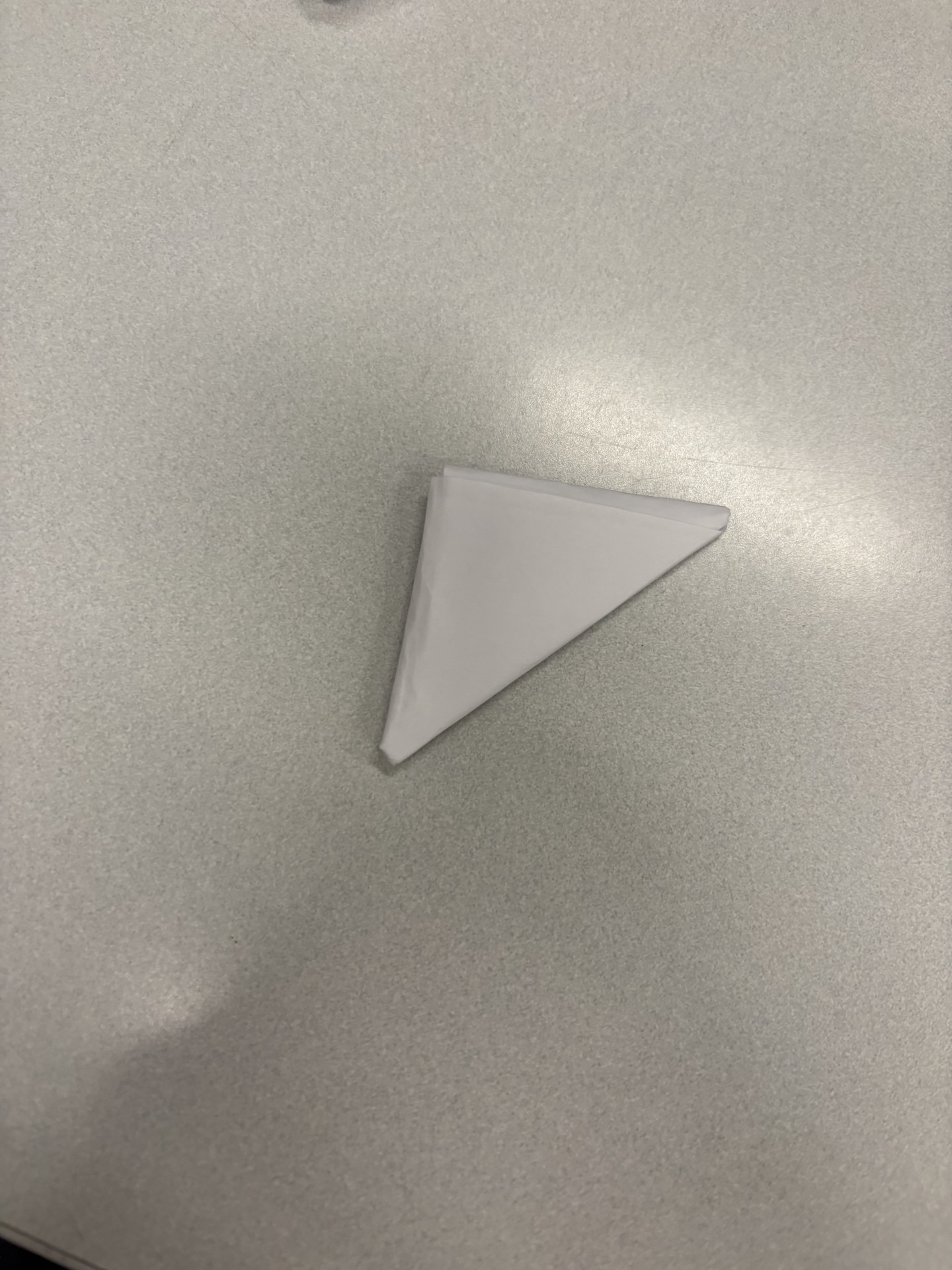
During an in- class activity, my informant showed me how to fold a standard piece of paper into a football that he used to play small desk games with friends as a child. He said said that he learned this in elementary or early middle school and often created these footballs while bored in class. It was a fun way to stay busy and play with friends when class allowed it.

Text:

My informant repeatedly folded a standard 8×10 piece of printer paper, ensuring tight, straight folds with no unnecessary creases. The shape is formed by folding triangles into one another, making the final product dense and sturdy. My informant used an older YouTube video for assistance to remind him of some of the steps. He demonstrated the folding process and explained key details, such as the aforementioned tight folds, minimal creases, and common mistakes people make when folding them.

The final result is the Paper football pictured above, which can be used to play a fun game with a friend. Each takes a turn: one holds their fingers in the shape of a goalpost, the other positions the football in a punting position by holding the top corner and pushing down so it stands vertically. The “kicker” then flicks the football, propelling it forward into the goal. The player who gets five goals first wins.

Analysis:

It is interesting that he called it a football. I had never heard it called a paper football before, but when he showed me the process, I immediately knew what he was talking about, which I called a “paper triangle.” It’s funny, because I also learned how to make those from friends back in elementary school. These kinds of foldables often appear when we’re supposed to be learning, paying attention, or otherwise doing something else. Due to their location, students had to be somewhat sneaky when creating or playing with them, keeping them hidden from the teachers.

It is also a perfect representation of school children’s folk art. It is an item made informally from mass-produced materials, that’s taught from student to student, or unofficially online, and holds no monetary value. However, it does hold sentimental and nostalgic memories for the children and communities who grew up with these.

It is also interesting how he used some assistance from a random YouTube video. This reminds us that folklore continues to thrive online. There wasn’t one specific “right” video. Although the end product is roughly the same, each creator has a slightly different way of folding the paper or presenting the instructions, giving the process variety. Even though the digital tutorial exists, he still showed me in person how to make it, and the details (described earlier) he added were quite interesting and different than what the video did or could have mentioned.

Origami Cranes

Informant: “I learned origami as a child in my home. My siblings were the ones to teach me. My parents had bought instructional books for my older brother and sister and before I could read, they were teaching me to fold paper cranes and frogs. At school, I would habitually fold scrap paper into birds and other creatures and sometimes gift them to friends or teachers. If asked, I would happily show my friends how to make origami creations of their own, as my siblings had for me.”

Context: Informant is a 23 year old Japanese American USC student who grew up in Lancaster, CA. He also recalls how often other classmates would make things out of paper in his elementary school. Fortune tellers, paper airplanes, and other origami animals were among the many things he learned to make when he was younger, usually taught by family.

analysis: Origami is a classic example of material folklore. This material folklore tradition may have a deeper meaning to the informant’s family due to his Japanese cultural heritage, because origami originated in Japan and has been taught across multiple generations. It’s interesting how the origin of this folklore has adapted and changed over time. Although the original teachings of Origami may have required someone to physically be there to teach you, it has been more commercialized due to its instructions being published and spread in kids books across the world. Also, being able to make Origami swans in school is a way for children to socially collaborate and interact with one another. Its a living tradition amongst children, and is still shared even today.