
Category Archives: Material

Catholic School Christmas Tradition

Age: 22

Text:
“When I was in grade school, I went to a Catholic School, so they taught us about the history and the tradition of Saint Nicholas. Around Christmas time, we would all have a set time where we would put our shoes outside, and then we’d have classes normal. All of a sudden, the teacher would say, ‘Oh! Saint Nicholas was just here. He left you guys gifts.’ We’d go back to the hallway, and our shoes would be filled with candy and gifts.

Context:
A boy from Kansas City, Missouri discussing a Christmas tradition/legend he experienced in his Catholic elementary school, celebrating the holiday through Saint Nicholas.

Analysis:
It is interesting to see that rather than discussing Santa Claus, the more commercial version, the Catholic school was pushing forward Saint Nicholas. It also reminds me of a holiday/tradition that I used to celebrate (a Latina girl from LA), called Dia de Los Reyes Magos, otherwise known as The Three Kings Day, which is celebrated on January 6th, commemorating their long journey to baby Jesus. You place your shoes outside, overnight, and the Kings fill them with candy and gifts. Christmas is typically celebrated with family, so this Catholic school adapted and combined the tradition of Santa bringing gifts and The Three Kings filling shoes with gifts to create a new Christmas tradition each year at this Catholic school.
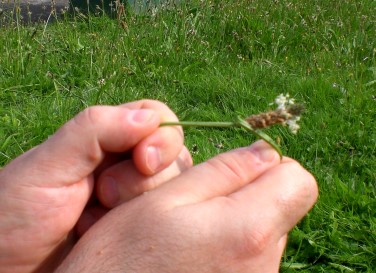
How to Turn a Common weed Into a Weapon

Ribwort Plantain Gun

context:

This is a techniques of turning a common Ribwort Plantain into a catapult. This technique was collected form my grandfather who grew up in Georgia and how to do this when he was very young.

Text:

This is the ribwort plantain, and it is very common in Georgia, where I grew up. My grandfather taught me how to turn one of these into a gun by folding the stem over itself and pulling hard to launch the bulb at the very top. My sister and I had full-on wars where our only artillery was this common weed. My grandpa told me that he himself learned it from his grandfather, so I assume this simple trick is very old. The origin of this practice is unknown, but I assume it exists in most places where this plant grow

The White Lighter (Bic)

Background on Informant:

My informant is a 40-year-old student from California. I know him from Discord, where we often play video games. He explained that he first heard about the superstition in high school, especially among his peer group, who used to smoke weed

Text:

Interviewer: Can you tell me about the white lighter superstition?

Informant: Yeah, so growing up, I was a stoner, and my group always had lighters for smoking weed right? Well, I always remember people freaking out about white lighters, BIC lighters to be exact, some wouldn’t even touch one, like they wouldn’t even smoke weed if that was the only lighter.

Interviewer: Why?

Informant: So the story goes that all these great musicians that passed away, like Kurt Cobain, Jimi Hendrix, Elvis Presley, all had white lighters in their pockets when they were found dead.

Interviewer: Have you heard about this anywhere else?

Informant: A few times, usually at bars, someone asks for a lighter to spark a cigg, and a white one comes out, it’s pretty funny some of the reactions.

Interviewer: interesting so it is believed that if you use a white lighter, you die?

Informant: It’s not that cut and dry; it’s more like IF by chance it does have something to do with a white lighter, there are so many other colors, why tempt fate?

Analysis:

This is a great example of a modern superstition. BIC lighters were not introduced until 1973, which shows that superstitions are still being created and spread in modern culture. The belief is tied to celebrity deaths, like musicians like Kurt Cobain, Jimi Hendrix, and Elvis Presley. These were iconic musicians that were deeply loved and mourned upon their death, that significance is why I believe the superstition holds any validity. The superstition’s transmission is horizontal through friend groups, specifically stoners and smokers (due to the use of BIC lighters),  as my informant explained, he heard it within his group of marijuana smoking friends. Even though there is no factual evidence linking white lighters to these deaths, the belief continues because of the fear and uncertainty, this shows symbolic thinking because this group believes that the lighter could change outcomes. This superstition also functions as a form of group identity, as well as displaying multiplicity and variation as not just stoners follow the white lighter belief but cigarette smokers sometimes do too.

Black Milk Tea

Text: Below is a performance describing the consumption of black milk tea family ritual.

The Interviewee was asked to recount any folklore or superstitions he remembered.

Interviewee: Another, I guess, family tradition or superstition we have, you can also call it a superstition, like, uh, my Grandpa on my Dad’s side of the family always, he would always make black milk tea, brew, almost boil, these black tea leaves, concentrate it super, super hard, and then, like, add evaporated milk to it, and would alway add two cubes of sugar to it. That was just like his tradition.

Interviewer: And what was that supposed to bring, or, what is the purpose of that?

Interviewee: So, actually, like my Grandpa, and especially, like, my Dad’s side of the family, like, they, uh, suffered a lot during the Cultural Revolution in China. I’m not going to go through that, but there’s, like, a whole thing you can look at it. Um, it was also even hard to get black tea leaves during the Cultural Revolution during that time, so like for them, those black tea leaves that they had was, like, almost like sacred to them. Even though now it’s like fifty years later, and, like, that chaotic time is now passed, even I still, like, brew black tea leaves the way my Grandpa used. So, it’s like, I guess it’s like a tradition that, like, I’ve held on to even though he’s passed it on.

Context:

This excerpt is from a conversation with a grad student studying Biology after a MMA (mixed-martial arts) practice. The student was raised in Walnut, California, and has parents that are Chinese immigrants. Currently, the ritual consumption of black milk tea is performed by his father and grandfather whenever they want to bring about good luck, but historically, during the Cultural Revolution in China, it was performed rarely, only every once in a while, when they could find black tea leaves, living in extreme poverty.

Analysis:

This example illustrates how tradition can endure as context and place change. The original habit of consuming black milk tea was informed by extreme poverty, where the consumption of the tea’s ingredients could only happen rarely due to the circumstances of famine. Now, the tradition endures as a ritual consumption of the black milk teas, to recall that time in the past, and signify the surviving that took place. The original creation of this black milk tea could only happen when interviewee’s father and grandfather were lucky enough to find the ingredients, so now, even though the ingredients now take no luck to find, the tradition has held on to that feeling, as it now conveys good luck and fortune.

Birthday Noodles

Text: Below is a performance from a student describing a Birthday tradition.

Interviewer: Are there any superstitions you know or follow for certain events?

Interviewee: Yeah, so uh, in my family especially, anytime there is, like, a birthday for someone, we eat noodles for their birthday, and, if it’s like my dad’s birthday, we and my family’s whole small family will eat noodles because noodles are, like, long, and that long shape of noodles signifies, like, longevity.

Context:

This excerpt came from a conversation with a 26-year-old grad student who grew up in Walnut, California, and whose parents are both Chinese immigrants. He partakes in this ritual when he or one of his family members celebrates their birthday.

Analysis:

This folk tradition of eating noodles reflects the very common role of food consumption in folk traditions, where a food is consumed for its characteristics. Other examples of this include eating coin-shaped objects for wealth in Lunar New Year, and eating fish for fertility. Here is showcased the sympathetic magical effect of food in folk tradition, as the person eating the food magically takes on the qualities of the food they consume.