Text: Below is a performance about a Legend of Flight MH370:
Interviewer: So what conspiracy theories have you heard or do you believe?
Interviewee: This is not one that I believe, because, I think there is no definite conclusion on what happened, but, for sure one I’m interested in, like, the disappearance of flight MH370, an airplane that took off in, like, Singapore, or something like that, and, like, rerouted and no ones knows where it’s been, no one can find out any materials of its crash, or anything, and it’s, like, really fascinating because that points to so many other conspiracies, like aliens, or other life on Earth, or whatever it is, like, for a flight to completely lose contact, and, like, for no one to be able to find the people in it, or find the remains of it, is very scary, very interesting, given that it hasn’t been solved yet. It’s, like, a conspiracy theory that really interests me, and, I mean, I sometimes want to, like, try to think on my own, like, what could have happened?
Interviewer: Do you have any, like, belief of what’s possible, of what could’ve happened, any theories?
Interviewee: I feel like, definitely, it was not related to aliens. I think it was probably, like, an inside job, or something, by like, you know, I don’t know who I might’ve been because, like, a lot of those controls that you have to turn off for it to get off the radar, are stuff you can only do from the cockpit, so, like maybe, along those lines, but, it for sure probably crashed somewhere where it’s going to be really hard to find, and they probably crashed there because it’s hard to find, and, in general, I think, like. barely anything of the ocean has been explored, so given that, it’s probably somewhere in the ocean.
Context:
This question was asked to a fellow USC Forms of Folklore student after a class discussion. This interviewed student grew up in America and is from a Southern Indian immigrant family.
Analysis:
This example illustrates how mystery naturally leads to the creation of folk narratives. Because there was no definitive, full explanation of the crash, multiplicity and variation arises as everyday people try to gain understanding about the flight. We also are able to see how folk narratives overlap each other, as bearers of this legend about the flight use other folk beliefs, like aliens, to make sense of the disappearance.
Interviewer: “Tell me more about this haunted film camera”
TN: “Ok so basically I heard this story of this girls creepy experience with a film camera. She allegedly bought the camera from an estate sale for like 20 bucks because it was a dead guys camera. When she was on vacation she took pictures on it. It was a really old like vintage film camera where you have to get it developed.”
TN: “When she got it developed they shipped the photos to her house and in the package with her pictures was like old photos from the guy who died. Photos of him with family and like his kids, and some really blurry pictures it was really weird cause she didn’t know the camera was used.”
TN: “But the thing that was scary is that his face showed up in pictures she took of her and her parents. Like a shadow behind her in the pictures, and you could see his teeth and his eyes on a lot of the photos, like he was haunting her.”
Interviewer: “Wow thats really creepy, thank you for sharing!”
Context: The informant learned this story on a trip with friends. They all told ghost stories and tales at the fire at night, and this is one of the stories that was performed. The informant is aware that there is no verifiable truth to this story as it came from a friend of a friend of a friend, as is the nature of folklore. However, it has become a ritualistic practice for him where he tells the story whenever prompted, essentially acting as a mechanism for entertainment for audiences.
Analysis: This story is a classic example of contemporary legends or “urban legends” because it blends supernatural horror with relatability and modern technological mediums. This makes the story feel more modern and accessible because cameras are engrained in every aspect of daily life, making it feel visceral and contagious. The story also has “friend of a friend credibility” which isn’t completely valid, but the storytelling nature and the transmission of the story makes it folklore, regardless of its truth. The story essentially is a warning tale, cautioning listeners to not take from the dead, and to leave the past in the past.
Interviewer: “So tell me more about this story, how did it start and become this huge legend?”
MA: Basically, I live in New North, and there’s always floods, or leaks, or water damage happening in the building. There’s this story where this girl died in the communal showers a long long time ago, and her ghost haunts peoples rooms. If your room gets a leak or water damage, she’s picked you to be her next victim.
Interviewer: Interesting, do a lot of people in your dorm believe this or is it more of a joke amongst residents”
MA: “Yea, honestly it’s a big deal and people get kind of freaked out going to the bathroom or showering late at night. My friends place had a leak and people have been teasing her about slipping and dying in the shower so she’s been extra careful”
Context: The informant first heard this story from her RA, and was told the entire dorm flooded the year before. She, and other residents her age tell this story for entertainment value, however some residents, including the one interviewed, believe the story enough to be wary and cautious when in the communal bathrooms.
Analysis: This is a classic ghost tale, however this could be employed from the RA’s to redirect attention from the water problems and convert it into folklore, as its transmission amongst residents is rapid and it seems to have grabbed their attention. This cautionary tale functions beyond a warning, it creates communitas between residents allowing them to bond over their shared belief, and the story evolves and changes the more exposure it gets, feeding more into the folklore.
My friend is a senior at Cal Poly San Luis Obispo. She is in a sorority up there, and we have known each other for about seven years now. Once, when I was up there visiting, she had told me about a legendary Uber driver that everyone in SLO tries to get when traveling to the bars. I asked her about it later over the phone.
Text:
In SLO, there’s one Uber driver, “Big Larry”, who became very popular with the students. My friend explained that he rose in popularity mainly because he was really funny, and his car had colorful lights, great speakers, and a karaoke for passengers to use. He is instantly recognizable with his huge cowboy hat, sunglasses at night in his “funny-looking minivan.” My friend said that “if you get an Uber with Big Larry, you have to take a pic.” Big Larry also makes and posts compilations of the riders with their consent on Instagram and TikTok. He’s “promoting his side hustle,” personal driving service. He does a great job branding his rides, and it has become a ritual for passengers to take a selfie with him. He also posts crazy AI videos of himself doing wild things to get people excited for big events like the Fourth of July, Spring break, and St. Patrick’s Day.
Big Larry typically works weekends, from what my friend explained, and typically around that time and location, drives around kids going or coming from parties. But he does drive during the day and on weekdays too. She believe that “riding in Big Larry’s Uber will guarantee a legendary night out.” They’ll take pics with him and post them on their Instagrams. My friend explained that some of her friends said they had very memorable nights out after riding in his Uber. Also, in her sorority, when someone is out having too good a time, they’re on “Big Larry’s wild ride.” The story gets passed around by students to the point where almost everyone who went to SLO knows Big Larry, and knows how lucky they are when his name pops up on the app.
But not everyone loves the legendary character Big Larry. My friend got to ride with him once, she said that the ride was kind of awkward. They hopped in and asked, “Are you big Larry? He was like yes, want a picture.” They didn’t really want one, because the vibes were off, but took one regardless because it’s what everyone else has done. That said, my friend said that she wouldn’t give him legend status; in fact, he’s kind of a creep-o in her mind based on the encounter and his demeanor. But I guess they do say, never meet your heroes.
Analysis:
From my understanding, Big Larry is something of a local legendary figure in SLO. He is something like a patron Saint of the nightlife and social scene in SLO. He is an omen of luck, and students are happy to see him as their rider. Students learn about his character from friends in casual conversation or on their Instagram. This reflects the traditional word of mouth and more recent digital spread of folklore. But Big Larry represents a new wave of folklore. What was interesting to me was how Big Larry uses Instagram and AI to further bolster his reputation and public image. For example, a recent St. Patrick’s Day post shows an AI video of Larry carrying a pot of gold, calling himself “The Big Shamrock”, and giving gifts to everybody. Big Larry is very much an active participant in forming his own legendary reputation in the neighborhood.
The legend functions as a way to unite the social scene in SLO. Friends can bond over their experiences with Big Larry, or just laugh about how silly his persona is. Either way, it helps people bond and creates a unique community of students who have a distinctly SLO identity. We have strange and unique Uber drivers in LA, and we had some when I went to Santa Barbara, but nothing like Big Larry. It also gives students a way to control the unexpected. They can’t pick their Uber driver, nor can they decide how fun their night out will be. But getting Big Larry is an omen that helps alleviate those anxieties and doubts. When they see him, they know they’ll have a great time, so just relax and enjoy.
Some might believe that the man really is magical, and you should buckle up for a great night when you take his wild ride. But my friend is more of a realist; she doesn’t think anyone else can make or break your night out. That doesn’t make the character any less of a legend, though. People generally remember the hits and forget the misses. Everyone who had the awkward encounter still says their out-of-control drunk friends are on “Big Larry’s Wild Ride.” So the legend still does mean something to them. But, in that context, the legend is kind of flipped and used ironically. We learned that legends aren’t always what the grand stories make them out to be. My friend’s awkward encounter essentially counters the legend; she didn’t have an especially amazing night out. The encounter was awkward, mundane, and altogether just didn’t feel right. But, I would say that her encounter humanized him. In reality, Larry was just a tired guy on a weekend driving students. Larry can curate his online persona, but he can’t mediate every real- world interaction he has. At some point, his persona outgrew his ability to maintain it. In reality, he’s just another guy. Legendary stories don’t focus on these more mundane aspects because people sensationalize them. We often want to believe in larger-than-life figures because it makes the world feel that much more special. When we encounter one of those legendary figures, we might take something from it. In this instance, we might leave our anxieties about the night behind.
The performance is a telling of the Chinese legend of Chang’e and Houyi told to me by a Chinese international student at USC, who I will refer to as “EY.” We are sitting together outside of Taper Hall discussing legends. EY goes on to explain the legend and its connection to the Mid-Autumn Festival, along with the cultural beliefs associated with the story.
TEXT:
EY: The legend story I’ll be telling you about is called Chang’e’s legend. It is a Chinese legend um that explains where we have or how we have the Mid- Autumn Festival in mid September in China. Umm so the story basically is about like there’s a goddess whose name is Chang’e who kinda like takes a pill and turns into a rabbit that runs to the moon on the day of mid-autumn festival. Nowadays people in China usually have moon cakes on that festival to celebrate Chang’e.
Interviewer: Oh that’s interesting
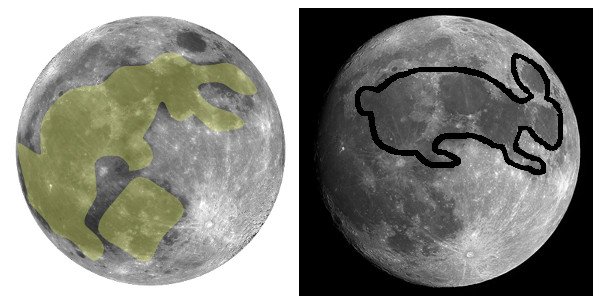
EY: So if you look closely at a picture of the moon, there’s a shade that’s in the shape of a rabbit and so people often see that shade as the picture of Cheng’e. The rabbit shape is Cheng’e.
The longer version of the story is mostly about how previously there’s a god called Houyi who kinda shoots the sun in the sky. Chang’e and Houyi get married to each other. Bu then, Houyi was originally supposed to take a pill but he refused to and like the person who asks him to take the pill hides in their home. When Houyi is out and Cheng’e is home, Cheng’e has no other options but to take the pill. When Houyi returns home, he finds out his wife is gone and he’s sad… He might be sad… He must must be sad.
Interviewer: Probably, he’s probably sad.
EY: Yeah, and so the two are separated and Cheng’e is in the sky.
Interviewer: Okay, that’s cool. Do you think there’s like a metaphor, like a meaning behind the story. A meaning that you or your family and friends associate with it?
EY: Yeah, so it’s mostly about nostalgia and separation, I guess. There’s a metaphor in China where we compare the moon to reunion and a happily ever after.
Interviewer: That’s pretty cool, I never thought of the moon as associated with that before.
EY: And so we can associate the moon with romance or reunion in some sense. In Western [Chinese culture] ideas.
Interviewer: I don’t think that’s very common over here. We don’t typically associate the moon with romance. I think I got the story and the meaning behind it. Is there a personal meaning for you that you take on specifically to that story?
EY: I just felt like the look of the rabbit is very interesting. Yeah if you google a picture of the moon.
*looking up a picture of the moon*
* not the image referenced, but gets the idea*
EY: For example, this part is the rabbit’s head. These two are the ears of the rabbit.
Interviewer: So, I gotta look at it upside down.
EY: Yeah, so this is something that most people don’t usually observe.
Interviewer: Interesting, is that something you can only see at a certain time? Cause there’s different phases of the moon and seasons. Is this something you can only see in September? [The month of the festival].
EY: I guess yeah, but like that time that day is when the moon is like a full moon.
*end of interview
Analysis:
EY explains the story has a significant meaning not just to her, but her family and culture. The story explains the shapes in the moon, gives meaning to culturally significant foods like moon cakes and serves as a fun story to tell. The story is distinctly Chinese and like any cultural story serves as a great reminder for who you are. Without the legend, the mid-autumn festival is really just another holiday. The legend gives the celebration new meaning and amplifies the significance beyond just a fun tradition.
It also gives a standard story to relate to across generations. The culture as a whole can appreciate and enjoy this story. Parents telling their children aren’t just entertaining them. They’re connecting them to their family and culture giving them an identity. It also creates a symbolic meaning that Chinese people can relate to.
EY explained how the story recontextualizes the moon as a symbol of reunion, romance or “happily ever after.” This is interesting because in my culture, the moon doesn’t really mean anything in particular, it’s just the moon. So, to hear how this legend breathes new meaning into the natural world is quite cool. It gives an “everyday” object new culturally significant meaning. In this case, love and reunion. I’m familiar with the idea of roses symbolizing love and affection. But I actually think the moon is better. Unlike a rose, the moon won’t fall apart over time. It might wane, but it always comes back. That makes the reunion and meaning so much more impactful. The same moon can be seen across cities or continents, so it really does connect family and friends. Also, I think there is some more meaning with the moon in that it represents reunion. Every morning, the moon disappears, but we know it’ll come back. That physical movement and repetition adds to meaning that EY explained.
I think that the ritual of eating moon cakes and celebrating during the festival is a way for people to connect with their family, culture, and partners. It’s something that I’ve heard my other friends do, whether they were in China or here in LA. That makes it a cultural signal and reminder of shared belief and identity. It’s given meaning by the story, and eating mooncakes is a way for people to actively participate in that story and culture. The food, story, and importance of the moon itself are great because they can be transmitted anywhere. People can relate to and appreciate that meaning, whether in China or here in America. That story, food, and connection to the moon a ways for people to share their culture without needing to be “at home” for the festival and celebrations. These traditions can be transported and adapted to new regions or environments while maintaining that unique cultural identity.
It’s very interesting to me because, like Houyi, my informant is away from home, separated from loved ones. This must be a very personal story for her, and maybe a very significant one at this moment as well. The legend she chose to share specifically covered longing, separation, and the desire to be together. Whether she meant to or not, the choice to tell that story seems to have been influenced by her feeling away from home; it is probably a way to process her emotions, which is quite cool.