
Tag Archives: Moon Cakes

The Legend of Chang’e and Houyi

Performance Date: 2/26/2026

CONTEXT:

The performance is a telling of the Chinese legend of Chang’e and Houyi told to me by a Chinese international student at USC, who I will refer to as “EY.” We are sitting together outside of Taper Hall discussing legends. EY goes on to explain the legend and its connection to the Mid-Autumn Festival, along with the cultural beliefs associated with the story.

TEXT:

EY: The legend story I’ll be telling you about is called Chang’e’s legend. It is a Chinese legend um that explains where we have or how we have the Mid- Autumn Festival in mid September in China. Umm so the story basically is about like there’s a goddess whose name is Chang’e who kinda like takes a pill and turns into a rabbit that runs to the moon on the day of mid-autumn festival. Nowadays people in China usually have moon cakes on that festival to celebrate Chang’e.

Interviewer: Oh that’s interesting

EY: So if you look closely at a picture of the moon, there’s a shade that’s in the shape of a rabbit and so people often see that shade as the picture of Cheng’e. The rabbit shape is Cheng’e.

The longer version of the story is mostly about how previously there’s a god called Houyi who kinda shoots the sun in the sky. Chang’e and Houyi get married to each other. Bu then, Houyi was originally supposed to take a pill but he refused to and like the person who asks him to take the pill hides in their home. When Houyi is out and Cheng’e is home, Cheng’e has no other options but to take the pill. When Houyi returns home, he finds out his wife is gone and he’s sad… He might be sad… He must must be sad.

Interviewer: Probably, he’s probably sad.

EY: Yeah, and so the two are separated and Cheng’e is in the sky.

Interviewer: Okay, that’s cool. Do you think there’s like a metaphor, like a meaning behind the story. A meaning that you or your family and friends associate with it?

EY: Yeah, so it’s mostly about nostalgia and separation, I guess. There’s a metaphor in China where we compare the moon to reunion and a happily ever after.

Interviewer: That’s pretty cool, I never thought of the moon as associated with that before.

EY: And so we can associate the moon with romance or reunion in some sense. In Western [Chinese culture] ideas.

Interviewer: I don’t think that’s very common over here. We don’t typically associate the moon with romance. I think I got the story and the meaning behind it. Is there a personal meaning for you that you take on specifically to that story?

EY: I just felt like the look of the rabbit is very interesting. Yeah if you google a picture of the moon.

*looking up a picture of the moon*
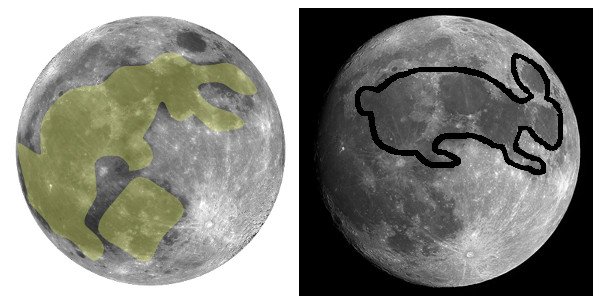
* not the image referenced, but gets the idea*

EY: For example, this part is the rabbit’s head. These two are the ears of the rabbit.

Interviewer: So, I gotta look at it upside down.

EY: Yeah, so this is something that most people don’t usually observe.

Interviewer: Interesting, is that something you can only see at a certain time? Cause there’s different phases of the moon and seasons. Is this something you can only see in September? [The month of the festival].

EY: I guess yeah, but like that time that day is when the moon is like a full moon.

*end of interview

Analysis:

EY explains the story has a significant meaning not just to her, but her family and culture. The story explains the shapes in the moon, gives meaning to culturally significant foods like moon cakes and serves as a fun story to tell. The story is distinctly Chinese and like any cultural story serves as a great reminder for who you are. Without the legend, the mid-autumn festival is really just another holiday. The legend gives the celebration new meaning and amplifies the significance beyond just a fun tradition.

It also gives a standard story to relate to across generations. The culture as a whole can appreciate and enjoy this story. Parents telling their children aren’t just entertaining them. They’re connecting them to their family and culture giving them an identity. It also creates a symbolic meaning that Chinese people can relate to.

EY explained how the story recontextualizes the moon as a symbol of reunion, romance or “happily ever after.” This is interesting because in my culture, the moon doesn’t really mean anything in particular, it’s just the moon. So, to hear how this legend breathes new meaning into the natural world is quite cool. It gives an “everyday” object new culturally significant meaning. In this case, love and reunion. I’m familiar with the idea of roses symbolizing love and affection. But I actually think the moon is better. Unlike a rose, the moon won’t fall apart over time. It might wane, but it always comes back. That makes the reunion and meaning so much more impactful. The same moon can be seen across cities or continents, so it really does connect family and friends. Also, I think there is some more meaning with the moon in that it represents reunion. Every morning, the moon disappears, but we know it’ll come back. That physical movement and repetition adds to meaning that EY explained.

I think that the ritual of eating moon cakes and celebrating during the festival is a way for people to connect with their family, culture, and partners. It’s something that I’ve heard my other friends do, whether they were in China or here in LA. That makes it a cultural signal and reminder of shared belief and identity. It’s given meaning by the story, and eating mooncakes is a way for people to actively participate in that story and culture. The food, story, and importance of the moon itself are great because they can be transmitted anywhere. People can relate to and appreciate that meaning, whether in China or here in America. That story, food, and connection to the moon a ways for people to share their culture without needing to be “at home” for the festival and celebrations. These traditions can be transported and adapted to new regions or environments while maintaining that unique cultural identity.

It’s very interesting to me because, like Houyi, my informant is away from home, separated from loved ones. This must be a very personal story for her, and maybe a very significant one at this moment as well. The legend she chose to share specifically covered longing, separation, and the desire to be together. Whether she meant to or not, the choice to tell that story seems to have been influenced by her feeling away from home; it is probably a way to process her emotions, which is quite cool.

Chang’e: The Moon Goddess

Context:

Y is my other parental figure of mine who grew up in China and is currently living in California. 

This conversation took place over a weekly phone call with my parents after I asked them about stories that they knew from China. 

Text: 

Y: Chang’e is the one we see the shadow in the moon, and the shadow looks like a lady there.

Me: Oh yeah.

Y: But the story goes that there’s a beautiful woman who’s married to a famous archer, and his name is Hou Yi. The guy is the one who, when in Ancient Times, they had 10 suns. The sun in the sky, not the kids. The sun in the sky, when there was 10 of them, the sky was so hot that the earth, the crops couldn’t grow because of the squelching from the sun, and the soil is cracked and everyone was dying from the heat. So Hou Yi, the husband, because he’s a famous archer, he decided to shoot the nine suns down and just leave one of them left.

Me: Uhuh.

Y: So he pulled his legendary, he had this bow that was a legendary sun and succeeded in shooting down nine of the suns. So the earth was back to normal.

Because of what he did, he met the like, goddess, the goddess decided to reward him with some kind of medicine that will make him live forever. The goddess name is… the jade- no, the Wángmǔ Niángniáng, yeah. Hou Yi felt very, unsure about whether he should take the elixir or the medicine because he didn’t want to live forever after his wife dies. Wife is mortal so if he becomes immortal he’s going to be living alone without his wife. So he just put the medicine underneath the bed or in a closet, wherever, but the wife found out about it and she decided to steal it. And after the husband fell asleep, she took the medicine and drank the medicine, all of it. And after, she felt her body get light and she started to float in the air. Then the husband woke up and saw the wife floating away. He saw her floating away and tried to grab onto her but couldn’t because she was already in the sky. He tried to call her to stop but she couldn’t really stop it. When she saw the moon, she tried to land on the moon and she stayed there forever. Because she couldn’t move after and the husband really missed her so he put out her favorite food, dessert like the mooncake, out every night to hope she will see it and return. But she couldn’t return.

After that, on the moon festival, everyone would eat moon cakes and look at the moon where Chang’e lives. And the moon shadow suggests there’s a rabbit called the jade rabbit to keep her company on the moon. So poor Hou Yi put out the food until he died, basically, but she couldn’t return. She became immortal but he was mortal so he died, eventually. 

Reflection:

This is another story that I was told when I was a kid. I remember distinctly looking up at the moon and imagining the lady on the moon and her rabbit. This origin story is interesting because Chang’e is seen as the moon goddess yet the reason why she is up on the moon is for selfish reasons. Additionally, this plays into the traditional view of the moon as a feminine symbol while the sun is a masculine symbol. While the sun is not her husband, her husband was the one who shot down the other suns in order to restore peace to Earth. I think it is also interesting how the tale affects the food that we consume during the festival as the egg yolks in the mooncakes are meant to represent the moon in the sky. Some versions of the story also explain her reasoning for taking the medicine because they portray her as someone who previously worked in heaven in the Jade Emperor’s palace before she was sentenced to earth for breaking a vase. 


“The Legend of Chang E.” The Legend of Chang E, http://www.moonfestival.org/the-legend-of-chang-e.html.

Legend behind Chinese Mid-Autumn Festival

Nationality: French/ Chinese
Age: 23
Occupation: Accountant
Residence: Los Angeles
Performance Date: 2/25/2020
Primary Language: English
Language: French, Mandarin

The following story was told to me by my friend:

So in China we have the Mid-Autumn festival, as I am sure you have heard of, the mooncakes are famous. But, what a lot of people do not know is the myth of how it came to be. It all became long ago. There is a princess who lives on the moon in her moon castle with her little bunny. And as it goes, on the full moon -the 15th day of the month on the Lunar calendar- the princess could see Earth at its fullest. Every full moon she would look down at earth and she would always look at this one farmer and she eventually fell in love with him from afar. So one day, she went down to Earth and disguised herself as a human. Her and the farmer fell in love and she was happy on Earth. Then one day her brother noticed she was missing, so he searched for her and found her on Earth having married a mortal human. Outraged, he came down to Earth, and took her from her lover since it was a disgrace that a god would marry a human and he took her back to the moon. There, he imprisoned her in her castle and she could no longer see her lover. Eventually, the other gods felt bad for her because she was so very sad. So they made the agreement that in Autumn on the full moon she is allowed to go down once a year to visit her lover. So, the festival happens on the full moon on the 15th in Mid-Autumn every year and it is all about reunion and time with loved ones. 

Background: 

The informant is ½ Chinese and ½ French. While she spent the first 13 years of her life in Paris, she moved to Shanghai for high School to reconnect with her Chinese heritage. This story is one of her all time favorite stories from Chinese culture that her grandmother would tell her. She holds it very close to her. 

Context: 

The informant is a good friend of mine, and the conversation was held organically as she was reminiscing about things she loves about her culture one night over dinner at an Italian restaurant in downtown Los Angeles. 

My thoughts: 

I found this to be such a cute and lovely legend to how the festival came to be. Another one of my friends loves the Mid-Autumn festival. He is from Vietnam though, and while he never mentioned this moon princess story, he also loves the festival and what it signified for him and his friends and family spending time together. I love how this festival brings up such good memories for many of the people I have spoken to and it shows such a wholesome lineage between cultures.

The Moon Festival

Nationality: Taiwanese-American
Age: 22
Occupation: Student
Residence: Los Angeles
Performance Date: 4/5/2019
Primary Language: English
Language: Mandarin Chinese

Main Text

Subject: I feel like The Moon Festival for us is like the lowest key of the holidays, I think because the activity is usually just like, eating mooncake? And my parents aren’t like, particularly handy with baking, so we always just like, buy it from the store…maybe like Ranch 99, or Sheng Kee (subject laughs). And then…we’ll like have, maybe like, two sets, and then we just like, have it our house, and like, we’re sneaking bites up until the holiday, and then, the night of, I think we just like, prop up a couple of chairs, and like, sit outside and observe the moon and my parents will like, tell the same stories. Um…and then, you like, go back inside.

So like the whole…the whole observing of tradition takes, maybe like an hour. But, I think, like having the mooncake in the house is like pretty common, like having it for two or three weeks before and after.

Background

The subject is a 22-year-old Taiwanese-American woman in her fourth year at USC. Her parents are immigrants from Taiwan, and celebrating Chinese festivals have been a family tradition since childhood.

The interviewer is a 21-year-old Taiwanese-American student in his third year at USC. As someone who is from the same folk group, he is familiar with most major Chinese festivals.

By “tell the same stories,” the subject is referring to myths about the Moon Festival. Previously in the interview, the subject was asked to retell the myth of Chang-E (嫦娥), the immortal lady in the moon. However, the subject was unable to tell the myth in full without the interviewer being requested to fill in several gaps in the story.

Context

Growing up, the subject considered the observance of Chinese festivals such as this one a normal part of life. She grew up in Sunnyvale, California, where there were many Taiwanese people also participating in the tradition of celebrating these festivals. For her, the tradition was analogous to a Catholic family going to mass—something that was specific to that family and its folk group, that not all families (especially those outside the folk group) did.

The subject thinks about her family’s observance festival within the greater context of her family having a tradition of observing major Chinese festivals. She values the comfort of how the annual routine of returning home to celebrate these festivals reaffirms the stability of her family’s dynamic, relative to other Taiwanese-American families she has grown up with. Over the years, she has witnessed the families whose children are closer in age experience dramatic shifts in parental dynamics, after the children have left for college. Because of those shifts, those families tend to be less consistent in maintaining festival observances.

Unlike other families whose children are closer in age, the subject has two younger sisters. The middle sister is seven years younger than her. Because of the children’s large age gaps, her parents have continued to stick to the same everyday routines, such as driving the kids to high school, that the subject has known growing up. In a way, the family’s annual festival observances parallel the seemingly timeless everyday routines that the subject has grown up knowing.

Interviewer’s Analysis

Despite the brevity of the festival observation described, there are several notable items of folklore within. One is the iconic mooncake, which, beyond visually resembling the moon, was historically used to convey secret messages during wartime. Some modern, factory-produced mooncakes still reference this tradition, by including paper messages inside the mooncakes themselves, or by printing Chinese text on the surface of the mooncake. The sharing of messages through mooncakes, once done in personalized privacy, has now become commodified and publicized. The fact that the subject’s family eats mooncakes while sharing traditional Moon Festival myths adds a postmodern twist to the sharing of mooncake messages. It is a repetition of stories from the past in a present where a family watches the moon in private, while consuming mass-produced mooncakes with mass-produced text inscriptions. Moreover, the parents repeat this tradition every year, telling the same stories, only for the subject and her siblings to continuously forget them, almost as if so they can be annually reminded of them again. Is this truly a preservation of tradition, or is this an observation of selective tradition decay?

Moon Cakes

Nationality: Chinese American
Age: 20
Occupation: Student
Residence: Los Angeles
Performance Date: 4/19/12
Primary Language: English
Language: Chinese

The world used to have 10 suns, but a man took arrows and shot them down until only one sun was left. He had a beautiful wife that wanted to become immortal. One day, the wife found her husband’s medicine and ate it, turning into an immortal fairy. She flew away to the moon where all the fairies lived and the woman brought a rabbit with her. Even though the husband was angry, he did not shoot down the moon because he loved his wife so much.

Whenever my informants family buys mooncakes (the Chinese sweet cakes that are consumed on/around Chinese New Year), there is a picture of a lady included in the package. Neither he nor his family is quite sure how this story relates to mooncakes, but they all agreed that the lady in the image is the lady from this story. He first heard this story from his mother when he asked about the picture. Unfortunately, my informant did not remember many of the details from this story, so it is difficult to analyze it without explanations for why she left her husband, however it is worthwhile to note that this story serves as an origin story for the rabbit on the moon visible if you turn your head to the right.