
Tag Archives: Narrative

The Legend of Chang’e and Houyi

Performance Date: 2/26/2026

CONTEXT:

The performance is a telling of the Chinese legend of Chang’e and Houyi told to me by a Chinese international student at USC, who I will refer to as “EY.” We are sitting together outside of Taper Hall discussing legends. EY goes on to explain the legend and its connection to the Mid-Autumn Festival, along with the cultural beliefs associated with the story.

TEXT:

EY: The legend story I’ll be telling you about is called Chang’e’s legend. It is a Chinese legend um that explains where we have or how we have the Mid- Autumn Festival in mid September in China. Umm so the story basically is about like there’s a goddess whose name is Chang’e who kinda like takes a pill and turns into a rabbit that runs to the moon on the day of mid-autumn festival. Nowadays people in China usually have moon cakes on that festival to celebrate Chang’e.

Interviewer: Oh that’s interesting

EY: So if you look closely at a picture of the moon, there’s a shade that’s in the shape of a rabbit and so people often see that shade as the picture of Cheng’e. The rabbit shape is Cheng’e.

The longer version of the story is mostly about how previously there’s a god called Houyi who kinda shoots the sun in the sky. Chang’e and Houyi get married to each other. Bu then, Houyi was originally supposed to take a pill but he refused to and like the person who asks him to take the pill hides in their home. When Houyi is out and Cheng’e is home, Cheng’e has no other options but to take the pill. When Houyi returns home, he finds out his wife is gone and he’s sad… He might be sad… He must must be sad.

Interviewer: Probably, he’s probably sad.

EY: Yeah, and so the two are separated and Cheng’e is in the sky.

Interviewer: Okay, that’s cool. Do you think there’s like a metaphor, like a meaning behind the story. A meaning that you or your family and friends associate with it?

EY: Yeah, so it’s mostly about nostalgia and separation, I guess. There’s a metaphor in China where we compare the moon to reunion and a happily ever after.

Interviewer: That’s pretty cool, I never thought of the moon as associated with that before.

EY: And so we can associate the moon with romance or reunion in some sense. In Western [Chinese culture] ideas.

Interviewer: I don’t think that’s very common over here. We don’t typically associate the moon with romance. I think I got the story and the meaning behind it. Is there a personal meaning for you that you take on specifically to that story?

EY: I just felt like the look of the rabbit is very interesting. Yeah if you google a picture of the moon.

*looking up a picture of the moon*
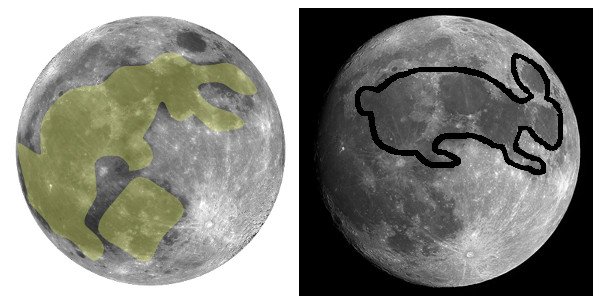
* not the image referenced, but gets the idea*

EY: For example, this part is the rabbit’s head. These two are the ears of the rabbit.

Interviewer: So, I gotta look at it upside down.

EY: Yeah, so this is something that most people don’t usually observe.

Interviewer: Interesting, is that something you can only see at a certain time? Cause there’s different phases of the moon and seasons. Is this something you can only see in September? [The month of the festival].

EY: I guess yeah, but like that time that day is when the moon is like a full moon.

*end of interview

Analysis:

EY explains the story has a significant meaning not just to her, but her family and culture. The story explains the shapes in the moon, gives meaning to culturally significant foods like moon cakes and serves as a fun story to tell. The story is distinctly Chinese and like any cultural story serves as a great reminder for who you are. Without the legend, the mid-autumn festival is really just another holiday. The legend gives the celebration new meaning and amplifies the significance beyond just a fun tradition.

It also gives a standard story to relate to across generations. The culture as a whole can appreciate and enjoy this story. Parents telling their children aren’t just entertaining them. They’re connecting them to their family and culture giving them an identity. It also creates a symbolic meaning that Chinese people can relate to.

EY explained how the story recontextualizes the moon as a symbol of reunion, romance or “happily ever after.” This is interesting because in my culture, the moon doesn’t really mean anything in particular, it’s just the moon. So, to hear how this legend breathes new meaning into the natural world is quite cool. It gives an “everyday” object new culturally significant meaning. In this case, love and reunion. I’m familiar with the idea of roses symbolizing love and affection. But I actually think the moon is better. Unlike a rose, the moon won’t fall apart over time. It might wane, but it always comes back. That makes the reunion and meaning so much more impactful. The same moon can be seen across cities or continents, so it really does connect family and friends. Also, I think there is some more meaning with the moon in that it represents reunion. Every morning, the moon disappears, but we know it’ll come back. That physical movement and repetition adds to meaning that EY explained.

I think that the ritual of eating moon cakes and celebrating during the festival is a way for people to connect with their family, culture, and partners. It’s something that I’ve heard my other friends do, whether they were in China or here in LA. That makes it a cultural signal and reminder of shared belief and identity. It’s given meaning by the story, and eating mooncakes is a way for people to actively participate in that story and culture. The food, story, and importance of the moon itself are great because they can be transmitted anywhere. People can relate to and appreciate that meaning, whether in China or here in America. That story, food, and connection to the moon a ways for people to share their culture without needing to be “at home” for the festival and celebrations. These traditions can be transported and adapted to new regions or environments while maintaining that unique cultural identity.

It’s very interesting to me because, like Houyi, my informant is away from home, separated from loved ones. This must be a very personal story for her, and maybe a very significant one at this moment as well. The legend she chose to share specifically covered longing, separation, and the desire to be together. Whether she meant to or not, the choice to tell that story seems to have been influenced by her feeling away from home; it is probably a way to process her emotions, which is quite cool.

Slit Mouth Woman

Context:

MV: “So there’s this slit mouthed woman from Japan who around the 70s and 80s there were several reports of her walking around Japan with a pair of scissors or a long knife and asking children ‘am I beautiful?’ and if they responded no she would kill them…and if they responded yes she’d take off her mask and show her mouth which was cut from ear to ear and she’d be like ‘am I still pretty?’ and if they said no…she’d kill them and if they said yes she would carve their mouths like hers.”

Q: When did you first hear about the story?

MV: “I personally remember researching about it when I was super into urban legends and was looking into folklore in Japan. I found out about the legend online.”

Q: Have you seen this story told anywhere else?

MV: “Not that I know of. I would love to see one though.”

Q: Have you shared the story with others?

MV: “When I was a bit younger, I would yap on and on about this kind of stuff since I found it super interesting. I think I would just tell people about the legend but not get into detail since I don’t know folktales by memory.”

Q: What significance do you think the story has?

MV: “It’s thought that these occurrences happened due to masculine insecurity from the rising role of women in Japan in the 70s.”

Analysis: The Slit-Mouth Woman (Kuchisake-Onna) tells the story of a woman who in the 70s-80s would roam around Japan with a pair of scissors or a long knife. She would ask people if she was pretty and if they said no, she’d kill them and if they said yes, she’d carve their mouth similar to hers.

Elf Under the Bed

Age: 50s

Text:

I was alone in our creepy apartment in Buffalo, New York, this apartment always gave me the creeps, it was cold and drafty and dark and spooky. My husband was out working or something, I don’t really remember. Anyways, I was laying alone reading my book, one of The Rift War Saga books and, oh! I was pregnant, forgot to mention that. I always have weird things happen to me when I’m pregnant. When it was time for bed, I got up to check that all the doors were locked and to turn the lights off. I turned around from the lightswitch and, in the dark, there was an elf crouched down by the bed that said “you forgot about me”.

Context:

This story was told to me over Thanksgiving break by my aunt, it’s her story and from her perspective. It takes place in my aunt’s old apartment in Buffalo, New York at the time she was pregnant with my cousin, so around 1999.

Analysis:

My aunt is adamant that she saw something but she is also a very rational person so she chalks it up to “pregnancy brain”. The atmosphere of the creepy apartment combined with the book she was reading and pregnancy delusions makes her think that the setting was prime for imagining weird things. 

The Rift War Saga that she was reading is a fantasy series so I theorize that that is the reason a fantasy character manifested itself in real life. This manifestation might be a ghost of the book or of the story, as the elf does not seem to be a specific character from the book. Pregnancy can be seen as a liminal time in between being childfree and being a parent, especially since my aunt was pregnant with her first kid at the time. Being in this liminal stage, alone, in a creepy apartment, and reading a book that challenges the mind to think beyond reality, creates the perfect atmosphere for otherworldly beings to make an appearance. While my aunt may think it’s “pregnancy brain” I find it interesting that all her weird, spooky stories come from the same apartment, she now lives in Oregon and has no stories from her home there. I think this spooky apartment had a specific type of energy that encouraged the supernatural and the manifestation of the creepy elf. 

This story could serve as a lesson about personal safety, my aunt was alone in an apartment that she didn’t feel safe in and pregnant, a state that many societies would deem vulnerable. The moral of the story being don’t be left alone as a woman, especially a pregnant one; or don’t be the one leaving your pregnant wife alone in your spooky apartment or something might come for her. In this interpretation, the elf would serve as a warning for what could happen, as this elf was non-violent but said “you forgot about me” which could be a warning to always check on your and your loved ones’ safety.

The Ghost of Avalon

Text: “In the summer of 1987, right after I graduated from high school, my family rented an old beach house on the 200s block Claressa Street in Avalon on Catalina Island. For those who know Avalon, it was founded in the late 1800s and became an upscale vacation destination in the early 1900s. My great-grandparents had a long-sold off house there and once the iconic Art Deco casino was built in the 1920s, the big bands would come and host their national radio programs from there while dressed-up couples danced the night away overlooking the bay. 

The old beach houses (and Casino) are known for being haunted with spirits from vacations past, but there wasn’t any reason for me to believe it since I’d never seen anything myself in all the years my family had vacationed there. That changed that summer of 1987. 

The original Avalon beach houses all had a similar design with the bedrooms often opening up from each other rather than a hall. In other words you had to walk through one bedroom to get to another, train car style. I was in the bedroom that you could only reach from the one my parents were in, and I had to walk through their room to get to the bathroom.

We would spend the days on the beach and in the sun, and go to bed fairly early since almost all activity takes place there around the ocean. Not much happens at night in Avalon. So after dinner we’d play board games or cards, then go to bed so we could get up early for another day of surf and sun. 

I had gone to sleep that night as always and was awakened by a man standing at the end of the bed looking at me. He was dressed in a dated-style suit with a freshly starched dress shirt with crisp collar points that came up higher on his neck than was the style during the Reagan administration. He was wearing a tie and had a brown hat, rounded bowler style, on his head. He just stood at the foot of the bed looking at me. 

At first I thought I was still asleep, dreaming, or in the confused state between wakefulness and deep sleep. But once I sat up and knew I was 1000% awake and was scared even though he was just standing there looking at me with a benign expression on his face. 

I screamed thinking someone had broken into my bedroom and my mom came running out of her bedroom. She also saw him but knew immediately he wasn’t ‘real’, or flesh and blood like we were. 

She explained to him that he didn’t belong there, that we were in the house now for a visit and that he needed to move along. Just a few seconds later he disappeared into the air. No walking through walls or talking, just dissolved into the air at the foot of my bed. 

I was rattled the whole rest of our vacation but he didn’t appear again. The house is still standing as it was 40 years ago. I’ve walked by it on subsequent trips and thought of the tall, thin man in the suit that visited me.”

Context: This story was shared by the informant, who was a young child at the time of the experience. The event marked a significant moment in the informant’s life, as it was the catalyst for their belief in the supernatural. Prior to this encounter, the informant had not paid much attention to stories of ghosts or spirits, but the vivid and unsettling experience that summer changed their perspective. The informant interprets this as the beginning of their belief in such phenomena, as it was the first time they had directly encountered something they couldn’t explain through logic or reason.

Since then, the informant has experienced several other supernatural encounters, reinforcing their belief in the paranormal. The informant’s perspective is further shaped by the fact that their mother had similar beliefs and, before she passed, shared other stories of her own supernatural experiences. This shared experience between the informant and their mother helped to strengthen their connection to the supernatural world and solidified the informant’s conviction that these types of encounters are real.

Analysis: The figure in the story—a man dressed in an old-fashioned suit—seems to reflect a historical presence tied to the location, adding to the eerie atmosphere of the old beach house. The figure’s benign, non-threatening demeanor contrasts with the fear that the informant felt, suggesting that the supernatural can be perceived as both unsettling and intriguing, rather than immediately harmful.

The way the informant handled the experience—by accepting the figure’s presence and interpreting it as part of a larger, supernatural world—illustrates how personal beliefs can be shaped by direct experiences. This encounter became a touchstone for the informant’s worldview, influencing how they view similar occurrences in the years that followed.

This story also underscores the broader cultural theme of haunted locations, especially in areas with long histories like Avalon. The idea of spirits lingering in places with significant pasts is a common motif in folklore. The informant’s ongoing belief in the supernatural and the continuation of similar experiences suggest that such encounters are seen not as anomalies but as part of a larger, unexplainable reality that transcends time and space.

Informant Info

Race/Ethnicity: White

Age: 55

Occupation: Mother

Residence: Westlake Village, CA

Date of Performance: April 3, 2025

Primary Language: English

Other Language(s): N/A

Relationship: Parent

The tale of Heungbu and Nolbu

Nationality: South Korean
Age: 27
Occupation: PHD Student, Electrical Engineering
Residence: Los Angeles, California
Language: English

Informant: “Nolbu is the older brother. Heungbu is the younger one. Although they are family, Nolbu makes more money and is very greedy. His success puts Heungbu in a bad situation financially. On the other hand, Heungbu is a good person who tries to help other people. So, Heungbu goes to Nolbu’s house to get some rice since he is poor. But Nolbu slaps his face with a spoon and refuses to give him any rice. Nolbu is then going back to his home and sees a bird being attacked by a snake. He tries to save the baby bird by healing its broken leg. Heungbu cures him and lets the bird go. The bird comes back with a seed. A Calabash seed. When the Calabash is grown, he cuts it open and finds tons of gold and money, so Heungbu becomes rich. Nolbu hears his brother became rich by helping the bird, so he breaks a healthy bird’s leg to cure it. The bird then goes to Nolbu’s house and gives him the same seed. But when Nolbu cuts open the Calabash, goblins come out and bite him and take all his money.”

Context: The informant heard this story from his older siblings and claims that it is a common story in Korea. He compared this story to the American story of the tortoise and the hare, saying that it is frequently told to young children like the story of the tortoise. He believes the story is designed to teach kids to avoid greed and help others out of the kindness of their heart rather than to receive something in return. The informant is from South Korea and says that this story has been passed down from generation to generation, mostly orally.

Analysis: I think this tale expresses some cultural and moral values that parents likely wanted to pass down to their kids. The story is relatively simple, with clear moral signals presented throughout, likely to help drive home the point to a young audience. The story clearly puts an emphasis on the idea that kindness can not be (or should not be) faked for personal gain. It also serves to teach children that bad actions can come back to bite you, even if you think you’re tricking the system. Lastly, the story teaches children to be kind, paradoxically, by telling them they will be rewarded for it only if that act of kindness is genuine and not in pursuit of a reward.