
Tag Archives: gesture

Knocking on the head of a virgin

Nationality: Dallas, TX
Age: 20
Occupation: Hospitality

Text:

Perform the physical action of knocking on the head of a virgin.wood, they would knock on the head of a virgin instead. This gesture can also be substituted with the phrase itself “knocking on the head of a virgin” as a form of proverbial speech.

Context:

In high school, the informant learned this saying from a friend who was Greek Orthodox and claimed it as a part of Greek Orthodox culture. Preliminary research has yet to provide any link between this superstition and Greek Orthodox culture, instead pointing towards this practice stemming from urban legend.

Interpretation:

Though the connection between wood as a material and virgin’s heads may seem far-fetched, the substitution of heads for wood is common in the practice of ‘knocking on wood.’ When someone knocks on their own head as a substitution for knocking on wood, they are not only participating in the superstition but also making a joke at their own expense, implying that their head is made of wood rather than brains and thus they are dumb. With this common conflation in mind, knocking on the heads of virgins as a substitute for knocking on wood presents both as a means of participating in the ‘knock on wood’ superstition while making a joke, this time at the expense of a group (virgins) rather than the self. The claim that this superstition comes from Greek Orthodox culture is so far unfounded and inexplicable.
USC Football Superstitions – kick the lamp post

Nationality: Chinese
Age: 20
Occupation: student
Residence: school - California; home - Washington
Language: English

Text:

NC: “Before a football game, when you are walking to the Coliseum, you have to kick the lamp post right before you leave campus or else USC will have bad luck in the game. I have no idea where that comes from, but my friend told me on our way to one of the first football games we went to our freshman year. We saw a bunch of other people doing it too, so we did it. Now, I always do it because I don’t want to curse the team with bad luck. It’s like subconscious, I mean I’m not superstitious about anything else, but I always do it without fail before the game. You only do it before football games too, nothing else.”

Context:

NC is a undergraduate student at USC. She is 20 years old, and she is a sophomore. She is from Seattle, Washington, and did not most of USC traditions before coming to the school. She originally learned of this superstition in the fall of her freshman year. She does not know the origins of this tradition. I collected this superstition in person and recorded her to transcribe what she stated.

Analysis:

University of Southern California, as do many old and large universities, has many traditions that are passed on through new students in each incoming class. Often, the origins of these traditions are lost over the years, as is the case with this superstition. USC has a very large culture that is very specific to the people who are a part of the community, especially regarding football. These might be hand gestures, songs, objects, or in this case, superstitions. Even though many people who attend this school are not superstitious people by nature, they still partake in this game day good luck action. Kicking a lamp post for luck is not based in reason, and probably seems silly to people who are not a part of the community, as is common with superstitions. However, the desire to be a part of the community and partake in rituals nudges people to take part in a superstition they might initially think is illogical. As a person begins to feel the belonging associated with partaking in certain ritual experiences, the person is more and more likely to do the act associated with the superstition, until they believe in the truth of the superstition themselves, essentially causing an illusionary truth effect. This superstition clearly shows cultural influence on a person’s personal beliefs.

Telephone Gesture

Nationality: American
Age: 19
Occupation: college student
Residence: USC
Performance Date: 2/23/2023
Primary Language: English

M is a 19 year old college student. She shares a gesture that she learned from her mother in Colorado Springs when she was a toddler playing pretend.

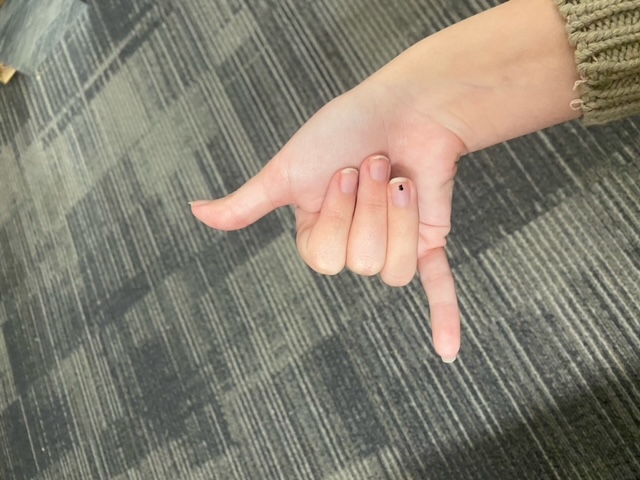
“When you mention you’re calling someone, you put your pinky out as the receptor and the thumb as the transmitter to motion you’re calling someone. When playing with my mom I’d pretend to be calling someone and my mom would answer with her “phone” that was actually her hand.” 

This gesture is particularly interesting because it is rapidly fading out. Now, if you ask a toddler or a child to show you them making a phone call, they’ll put their whole hand flat to their ear, replicating a cell phone. The informant and I are nearly the last generation to learn the gesture of a telephone using our fingers. The gesture is terminus post quem the invention of the dial telephone, and terminus ante quem the generation raised with cell phones. This shows how rapidly folklore changes, and how easy it is to lose folklore. My generation will be the last ones to use the finger gesture, and eventually it will entirely die out when kids barely remember what old phones used to look like. As technology rapidly changes, folklore is changing at an even faster rate than ever before. We have no clue what folklore might look like for children in 20 years. It will be interesting to see what folklore says, and which is phased out. 

The Indian Head Wobble

Nationality: American
Age: 22
Occupation: student
Residence: USC
Performance Date: 2/21/23
Primary Language: English

This gesture comes from my roommate, NH, who is half Indian and participated in Bharatanatyam dance for 14 years.

Text:

“In Indian culture, instead of an up and down head nod that is common in American culture, a  side to side tilt is more common. It is used often when answering ‘yes’ to a question or to indicate that you understand what someone is telling you,” NH said.

Context: 

“I encountered it the most when at dance practice, as my dance teacher would often use it. My grandmother also uses it,” NH said. She also mentioned that as a kid she would sometimes use this gesture after being around her grandmother, but as she grew older, the American up and down nod became more second nature.

Analysis:

After some research, I discovered that this gesture NH described to me is often called the “Indian head bobble/wobble” and can be used to express a range of emotions. One website described an array of bobble subgroups such as “The Hello Wobble,” “The Acknowledgment Wobble,” “The Sign of Respect Wobble,” “The No / Yes / Maybe Wobble,” “The Not Sure / Maybe / Perhaps Wobble,” and “The Got it! Wobble.” I find it very interesting that NH only described “yes wobble” and “the got it wobble.” I’m sure it just takes conversational context to figure out what someone’s wobble means, but it is very fascinating that the same gesture can mean so many things. 

Gesture – “Black Lives Matter”

Nationality: American
Age: 18
Occupation: Student
Residence: Chicago, IL
Performance Date: 2/19/23
Primary Language: English

Text: The above image depicts the gesture, which is essentially a fist.

Context: One of my roommates who is of African American and Puerto Rican descent shed some more light on this gesture. She mentioned that the gesture is a fist and then went into the background of this gesture and how it came to be. She started off by saying, “for years in the African American community…[they] have always used a fist as a significance of saying power to the people, it’s a way to show allyship with each other, like to say I’m with you brother, I’m with you sister…it eventually became the logo of the Black Lives Matter movement”. Overall she said that “it’s always had the same meaning…it was to better the circumstances and oppression that black people face”. I then went on to ask about the importance of this gesture to her and she said that “as a child [she] would watch movies about the black panthers and [she] grew up meeting people that was part of the black panther party or that marched with Martin Luther King or Malcolm X because [her] mom immersed [she] in that stuff…they would tell [her] the significance of the fist and how it was like a signal to each other…like peace be with you brothers”. She went on to talk about how “the gesture took on a different meaning once the Black Lives Matter movement started to gain traction”. Overall, when asked of its importance she said, “it’s important because it shows allyship with each other in the community…it means community and I’m a black woman and I don’t want to be oppressed”.

Analysis: While to others this might look like a simple fist or a sign of victory (like you see in the movies), this hand gesture has so much more meaning to the African American community. Looking back through history they have experienced so much hardship, which is why this gesture has become so important to this community. It could have stood as a sign that one is not alone. Through the struggles, this gesture reminds those within this community to stay strong and that there are people who stand together. We can see this strong sense of community in the African American community during the Black Lives Matter movement, as well as the support from other communities.