Tag Archives: memorate

The Ghost on the Phone

Nationality: German
Age: 25
Occupation: NA
Residence: Illinois
Performance Date: 04/25/21
Primary Language: English

Main Performance:

The M family lives in Lemont, Illinois. An old industrial town south of Chicago, Lemont is proud – almost deliberate – about their town’s culture and influence in Chicago. The town is fundamental to Chicago, one of the world’s largest economic metropolises. Lemont is the convergence of several key waterways – including the canal that reversed the flow of the Illinois River, sending waste south, instead of north, towards the city’s water supply. Lemont is also home to the oldest parish in Chicago – St. James at Sag Bridge. The same hilltop used by French explorers, is home to the 1825 chapel and one of the most haunted areas of Chicagoland.

Mrs. M is the organist at St. James. Around 10 years ago, after finishing playing music for Christmas Eve Mass, Mrs. M locked up the church, went down the hill, locked the campus gate and went home – but forgetting her phone. When she got home and realized her mistake she had her oldest two daughters call the phone to check it wasn’t lost in the car. Instead, a male voice answered the call and said, “Hello, this is Alex.” Now the odd thing is that the phone was found the next morning, where it was left – in the organ loft of the church. Mrs. M was the last person in the church and the one who locked the gate. No ushers, volunteers, clergymen, or anyone with any considerable amount of access to the church and campus is named Alex. What are the odds an outsider broke into the church, was up in the organ loft and answered the phone – while committing a crime – much less leave the phone where it usually lies. The afterlife isn’t as far away as people believe.

Background:

The informant, MK, is one of my close friends from highschool who had heard this story from his wife’s family and their encounter with local ghosts in their neighborhood, Mrs. M being his mother-in-law and the M family being his in-laws. While he has undoubtedly heard this story from them before, he took the liberty of interviewing his in-laws again in-depth to provide this story. Being Catholic, the realm of spirits, souls, and ghosts would not stray too far from his world views.

Context:

Looking to expand my collection’s scope, I contacted my friends from highschool through Facebook and asked if he had any he could share with me. By coincidence I contacted him in the middle of his trip to visit some of his in-laws and he promised to deliver some of the ghost stories he had previously heard from his in-laws.

My Thoughts:

It’s a memorate like this that usually freaks me out the most. Doing some more research on the area explains the myriad of ghost stories originating from a fictional published story involving a ghost haunting the church, as well as the amount of cemeteries around the area, providing that liminal space between life and death for these stories to flourish. Apparently the published stories on the ghosts of Lemont have become a community-wide belief so the ghosts, fictional or real as Mrs. M’s story suggests, only adds to the collective identity of the town and their local ghosts. While the name of the ghost in the published story is not known to me, the fact that this one actually has a name and supposedly spoke on the phone only adds to the level of personal investment that can go a long way into a believable tale. The prospect that it was instead a random person staking out in the middle of the night at church on that particular occasion feels even creepier than a ghost.

White Things: An Account of Demon Possession

Nationality: Indian
Age: 52
Occupation: Homemaker
Residence: Mumbai, India
Performance Date: 28/04/2021
Primary Language: English
Language: Hindi

The Interviewer will be referred to as ‘I’, and the informant as ‘S’. Explanations and translations for Hindi words will be italicised and in parentheses. The Informant is a 52-year-old Punjabi mother, born and raised in North India.

S: We’ve had a possession in our own family! If you talk to mama (the informant’s mother), her own sister died… she was like that. She was a very bright, bright, exceptionally bright kid. I think she was just younger than mama, the second born. She was in college, one of those typical toppers, this and that, very bright. And… now I don’t know too much, but there was a family gathering, and it was like, “kisi ne kuchh khila diya hai,” (someone has fed her something) because she was… [she acts it out, makes a face by crossing her eyes and rolling them back, making a strained noise] like, as if she was possessed at times, she was acting crazy. And, I think she got… I don’t exactly know how she went, but she went (died). She was in college when she went, so young. I don’t remember exactly how, but I remember that this whole thing, I remember as a personal thing, I was always told this, we all were, in the family, because sometimes mama would tell us she was still around because her going wasn’t peaceful, not content, she would… like, feel the spirit sometimes.

I: Was this pre-partition or post?

S: Post, post. This was mama’s younger sister. She died when she was in college, but she was born pre-partition. See, what they said to us was that one of the relatives who was jealous had fed her something, haan (yes), that’s why they told us, “Safed cheez kisi se mat lo.” (Don’t take anything white from anyone.) Even when we were little, mama always told us, be careful of things people offer you, but never accept something that is white. She specified that. Like kheer (a white staple dish, like a sweet rice pudding), so never take kheer from anyone. Jaadu tona (Urdu and Punjabi for witchery, sorcery), is what it’s called in Punjabi, where someone’s fed you something, or you’ve ingested something, you’re spelled and then you act differently like you’re possessed or cursed, under nazar (bad luck, evil). You do weird things, then, act like you’re… you know, crazy, so you dance, or tremble, or shake, sometimes make weird noises. This story became, kind of… a teaching, a lesson for us, even though nobody really knows the whole story, not even mama.

Analysis:

Within Indian culture, the idea of nazar is common, something you need to caution everyone about and physically ward off—a method of warding off nazar is detailed, in part, in “The Lemon-Chilli Bad Luck Repellent” (http://uscfolklorearc.wpenginepowered.com/the-lemon-chilli-bad-luck-repellent), and a method used to ward off demon possession is detailed in “Don’t Kick the Watermelon!” (http://uscfolklorearc.wpenginepowered.com/don’t-kick-the-watermelon!)—whenever it’s suspected to have fallen upon someone. Simultaneously, the act of “behaving weirdly” is often generalised and exaggerated, the concern can be misplaced when put down to nazar or possession. This is why I asked the question about the partition: the partition was a turbulent time, after finally gaining independence from their colonizers after centuries, having to uproot and move from one region, now in Pakistan, to another, in modern India, through all the trials and tribulations of the time… well, it would have been very traumatic for anyone, especially a child. Therefore, I wanted to ask that question to bring another idea into play: the idea of untreated and un-recognised trauma, manifesting as this “weird behaviour”, being thought of as possession or nazar, leading to an early, unexplained death… it’s a grim thought, but that sequence of events is familiar, even without the supernatural explanation and course of action. However, this woman’s story is now a lesson to the children and adults of this family, a mysterious thing, the story being exaggerated and mystified further with time, while also being a lesson to not take things, especially white things (a common superstition), from anyone, rooted in a folk belief that these invite nazar, or even witchery. The evil eye, or nazar, is also observed in ancient Mesopotamian and Egyptian ideology and texts, where they used incantations to ward off negative spirits and witchery, resulting in odd behaviour or sickness. [For more on this, see: “MESOPOTAMIA AND EGYPT.” Beware the Evil Eye: The Evil Eye in the Bible and the Ancient World: -Volume 1 Introduction, Mesopotamia, and Egypt, by John H. Elliot, 1st ed., The Lutterworth Press, Cambridge, 2016, pp. 77–104. JSTOR, https://www.jstor.org/stable/j.ctt1cgf2hs.9.]


Memorate of Racism and Corona Coughing

Nationality: British European
Age: 22
Occupation: Student
Residence: Sherman Oaks, California
Performance Date: March 10, 2020
Primary Language: English

Informant: My editing partner told me about how she started having a coughing fit in class and the teacher actually asked her to leave. Like it wasn’t even the cough associated with Covid, it was a wet cough that she had been suffering from for a while. Everyone in class was freaking out even after she left.

Interviewer: She actually left the class? Do you think there was any racism as a part of it?

Informant: Oh it was racially charged. To say that it wasn’t racially charged would be f***ed. She’s f***ing asian.

Background: My informant and I were discussing the fear that was taking over the university campus and she brought up this story she heard from a friend.

Context:

Thoughts: The reason why I had to ask a clarifying question was because I suspected the student in question was Asian. At the time a lot of Asian students were facing racists slights such as this. It makes me wonder if the informant’s friend still would have been asked to leave the class if she wasn’t Asian.

Shadow Person Memorate

Performance Date: March 8, 2020

Context: 

There is a message board, or “thread,” on the website Reddit, one of which is titled r/AskReddit, in which people post open ended questions for anyone in the Reddit community to answer. I, the interviewer, posted this question: What was a real life experience you had with a creature from a legend (ghosts, aliens, La Llorona, Big Foot, etc.)? The reddit user “Thatoneguy111700” replied in the comments, “Saw a Shadow Person in my living room. My dogs saw it too.” I then messaged Thatoneguy111700, explained that I was looking to collect his account, and asked him for the complete story. He agreed to tell me, and his full message is transcribed below.

Piece:

It was October 26th, 2016, around 8 to 8:20 PM. I was walking into my living room when I saw my three dogs barking at the back door to be let in (the back door was all glass with two big glass panes on either side of it). The only lights on were the ones inside so I could see a perfect reflection of the room around me in the glass. I was going to go let them in when they suddenly just stopped barking and looking to my left. I was weirded out so I looked in the reflection too. There, standing in the corner of the room, was this big-ass, really black shadow. I was maybe 5’7″ at the time and this thing towered over me, even with its shoulders hunched over. The four of us just stared at this thing until it seemingly noticed me looking at it and went into the hallway. I stood in place for a good 5 minutes, like I was frozen. I tried recreating it on several occasions, to see if I’d made the shadow, but my shadow either didn’t reach that part of the wall or wasn’t dark enough or simply wasn’t big enough.

Analysis: 

This memorate shows similarities to a ghost sighting, but the use of the title of a shadow person removes the religious and spiritual connotations of a ghost.

Screen capture of question posted on r/AskReddit with Thatoneguy111700’s reply
Conversation over Reddit with Thatoneguy111700

Mardi Gras Cups

Residence: New Orleans
Performance Date: 4/20/20

Main Piece:

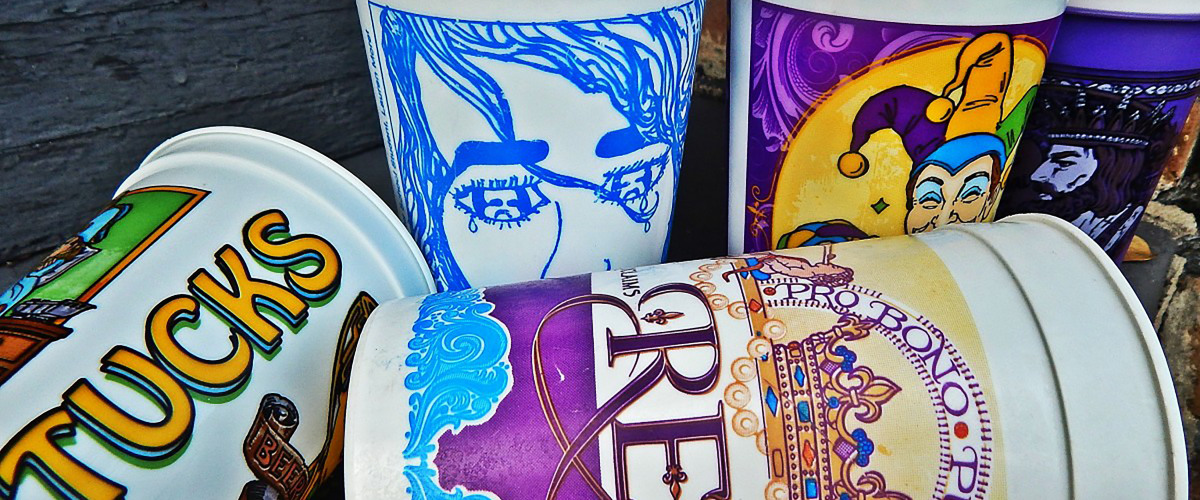
SG has been to Mardi Gras almost every year since she was a little kid. Decorated plastic cups are a typical throw in every Mardi Gras Parade. Parades, known as Krewes to the locals, each have a unique name and theme to them. Riders in each parade have “throws”, which are items riders throw off of floats. These commonly include beads and doubloons, but what is solemnly talked about is cups. Cups are a collectible item during Mardi Gras as they have more value than most other throws. Not only can you keep it as a memorate of a parade, but you can use it for years to come. Families collect these and use them as normal drinking vessels in their homes and lives. Go in any cabinet and next to the glass cups you will find various Mardi Gras cups themed to each parade.

A Swig of History: The Mardi Gras Cup | Where Y'at
https://www.whereyat.com/a-swig-of-history-the-mardi-gras-cup

Context:

SG is my mother and has been to Mardi Gras with kids since I was born. She is from New Orleans and attends every year. This was taken during a conversation with her in our backyard while reminiscing Mardi Gras. She still collects cups and send me them each year.

Thoughts:

As a New Orleanian and a avid fan of Mardi Gras, as I have been many times before, I did not realize that this was not much of a practice outside of New Orleans, collecting cups to use throughout the years. For instance, after my first year at USC, I missed Mardi Gras for the first time in my life. As a response I got my parents to ship me a King Cake and some decorated cups. In the house I was living in, I used them frequently, and people always commented on the designs on the cups calling them unique. I was so used to using the cups that I never took a moment to think about the designs. Each design reflects the idea of that parade. Krewe D’etat, a parade devoted to a satirical take on the previous year, would have cups that mock events from the last year. Krewe of Muses, an all female parade, would have cups with feminine symbols such as the iconic red lips symbol of the krewe. Each design is unique and can only be gotten if one attended that parade in that year.