
Tag Archives: ceremony

Mitmit Ceremony

Background: The informant was born in the Philippines to a Filipino mom and a white dad, and spent his childhood, from age 2 to 13, from 1966-1977. Yap is a small group of islands in Micronesia, of which he grew up on the main island of Yap. I was told of this legend over the phone. 

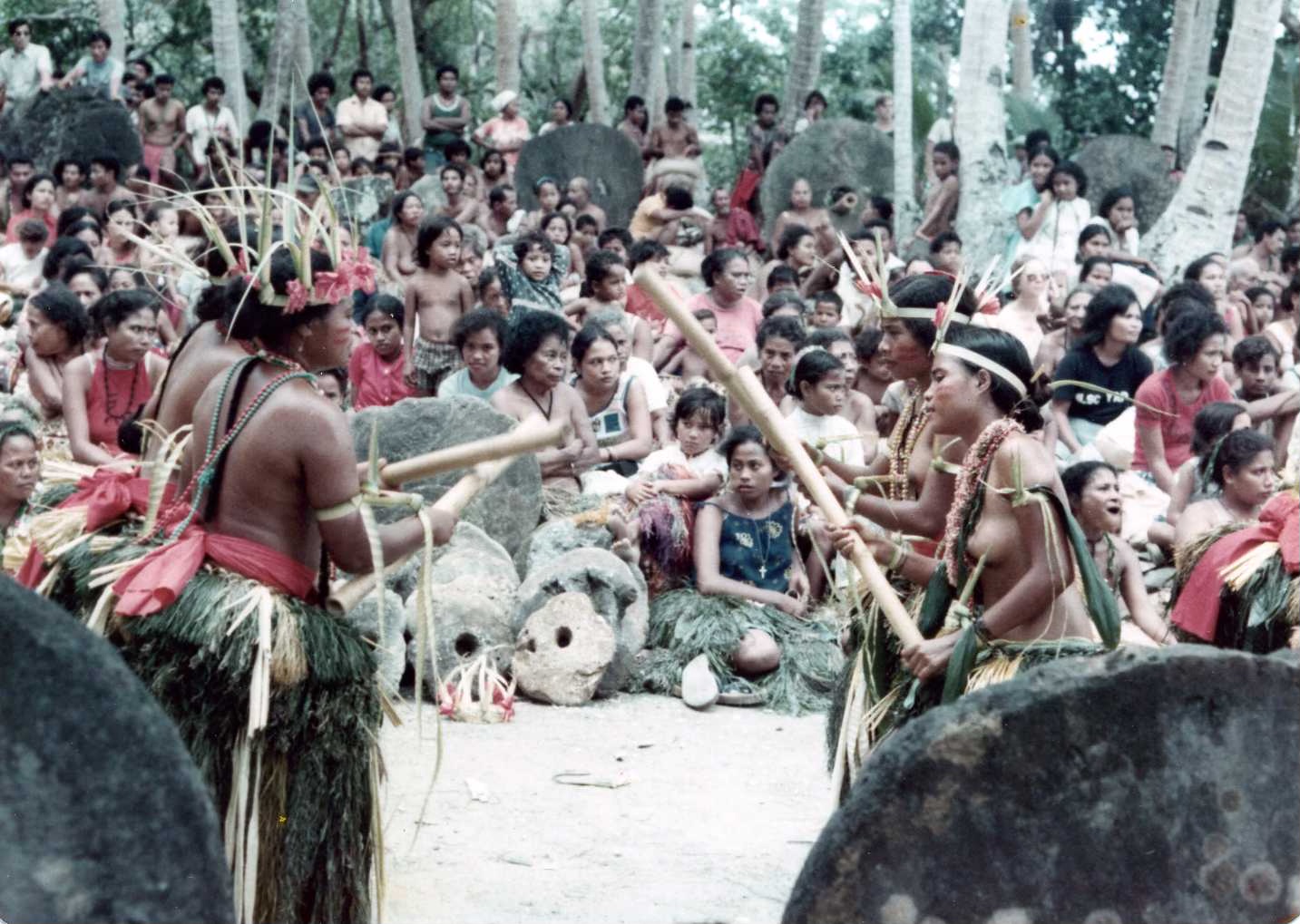
Informant: A mitmit is a Yapese ceremony … a ceremony that… or rather a festival that signifies an exchange of wealth. Dances are performed, in this case, this is a stick dance, a bamboo dance and this next photo is men and boys bringing or delivering—and you can see, there’s stone money in the background—they’re bringing shell money, which is made out of mother of pearl shells, and they’re hung on a piece of coconut husk twine. So what they’re doing is they’re presenting this… well all of this money, really, currency, to another village.

Me: Why are they presenting it? What’s the significance of that exchange?

Informant: Yap has a very, very stringent caste system, not unlike the caste system in the Hindu tradition. There’s no concept of priests or Brahmins like in the Hindu system or the concept of an “untouchable,” but the caste system is based on another legend actually, and the caste system is based on villages, well actually, municipalities. 

Within a municipality, there are a number of villages which contain a number of family units. Frankly, the outer islands of Yap as well are included in this same caste system. There is a ranking system, a social hierarchy if you will, that is based on one’s municipality and even further, there is a village that holds the highest caste ranking within a municipality.

There are the municipalities of Tomil and Gagil, and those are the highest ranked two in Yap.

A mitmit is a celebration of a number of things however, but a very common reason for it, particularly if someone in a lower caste village slighted someone in a higher caste village. One village is paying tribute to another village or the chief of another village, so they bring these offerings of stone money—to the extent of which they can transfer it. 

In addition to the dance, there is a long procession of offerings. The stone money, again to the extent of which it can be carried, and the shell currency on coconut twine. 

Me: So, would you say a mitmit is a way for a village to atone? And does the mitmit have to be “accepted,” or is it unspoken that after a mitmit happens that all is well between the villages again?

Informant: Yes, and all is better after the gifts are accepted.

Me: Has it ever happened where the gifts aren’t accepted?

Informant: I am not aware of gifts being refused, I think the point is to overwhelm with lavish gifts so as to truly atone.

Thoughts: I’d never heard of a mitmit before, and it really shows the diplomacy and the level of respect that holds true between the villages. It’s hard to imagine a culture where disputes and issues were solved with a ceremony and then put to the side, and it’s beautiful that it’s a festival and ceremony where people can enjoy themselves while also atoning and solving their issues or disputes that they may have had.

Summer camp rituals

Nationality: American
Age: 20
Occupation: Student
Performance Date: 4/25
Primary Language: English

Background: The informant (A) is my roommate. She a college student and recalls a story of her experience at a sleep-away summer camp when she was younger.

A: When I was probably….I think 7th grade? Or like during the summer after 7th grade, or maybe 8th or something. I’m not sure. But basically I went to this summer camp at a college in New York for like….2 weeks I think. And the camp leaders made us do a lot of like…..these ritual or traditional kind of activities…I mean, I thought they were pretty weird but a lot of the kids were actually really into it ’cause they had gone to the same camp before and they literally were just…..so into it. I don’t remember a lot of the specific actual stuff we did but the one at the end was called Passionfruit, I only remember that because we drank actual passionfruit juice at it. Or at least they said it was passionfruit juice. But …basically it was the last day of camp for everyone and everyone would wake up super early and the counselors would bring us out to see the sunrise. I think me and my camp friends did a sleepover or something and we set alarms for literally 4:30am and I was so tired but everyone went out onto this grass field kind of thing…it was just outside and we sat on blankets and stuff. I don’t remember exactly the stuff we did but I know we just sat there for a really long time until the sun was up and then we all gathered in this giant circle and people would talk about their favorite memories of camp, or how camp had changed them, or…..something like that, I don’t really know. But it got so emotional I remember being kind of weirded….like half the people were breaking down into tears and stuff. I mean like I was kinda sad but I wasn’t that sad….but I think to be like…nice..or fit in or something I tried to seem super sad too.

Context: This was told to me during a recorded in-person interview.

Analysis: The informant recalls her experience at a summer camp where campers and counselors took camp traditions very seriously. Specifically during the goodbye ceremony, she observed many of her peers in extremely emotional states. This is an example of folklore created by a common experience or location rather than backgrounds or ethnocultural identity. Campers who had experienced the traditions multiple times felt very attached to them while my roommate, who was witnessing them for the first time, felt confused and surprised at her peers’ dedication to these camp rituals. People who have experienced the camp and understand its lore can be considered the “in group” while people who have not can be considered the “out group”.

Joint Marriages in Gujarat

Nationality: Indian
Age: 36
Occupation: Homemaker
Performance Date: 3/05/2020
Primary Language: Gujarathi
Language: Urdu, English

Context: The following is an account from the informant, a family friend. She told this during a conversation at a get-together.

Background: This information was regarding the wedding customs of her village in the state of Gujarat in India. She had firsthand knowledge from her family and her own wedding.

Main piece: 

Informant: In our village, it is common and customary to have big joint weddings. Families will get together and plan to have five or six different couples getting married at the same time. 

Me: So do they know each other, or are they just random couples from the village?

Informant: Since most people in the village are either related to each other at least distantly or know each other well, people can coordinate without much difficulty. Everyone gets together to help, and my own grandfather helped cook the food in traditional cauldrons. Usually it ends up working well, and is much more economical since multiple marriages happen at the same venue, and the attendees who would have otherwise had to have been invited separately can all come at the same time.

Me: Wouldn’t there be extra attendees because there are so many families?

Informant: No, most of the villagers will come to any wedding that is happening anyways, so the number is about the same as there would be for just one couple getting married.

Analysis: This is a unique way of performing the wedding ceremony that seems to work well mainly due to the close-knit nature of the village, especially since many of the families of those getting married are actually relatives, whether close or distant. It seemed surprising at first because usually weddings are considered to be a special event for the couple, but this style of marriage seems to have more of a social aspect.

Turkish Wedding Customs: Coffee

Nationality: Turkish-American
Age: 19
Occupation: Student
Residence: San Diego, California
Performance Date: 4/25/19
Primary Language: English
Language: Turkish

P.N. – “When Turkish girls are old enough to make a good Turkish coffee, a joke is made in the family that they are now ready to be married off.”

What happens during a traditional Turkish engagement ceremony?

P.N. – “In the actual engagement ceremony, the groom’s family sits in the living room while the bride’s family stays in the kitchen, making and preparing the food of the day.  The bride is not to sit down with the groom’s family until the end of the ceremony, because the bride is supposed to be all up, being the working woman, and that kind of stuff.”

“But, at the very end, after all the pastries are eaten and the tea is drank, you always end the ceremony with coffee.  So the bride goes in to the kitchen to prepare the coffee, and she has to carry the coffee one by one to each of the family members present, and the most important one she has to hand the coffee to is the groom.  That always happens.  She is carrying the coffee to her future husband, whether or not that is what is desired or anything.”

“If she spills any coffee onto the saucer, it’s gonna be a failed marriage, and they blame her for it.”

“That’s the whole thing; whenever I’m carrying Turkish coffee, (I used to have really shaky hands) I’d always spill it when I was younger, and my mom would always tell me I’d have bad luck.”


 This particular story struck me as odd, because I could tell how conflicted the person was while she was talking.  She, an extremely powerful woman, clearly doesn’t love this custom, as it’s implicit biases against women both in Turkey in general and during the wedding specifically are clear.  


El Entierro de la Sardina, Panama

Nationality: Panamanian
Age: 20
Occupation: Student
Residence: Los Angeles
Performance Date: 04/24/18
Primary Language: Spanish
Language: English

This tradition was collected from a friend, who was born and raised in Panama City, Panama and is 20 years old. It is about el entierro de la sardina, which translates to English as “the burial of the sardine,” a ceremony that marks the end of the carnival festivities in Spain and some Latin American countries.


She told me that this ceremony consists of a carnival-like parade that mimics a funeral procession with the burning of a symbolic figure, usually a sardine. It is celebrated the Saturday after Semana Santa, or Holy Week, and it represents a metaphorical burial of the past that allows people to be reborn. My friend has attended many of these throughout the years and says it is a very fun experience, as well as a nice metaphor for starting over and she likes that it incorporates her religion as well.


I am from Panama as well, but since I am Jewish, I had never seen or even heard of this ceremony, but it sounds really fun. I’ll make sure to attend one of these when I go back home to visit, since the carnival festivities have always been a very important aspect of Panamanian culture and everyone seems to enjoy them.