
Tag Archives: dance

Šokių Šventė, Traditional Dance Clothing

Main Text

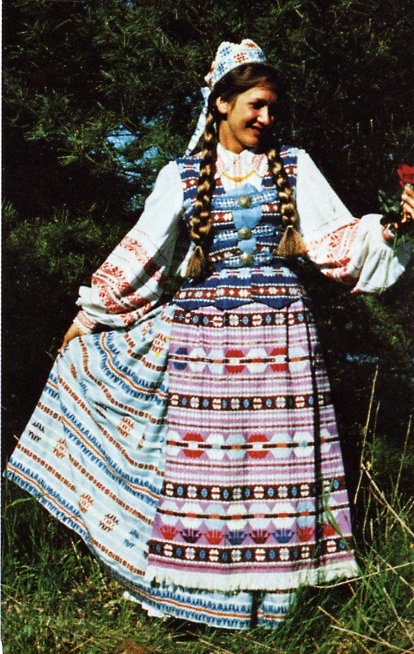
GD: “Šokių Šventė is the International Lithuanian Folk Dance Festival that happens once every four years, and what it is, it’s a folk celebration. So everyone dresses up in their tautiniais drabuziais which is their traditional clothing and does their hair, does their makeup. So everything is made out of wool and linen, the women traditionally wore like long skirts with aprons, obviously not floor-length as you have to go work, shirts with poofy sleeves which often had red embroidery around the wrist and a vest that matches the skirt. There are a lot of patterns in Lithuanian culture, in terms of vest and the skirt, and they would mainly distinguish where you are from.”
Background

D is a 19 year old Lithuanian-American second year student at USC studying Theatre and Classics. Her mother was born in Lithuania and moved to a Lithuanian community in New Jersey, where GD attended Lithuanian school and church. She is excited to attend Šokių Šventė for the very first time as it is being hosted in Philadelphia this year.

Context

This traditional clothing was once everyday wear for people living in Lithuania, but has now been relegated to special wear for high profile cultural events like Šokių Šventė. It is also worn at weddings and other folk celebrations.

Interviewer Analysis

JThe phenomenon of once widespread folk dances being raised up as a symbol of a culture and then relegated only to manufactured displays of “Folk Culture” is a very common occurrence. Dance trends change, especially in our modern and more global times. Taking a cultural snapshot of dance and placing it into a category of folk importance may ensure that the dance lives on, but not that it will continue being the preferred style by the people. This has happened not only with the dances performed at Šokių Šventė, but also the clothing worn to the festival.

Danza del Venado (the deer dance)

–Informant Info–

Nationality: Mexcian

Age: 31

Occupation: Lawyer

Residence: Los Angeles, California

Date of Performance/Collection: 2022

Primary Language: English

Other Language(s): Spanish

(Notes-The informant will be referred to DA as and the interviewer as K)

Background info: DA was born in Mexico and moved to the United States when he was 15. He would go back to Mexico to visit family, and while there saw the deer dance performed by various members of his community. While telling me about the dance, he would occasionally perform small parts of it.

K: So what’s the dance called, and what’s the context of the performance? Like when or under, uh what circumstances was it performed.

DA: Its called Danza del Venado, or the deer dance in English. There’s a few different reasons why it would be performed. After Catholicism mixed with Mexico, it was performed around Lent or Easter. When my people still hunted, it was performed before hunting to ensure success, or as a welcome to spring.

K: Ok, so whenever you’re uh…ready to tell me about it go ahead

DA: I already mentioned when it’s performed but I forget to say that it’s now, along with the easter practices, a means to communicate with the spirit world, in which deers’ spirit resides. The dance is simple; it consists of a few men who are dressed in a cloth wrapped around them like a skirt, held up with a belt made of deer hooves. He has more hooves tied to his ankles and holds dried uh…calabaza (gourds) filled with beans or rice to make large rattling sounds. They would also have deer skulls attached to their heads with red uh…Cintas (ribbon) tied around the horns. All of this is meant to sort of thank the deer and celebrate how hard it fought and ran not to be hunted. All the noise from the hooves and calabaza is like it running and us chasing, while the cinta is meant to represent flowers actually, like rebirth and growth from spring. The entire dance is a thank you to earth.

Interpretation:
This was the first folklore I had collected specifically on a dance and it was so interesting to read about. The change in the dance from how it originally was, it being dedicated to the hunt and directly to spring, to the version it became after Catholicism was introduced, with the dance now being dedicated to easter, was so interesting to hear. DA also showed me a video he had taken of his family performing the dance, so I got to see it actually be performed. It’s a beautiful dance full of color and culture. What DA did not mention is how much audience participation there is. In the video I was shown, the entire audience was chanting and singing along with the dancers, and young children were even at the front of the room dancing alongside them. People in the audience were also dressed in ribbons and a few even have a hoove or two with them.

Snow Dance

Nationality: American
Age: 19
Occupation: Student
Performance Date: 4/29/22
Primary Language: English

Context: Has been vacationing in Utah for the past 10 to 11 years. He goes during the winter mainly to ski with family and friends. 

Text:

“And we go during the winter and during the summer. But especially during the winter, we do this thing called a powder dance or a snow dance. Just like right before we go to bed, me and my family do some crazy dance that doesn’t make any sense at all. But it’s not just the dance itself. It’s just the fact you are dancing, dancing for the “snow gods’ ‘. And I say it’s worked like 50 percent of the time, but it’s just a fun tradition I have with my family. And when it does work it’s epic, and we go ‘yooooo we did that’”. 

Analysis: 

This piece of folk dance here has three broader connections to the greater discussion around the discipline of folklore. Firstly, it is an example of folk dance, exemplifying the genre as variation is common with no two dances being the same. Additionally, it is another example of familial folklore, something that could be then spread down from generation to generation. Finally, it is also indicative of folklore generated as an attempt at explaining the unexplained. To pretend like we actually have any power of the all powerful forces such as weather is done through the means of folklore quite often. 

Spanish Fruit Eating Dance

DESCRIPTION OF PERFORMANCE: Spanish music was playing. She was standing, swaying her hips back and forth. She took her right hands and gestured it upward as if grabbing something out of a tree. She twisted her hand like pulling it out and pretended to take a bite out of the imaginary object. She then pretended to wipe the object all over her body until she reached her left hip and then it a swift movement, pretended to throw the object onto the floor. 

INFORMANT DESCRIPTION: Female, 72, Spanish

CONTEXT: This dance is supposed to symbolize taking an apple or fruit from a tree, eating it and then throwing it away. She learned it in a dance bar in Spain growing up in the 50s. It was a somewhat known dance that she said was very sensual and attractive. It involved the hip movement of her culture’s dance and incorporated themes of Adam and Eve and the countryside. She always loved this dance and would do it constantly to different music. To her it represented femininity and her country’s beautiful dance culture. 

THOUGHTS: When I saw this dance in person I was mesmerized. I had never seen anything like it and it was interesting because I could immediately understand that she was picking a fruit from a tree, the movements were very clear yet melodic.

Maypole Dance at Waldorf School

Nationality: German-American (American citizenship)
Age: 22
Occupation: USC undergraduate studying economics; Strategic Innovation Intern (technology consulting)
Residence: 2715 Portland St Los Angeles CA 90007
Performance Date: 5/1/21
Primary Language: English
Language: German

This friend told me this story late at night in the kitchen on May 1, 2021. We were surrounded by four other friends who moved in and out of the room, and he spoke about his experience attending annual Maypole celebrations at a New York (Ghent) Waldorf School.

*

“I went to a very alternative school called a Waldorf School… and they have a lot of different celebrations and practices and things, and one that is very timely is their May Day celebration… one of the main components of May Day is a maypole. I’m not sure which kids are assigned different parts but each has a ribbon and they dance around the pole creating a pattern, this interesting woven pattern on the pole. The ribbons all weave to form a lattice.”

The speaker said that he thought the celebration might be a way to welcome summer, and that different grades performed different tasks in the May Day celebration. The school included grades Kindergarten through twelfth grade, and students in the third grade often performed the Maypole dance. Students in the sixth and seventh grades played instruments (flute, cello, violin, clarinet, viola) in the orchestra.

I asked the speaker to explain, in his own words, what it meant to attend a Waldorf school. “Waldorf school is a pedagogical movement that began in Germany as an education system started by these same people wo run the Waldorf Hotels or Waldorf cigarette companies, and they started this school for the kids of the factory workers,” the speaker said. “And the goal is like to offer holistic creativity-focused education. So there’s a lot of visual arts and performing arts and a lot of things that wouldn’t really fall under the generally accepted scope of academics.”

The speaker said that grounds crew set up the 20- or 30-foot Maypole in late April and that the structure stayed up for a few weeks after May. He said that every student had to take part in this celebration. Younger students would get excited about the celebration. He said that older students did not want to stand in the hot sun playing a violin wearing a dress shirt.

The speaker said that he does not do anything special for May Day, and that he did not appreciate this celebration until after he left the Waldorf school. “That school never really communicated why we were doing what we were doing,” he said, noting that he appreciates this experience in retrospect

*

I did not know that this friend attended a Waldorf school, and I was able to tell him later that the Maypole dance is a fertility dance. It seems odd that third graders would take part in this dance, but they are also young and full of life. The Maypole represents a phallus. I asked questions about how the students received this tradition, and it struck me odd that a school designed to promote the arts would not explain the history or meaning of this celebration.

It is also relevant that this speaker told this tale on May 1. He later explained that he remembered this tradition because he had received a school email describing online May Day celebrations. This shows that some newsletters can be very important for the communities in which they share information. He continues to be loosely part of this Waldorf school community long after he graduated and moved away from this location.