
Tag Archives: tradition

Coin Rubbing / Cao Gio

Main Piece: Coin Rubbing / Cao Gio

“It is a piece of traditional Asian medicine and the prospect of it is, you take a coin, usually a bigger coin such as a quarter or silver dollar, and you use some type of oil or liquid that you can apply like vaporub, take that and you apply it to your skin, not to the coin, and it is performed on somebody’s back when they are feeling sick or cold. You put the coin on the persons back and you kind of scrape. There are a few variations, but for my family it has been that you go along the spine and outwards on both sides of the back. It leaves streaks on your back and the more red the streaks are after doing it continuously, that is the level of sickness that you have. The purpose of it is to get the bad blood to rise to the surface which is supposed to heal the sickness.”

Background Information:

The informant learned this performance from his parents. Both the informant and his parents are Vietnamese and this is a traditional Vietnamese ritual for healing those who are sick.

Context of the Performance:

This is performed on a person who is sick or is cold. It is a traditional medicine, so this would not be performed on somebody who is not sick.

My Thoughts:

I think that this is a very interesting folk medicine and I am very curious to find out whether it works or not. There are many different folk medicines, some of which work and some do not. If a folk medicine is proven to work consistently, it is taken into the field practicing professional medicine. This folk medicine reminds me of bleeding a person to get rid of the bad blood inside of them, but that was proven to not be an effective way of curing somebody from a sickness. Both are aimed at getting rid of the bad blood inside of a person, although bleeding a person literally rids the body of blood whereas this folk medicine only brings blood to the surface of the body, but it still remains underneath the skin.

Annotation:

For more information and versions of traditional Vietnamese coin rubbing, please see below.

Yeatman GW, Dang VV. Cao Gío (coin rubbing). Vietnamese attitudes toward health care. JAMA. 1980 Dec 19;244(24):2748-9. doi: 10.1001/jama.244.24.2748. PMID: 7441861.
German Easter-Water Ritual

Nationality: German
Occupation: Retired
Residence: Westergellersen, Germany
Performance Date: 4/10/22
Primary Language: German

Context:

HH is a retired former housewife who lives in a Westergellersen, a very small village in northern Germany.

Main Piece:

“Am Ostersonntag holen Frauen Wasser aus einer Quelle. Sie dürfen dabei nicht gesehen werden und es darf währenddessen nicht gesprochen werden. Dem Wasser werden heilende Kräfte nachgesagt und es soll die Fruchtbarkeit fördern. Mädchen erhoffen sich Schönheit und Verliebte bespritzen ihren Traumpartner mit dem Osterwasser um diesen für sich zu gewinnen.”

Translation:

On Easter Sunday, the women get water from the spring. They are not allowed to be seen during this and it is not allowed to speak. The water is said to have healing powers and is supposed to promote fertility. Girls wish beauty for themselves and those in love spray their dream partner with the Easter Water to win him for themselves.

Analysis:

This tradition follows step with Easter’s general association with fertility. The women gathering the water in silence, without being allowed to be seen, also aligns with some marriage customs that deal with purity. Since this custom was collected from Westergellersen, a very rural German village, from a grandmother who participated in this ritual when she was young, it follows that societal standards around purity, fertility, and gender roles were much more strict and strongly enforced than they are now.

Spraying the Easter Water on the subject of affection is a form of magic folk belief that falls into the Homeopathic category. I interpret the Easter Water to be symbolic of fertility, as Easter, also connected to eggs and bunnies/rabbits, has a general thematic connection with fertility. So, splashing a potential partner with Easter Water creates a metaphor for the future fertility of the relationship. This metaphor arguably even symbolizes a reversal of the typical conception process, as here, the woman splashes the man with a fertile liquid instead of the other way around.

Humboldt Broncos Bus Crash Remembrance Tradition

Nationality: USA/Canada
Age: 20
Occupation: Student
Residence: Boston
Performance Date: 4/2/22
Primary Language: English

Context:

Informant NR was visiting family in Canada on the anniversary of a bus crash that killed 16 and injured 13 more, mostly players on the Humboldt Broncos junior hockey team on April 6th, 2018. The crash was widely publicized and became a major topic in Canada. In the years since, NR says that many Canadians have started wearing hockey jerseys on the day of the crash to commemorate the dead and injured that were players on the team.

Main Piece:

“Everyone in Canada on that day wears a hockey jersey. I remember, one time we were, um, spending time with family in Hamilton, and we just happened to be in town on that day, and I remember, we did some sort of like, house tour, and this like lady who was apparently normally very fancy and like, put together, she was wearing a jersey as well., and like, she was the realtor.”

Analysis:

Hockey is a very popular sport in Canada, and the tragedy of the Humboldt Broncos bus crash really shook the population. Though there is a trend of folk speech disrespecting or making light of tragedies that are pushed as serious topics by national media, this practice moves against that trend. This may be because the victims were largely children, and because the sport of hockey acts as a uniting force for the country. The tradition is also very accessible, as many Canadians already own hockey jerseys for their preferred teams, so many do not have to purchase any additional materials to participate in the remembrance.

This national remembrance custom stands out to me because of the rising trend of insensitive or crude humor as a response to tragedy after the rise of mass media. In Of Corpse: Death and Humor in Folklore and Popular Culture, Peter Narvaez examines this phenomenon, illustrated for example through the internet memes surrounding the September 11th terrorist attacks. One theory he concludes with is the idea that mass media, by instructing everyone to care deeply about all major events, even those that had no connection to them, spurred an opposite reaction of humor jokes at the expense of those who suffered the tragedy. What is interesting to me is that this reaction does not seem to have happened in response to this tragedy. My analysis of this is that the victims, mostly teenaged hockey players, who had no fault in the driving accident, are very much aligned with the Canadian cultural ideal. They were generally of a privileged race and gender, and played Canada’s most popular and beloved sport. This endears them to the rest of the population, since even if they didn’t know any of the victims, they probably do know a teenage boy hockey player, or someone who used to be a teenage boy hockey player. The Canadian mass media succeeded at invoking sympathy for the victims of this tragedy because they were so relatable and emblematic of the Canadian establishment.

Mitmit Ceremony

Background: The informant was born in the Philippines to a Filipino mom and a white dad, and spent his childhood, from age 2 to 13, from 1966-1977. Yap is a small group of islands in Micronesia, of which he grew up on the main island of Yap. I was told of this legend over the phone. 

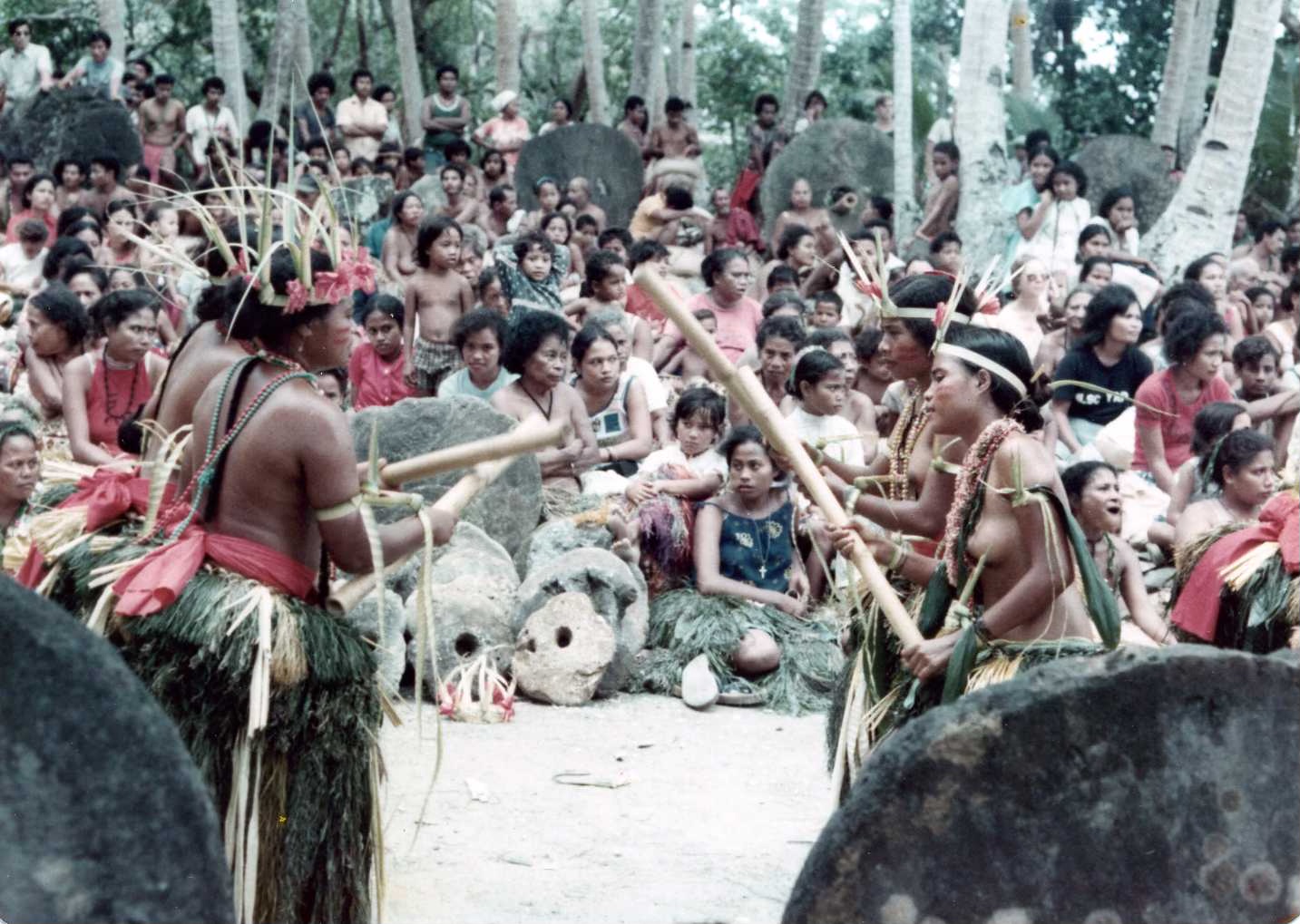
Informant: A mitmit is a Yapese ceremony … a ceremony that… or rather a festival that signifies an exchange of wealth. Dances are performed, in this case, this is a stick dance, a bamboo dance and this next photo is men and boys bringing or delivering—and you can see, there’s stone money in the background—they’re bringing shell money, which is made out of mother of pearl shells, and they’re hung on a piece of coconut husk twine. So what they’re doing is they’re presenting this… well all of this money, really, currency, to another village.

Me: Why are they presenting it? What’s the significance of that exchange?

Informant: Yap has a very, very stringent caste system, not unlike the caste system in the Hindu tradition. There’s no concept of priests or Brahmins like in the Hindu system or the concept of an “untouchable,” but the caste system is based on another legend actually, and the caste system is based on villages, well actually, municipalities. 

Within a municipality, there are a number of villages which contain a number of family units. Frankly, the outer islands of Yap as well are included in this same caste system. There is a ranking system, a social hierarchy if you will, that is based on one’s municipality and even further, there is a village that holds the highest caste ranking within a municipality.

There are the municipalities of Tomil and Gagil, and those are the highest ranked two in Yap.

A mitmit is a celebration of a number of things however, but a very common reason for it, particularly if someone in a lower caste village slighted someone in a higher caste village. One village is paying tribute to another village or the chief of another village, so they bring these offerings of stone money—to the extent of which they can transfer it. 

In addition to the dance, there is a long procession of offerings. The stone money, again to the extent of which it can be carried, and the shell currency on coconut twine. 

Me: So, would you say a mitmit is a way for a village to atone? And does the mitmit have to be “accepted,” or is it unspoken that after a mitmit happens that all is well between the villages again?

Informant: Yes, and all is better after the gifts are accepted.

Me: Has it ever happened where the gifts aren’t accepted?

Informant: I am not aware of gifts being refused, I think the point is to overwhelm with lavish gifts so as to truly atone.

Thoughts: I’d never heard of a mitmit before, and it really shows the diplomacy and the level of respect that holds true between the villages. It’s hard to imagine a culture where disputes and issues were solved with a ceremony and then put to the side, and it’s beautiful that it’s a festival and ceremony where people can enjoy themselves while also atoning and solving their issues or disputes that they may have had.

Pito-pito

Background: Informant was born in the Philippines, on the island of Cebu, to a Filipino mom and a white dad. He sent his childhood in Yap, in Micronesia, but spent a lot of time in the Philippines as a child as well and is fluent in Cebuano, a Bisayan language and grew up playing games with his mother, who was born and raised in Cebu. The following is a children’s game that the informant played as a child, which was then passed down to me when I was a child. We spoke about this game over the phone.

Pito-pito ubod

Kan-on pulos budbud

Sud-an pulos utan

Piesta’s kadagatan!

Transliteration:

Seven-seven small fish

Rice all sticky rice cake

Viand all vegetable soup

Fiesta at the beach

Translation:

Seven small fish

Rice for sticky rice cake

Main course for vegetable broth

Fiesta at the beach

Informant: Pito-pito means seven, and ubod is a small fish. 

Kan-on is rice… ka-on is food, and kan-on is “that which you eat,” which also means food which is kind of silly, but it also refers to rice. Kan-on pulos budbud is “rice for sticky rice-cake.”

Sud-an, when you eat, you always have kan-on (the rise, the base), and sud-an is “the thing which you eat with your rice,” so sud-an could be anything. For example, teriyaki chicken or adobo is both sud-an with rice, which is the kan-on. There’s usually a connotation or implication that there is vegetables. But, sud-an pulos utan is “main course for vegetable broth or soup.”

All the phrases are silly and backwards, really… it doesn’t make sense grammatically. The second and third stanzas would be grammatically correct if they were flipped.

Budbud para kan-on

Utan para sud-an

Piesta’s kada gatan is a fiesta at the beach. Pista’s is really just the “filipinization” if you will of the Spanish word fiestas.

The whole thing is really just silly, but someone would hold out their hand and the other person would put their pointer finger in the center of the other person’s hand. The person with their hand outstretched would sing the lines as slowly or quickly as you want, you can play with the tempo on the first couple lines and then when the line “piesta’s kada gatan!” Is said, the person singing would close their hand while the second person tries to pull their finger away so their finger isn’t trapped.

Thoughts: I remember playing this game as a child, and this is the first I heard of the meaning behind it. I find it interesting that it’s all food-based lyrics, though it’s not entirely surprising as Filipino culture is centered so much around food, but it’s funny that even in a children’s game that’s fairly nonsensical with no relation between the lyrics and the actions, food still is still at the focal point.