
Category Archives: general

The Piasa Bird

Nationality: American
Age: 80
Occupation: Retired
Residence: Jackson Hole, Wyoming
Performance Date: 4/30/2020
Primary Language: English

Main piece:

(The following is transcribed from a conversation between the informant and interviewer.)

Interviewer: Would you tell me your version of the legend of the Piasa Bird?

Informant: My version… back in the olden days, tribes of Indians lived on the bluffs above the Mississippi River. Which was not even the Mississippi river then, but, umm, uhh, and their nemesis was a – a uhh dragon, who lived in the caves on the bluff below them someplace. And the dragon would, umm, periodically umm, come and take a-an Indian, uhh, for it’s-for it’s its meal. Uh. The uhh… Indians would shoot arrows at it but uhh the-the-the it had kind of a… bunch of scale plates on the outside that umm, would deflect the arrows, and uhh, they couldn’t kill it! Finally the chief said, “this is enough of this.”

Interviewer: (laughs)

Informant: So he said, uhh, “what I’m gonna do, I’m gonna get the, the uhh, dragon to a place where i can do a better job of killing it.” And he thought and thought and though for a while, and then he said – he took his daughter, good looking lady young lady and put her out on the edge of the bluffs, and he hid himself where he could uhh, see her and also, see the-the-the dragon coming in… to get her. And as the dragon came in it raised up, and the chief stood up, and shot… the only spot… on the dragon that wasn’t protected, and put the arrow into the dragon. The dragon uhh was… mortally wounded, ummm did not get the daughter, umm, flew back over toward the river, umm crashed into the river, and was never seen again. And so then – the chief was renowned for his skill at archery and uhh saving the rest of the tribe.

Interviewer: Wow.

Informant: To this day… nobody’s ever found that dragon. Haven’t found where it is, and people have looked. Umm. I looked.

Interviewer: (laughs)

Informant: Up and down the river – the bluffs. We used to go down there and climb on the bluffs and up and down the roads and all over the place. But to this day the dragon has never been found, and people wonder whether it’s really true or not. But I guess you have to figure that out for yourself.

Background: My informant lived most of his younger life in Alton, Illinois, where the Legend of the Piasa Bird originated. The legend is well known, at least in the southern Illinois region, though there is much mystery around the legend and that causes many slight variations in the story. It’s one large source of pride for the city of Alton.

Context: The informant is my Grandpa, and this piece was collected after I asked him if he knew any ‘folklore’ and gave him a day to think about it, on his request. He is certainly getting old, but he’s still rather sharp for his age.

Thoughts: The legend of the Piasa Bird supposedly comes from a traditional Native American story, but the story that most people know is some version of a telling by a professor, John Russell, at the nearby Shurtleff College in Alton. This is a strange example of reverse authorship. Did Russell make up the story? If he did, why? Why would he make up a legend for another group of people? In all the Piasa Bird is an interesting study of folklore.
“Ope”

Nationality: American
Age: 22
Occupation: Student
Residence: Oswego, Illinois; Los Angeles, California
Performance Date: 4/27/2020
Primary Language: English

Main Piece:

(The following has been transcribed from a conversation between the interviewer and the informant.)

Interviewer: Describe to me the definition of Ope, if you can

Informant: Its kind of like like, excuse me but not in like a – aggressive way, more like a I’m sorry way.

Interviewer: It’s an apologetic “excuse me?”

Informant: Yeah.

Interviewer: Can you give me a situation in which you might use “ope?”

Informant: Umm, well recently I – at Trader Joe’s today I literally said it cuz i went too close to someone for the six feet distancing [this piece was collected during the Covid-19 outbreak of 2020], and I was like “Ope, sorry,” and turned back the other way – to not be so close to them.

Interviewer: Any other examples?

Informant: Or if I like do something to myself – I like drop my phone or something I say “ope.”

Interviewer: When you say it like that do you say it differently? Does the intonation change with the situation?

Informant: I say it like “ope.” [very clipped]

Interviewer: Every time no matter when you say it?

Informant: “Ope.” Yeah, it’s like one syllable.

Interviewer: Do you know when or where you learned this?

Informant: No but I was only made self-aware of doing it on – from twitter. I think I’ve always done it having grown up in the Midwest but I didn’t like, think about it, it was just something and then I went to California, and it – people didn’t do it… and that’s when I realized.

Interviewer: Do you know anything about where it comes from?

Informant: I always thought it started out just saying “oh,” but then it became like, I don’t know why people added “ope.” I don’t think you’d see it in, like, New York or anything. But it’s like, what is the boundary of the Midwest? It’s like – I don’t think about Nebraska and stuff as in – even South Dakota is Midwest but I don’t think of them as Midwest.

Interviewer: So what are the main states you think you’d see “ope” in?

Informant: Mmmmichigan? Ohio, Indiana, Illinois… Iowa? Maybe? I think it’s mostly, like states that I see as having like a bigger cit- like a bigger city in them. Wisconsin. It might just have to do with the fact that I grew up here [Illinois] so I feel like it doesn’t spread very far.

Background: My informant is Senior in College who grew up in Southern and then Northern Illinois. She comes from a family of middle-class background. She goes to UCLA, and therefore has adopted a mix of midwest and west coast slang.

Context: The informant is my sister, and she gave me this piece in a more research oriented setting, as she was the first person I collected from and I was determining the best way to go about the process still. She’s not very good at talking when asked to, according to herself, so I felt I had to do more prompting than I might with another informant.

Thoughts: “Ope” has become an incredibly well known, and so probably more widespread, piece of Midwestern slang/dialect. What is interesting is the informant’s discussion of where it may come from. I also use the word often and did not realize at all until recently thanks to it’s spread on the internet. I have no idea where it comes from, but I know many people think it can mean many things – one common belief is that it means “anything and everything” for example – and that is what makes it truly folkloric in my opinion.

Mardi Gras Cups

Residence: New Orleans
Performance Date: 4/20/20

Main Piece:

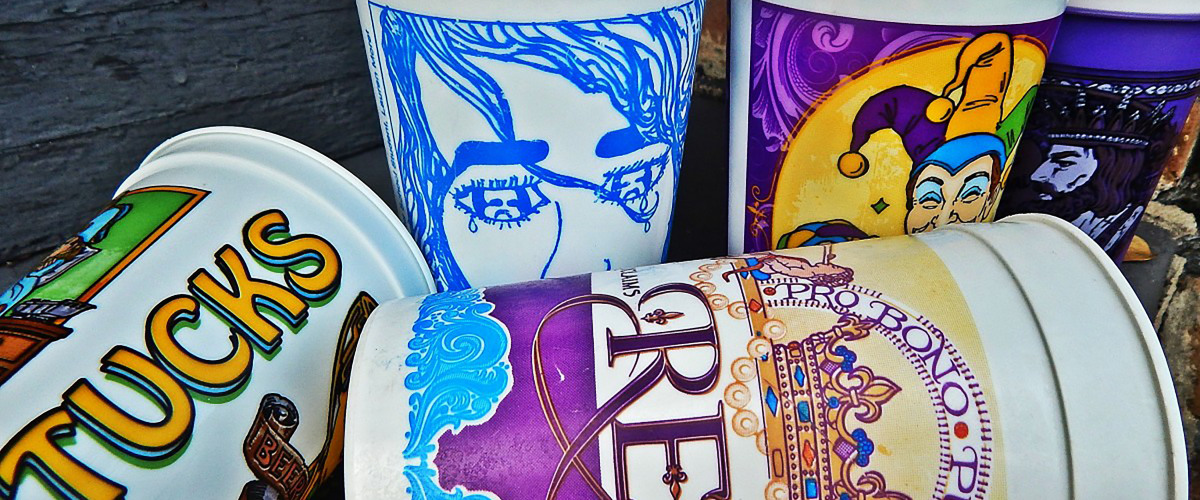
SG has been to Mardi Gras almost every year since she was a little kid. Decorated plastic cups are a typical throw in every Mardi Gras Parade. Parades, known as Krewes to the locals, each have a unique name and theme to them. Riders in each parade have “throws”, which are items riders throw off of floats. These commonly include beads and doubloons, but what is solemnly talked about is cups. Cups are a collectible item during Mardi Gras as they have more value than most other throws. Not only can you keep it as a memorate of a parade, but you can use it for years to come. Families collect these and use them as normal drinking vessels in their homes and lives. Go in any cabinet and next to the glass cups you will find various Mardi Gras cups themed to each parade.

A Swig of History: The Mardi Gras Cup | Where Y'at
https://www.whereyat.com/a-swig-of-history-the-mardi-gras-cup

Context:

SG is my mother and has been to Mardi Gras with kids since I was born. She is from New Orleans and attends every year. This was taken during a conversation with her in our backyard while reminiscing Mardi Gras. She still collects cups and send me them each year.

Thoughts:

As a New Orleanian and a avid fan of Mardi Gras, as I have been many times before, I did not realize that this was not much of a practice outside of New Orleans, collecting cups to use throughout the years. For instance, after my first year at USC, I missed Mardi Gras for the first time in my life. As a response I got my parents to ship me a King Cake and some decorated cups. In the house I was living in, I used them frequently, and people always commented on the designs on the cups calling them unique. I was so used to using the cups that I never took a moment to think about the designs. Each design reflects the idea of that parade. Krewe D’etat, a parade devoted to a satirical take on the previous year, would have cups that mock events from the last year. Krewe of Muses, an all female parade, would have cups with feminine symbols such as the iconic red lips symbol of the krewe. Each design is unique and can only be gotten if one attended that parade in that year.

Muses Decorated Heels

Nationality: American
Age: 20
Occupation: Student
Residence: New Orleans
Performance Date: 4/20/20
Primary Language: English

Main Piece:

According to EG, a resident of New Orleans, Muses is one of the first all female parades in Mardi Gras. To set it apart from the other parades they started throwing decorated heels. Each rider decorates their own shoes and put their spin on them, with glitter, writing, and designs. It turns into a pretty sculpture of a shoe. Each rider decorates 10-12 shoes and throws them off of their float during the parade. She has caught 3 shoes in her time at Mardi Gras and she considers it a symbol of New Orleans Mardi Gras. Because of muses other parades have started to throw other items like it. Other parades like the Krewe of Tucks and the Krewe of Nyx throw decorated toilet plungers and purses respectively.

Context:

EG is a college aged resident of New Orleans. She was born there and has lived there her entire life. This was collected in a conversation at my home. She has been to Mardi Gras every year since her birth and considers it to be a central part of her life.

Thoughts:

I, also being a resident from New Orleans, understand this piece of folklore very well. The heels thrown from the float are a sub-genre of what is know as throws, or things float riders throw off a float during a parade. Beads and Doubloons are what people mainly consider as Mardi Gras throws, but there are many more. Cups, spears, and as EG mentioned, heels and other decorated items are all throws that separate one parade from another. I think the main reason for these throws is that each has a distinct item that not only tells a story of the rider and the parade, but something you can only get if you participate in or go to the parade during the season.

Mardi Gras Ladders

Nationality: American
Residence: New Orleans
Performance Date: 4/20/20
Primary Language: English

Main Piece:

Mardi Gras ladders are used during Mardi Gras each year. They are used to put children higher up in the air to see the parade and to keep them safe from going in the street. Usually decorated in purple, green, and gold with a family’s name. They are on a ladder so that kids can see a float. Wheels are on the sides to help them roll easier from the car to parade route. On top of the ladders are seats which children sit in and they usually have a bar on the front to keep the kids from falling. Cup holders are put on the side for a parents’s drinks. They are put 6 feet away from the curb on the sidewalk or neutral ground, all painted differently. Families tend to put their ladders in certain spots next to each other forming a long row of ladders.

Context:

SG is my mother and has been to Mardi Gras with kids since I was born. She is from New Orleans and attends every year. This was taken during a conversation with her in our backyard while reminiscing Mardi Gras. She still brings ladders out each year for her younger children.

Thoughts:

I like this piece of folklore a lot as it brings me back to when I was much younger attending Mardi Gras. When I only went with my parents and not friends, my mom would put me in a ladder with my twin sister as we shouted at the float riders to throw us beads and other items. The uniqueness of these ladders is very important to me as I had the opportunity to decorate the newest ladder that we use for my little brothers. We painted it purple, green, and gold, while also putting our hand prints on it. This is something I had grown up with and realized how specific a ladder with a seat on it like this is to New Orleans and that you rarely see it elsewhere.