Tag Archives: Chinese

Hammer and Nail

Text

Interviewee: In a summer camp I attended while in elementary school, my teacher told us about this proverb: “If you are holding a hammer, everything you see is a nail.” In Chinese: “手里拿着锤子,看什么都像钉子.”

Hammer and nail are a perfect duo. However, when a hammer becomes the only tool you reach for, it distorts perception. In this proverb, the message is that if you always hold a hammer and see everything as a nail, you will forever be seeing this world through a single, fixed way of thinking.

It was a simple, concrete way for my teacher to educate me about not being hindered by my preconceived notions—my “hammer”—when seeing the world. It’s about teaching kids to have an open mind and think outside of the box sometimes.

Context:

My interviewee first encountered this proverb in China, shared by a teacher when she was attending a summer camp as an elementary school student.

Analysis:

This proverb is an educative proverb that teaches the audience about cognitive bias using the metaphor of a hammer and nail. It is vernacular because, while this was shared in a summer camp by a teacher, this proverb wasn’t in the textbook, and neither was it formally written down. It’s essentially a metaphor about having an open mindset: it warns against the human tendency to fit problems to our existing solutions rather than seeking solutions suited to the actual problem.

Genre analysis:
Metaphorical structure: This proverb’s metaphorical structure—using a concrete, well-known physical object to metaphorically render an abstract lesson—is characteristic of a proverb.

Sentence structure / phoenetics: In addition, the sentence structure in Chinese—each clause having the exact same number of Chinese characters—makes this proverb rhyme and easier to remember and tell from a structural/phonetic perspective.

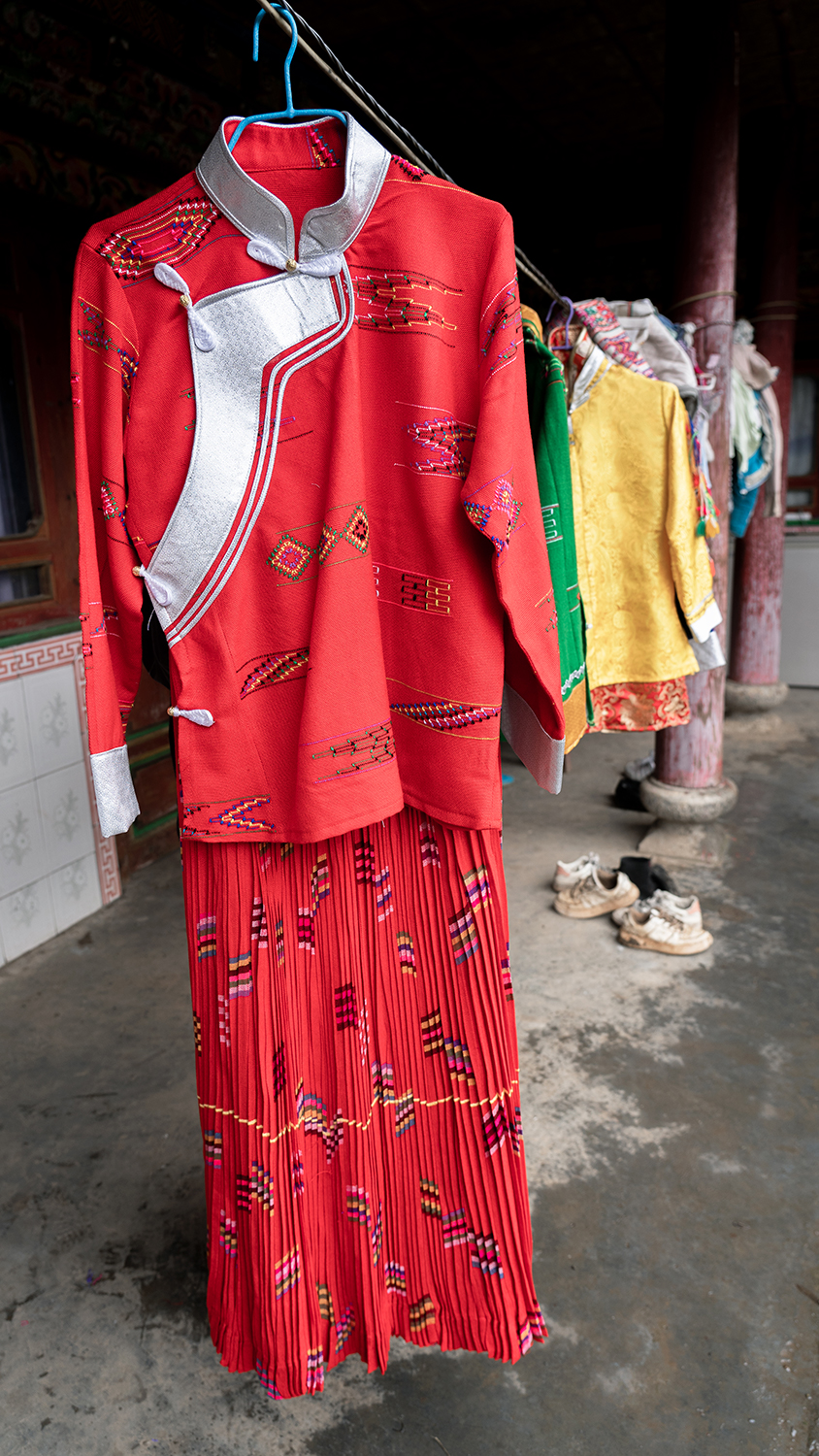
Material Culture – Mosuo Dress with Handwoven Mosuo Traditional Patterns

Text:

This dress is a traditional dress of the Mosuo people, handwoven by the Mosuo people.
The patterns on the dress are all traditional patterns with symbolic meanings to the Mosuo people.

This dress was made by my informant’s mother. Her name is Du Zhi Ma, a 60 years old Mosuo woman living in Lijiang, Yunnan’s Mosuo village. Du Zhi Ma is a provincial-level inheritor of the Mosuo traditional hand-weaving craft. Since 2003, Du Zhi Ma has transformed her home into a workshop studio, leading local Mosuo women in hand-weaving.

Over time, according to the informant, the growing tourist economy around Lugu Lake made machine-made textiles a lucrative commodity at tourist sites. Many Mosuo textile makers struggled to compete and lost income. Du Zhi Ma continued to lead women in Lugu Lake in weaving and making embroidery through her workshops, hoping that this tradition would not completely fade away.

Context:

The informant is the son of Du Zhi Ma. He learned about the story behind this dress from his mother, who made the dress and is a Mosuo person. The informant shared with me this picture as he told me about the Mosuo traditional handweaving as a cultural preserver—he is a local Mosuo museum owner, who specializes in the Mosuo culture (culture specific to the Mosuo ethnic group). The informant thinks of Mosuo traditional weaving as a precious technique that should be preserved, and he is personally very proud of this.

Analysis:

This Mosuo traditional dress is more than just a physical dress—it embodies the Mosuo culture, their artistic expertise, and traditional patterns which capture their cultural beliefs. It represents how material culture acts as a living tradition of the Mosuo.

Du Zhi Ma’s role as a provincial-level inheritor makes this culture endure in a special way. As society become modernized, machine-made clothes have created economic pressure that threatens to hollow out the living craft tradition. Du Zhi Ma’s workshops and her role as a provincial-level inheritor make room for this material culture to be preserved and promoted over time.

The Girl with the Red Thread

Age: 18

Context:

One evening, while walking on campus with my friend, we began sharing spooky stories. She suddenly recalled something that had haunted her for years — a strange experience she had as a child, which had blurred the lines between dream, memory, and legend. This is the story she told me.

The Story:

When she was around 7 or 8 years old, she lived in a home with a study room that had a bed but was rarely used. One night, after waking from a nightmare, she found herself in that very study — a place she never usually slept in. She remembered lying beside her mom, both of them facing the wall, and gently shaking her awake out of fear.

She asked her mom to tell her a story because she couldn’t sleep. Strangely, her mom — who was known to strictly avoid ghost stories or anything scary — agreed. What happened next would stay with her for life.

Still facing the wall, her mom began to tell a ghost story. In the story, a nurse was working the night shift at a hospital. One evening, while heading out from the first floor, she took the elevator — but somehow, the elevator inexplicably descended to the 4th basement level instead, a floor used as a morgue.

This floor had no button, no lights, and no one should have been able to access it. But the elevator stopped there, the doors opened, and the nurse saw a little girl standing silently in the dark. The girl got into the elevator with her.

As the nurse glanced over, she noticed a red thread tied around the girl’s wrist. In Chinese superstition, red thread on the wrist is sometimes associated with the dead. The nurse was so frightened she reportedly died on the spot.

What terrified my friend wasn’t just the story itself — it was the realization much later in life that this was a widely circulated urban legend. Many people she later met had heard it before. And yet, she had never heard it before that night, and neither had her mother — who later insisted, repeatedly and sincerely, that she had no memory of telling the story, or even of waking up that night.

My friend later searched the story online and found that it had indeed been turned into a movie, or at least referenced in popular media. This deepened the mystery: how could a widely known ghost story have been told to her by someone who had never heard it — someone who vehemently denied ever telling it?

To this day, my friend remains disturbed by this experience. She remembers it vividly. Her mother, however, insists it never happened.

The Informant’s Thoughts:

She finds this story creepy, not because of the ghost itself, but because of the contradiction between her clear memory and her mother’s absolute denial. She believes the most chilling part of the experience isn’t the plot, but the uncertainty of how she ever came to hear it.

Years later, when telling others the story of the girl with the red thread, people would say, “Oh, I’ve heard that one!” But she hadn’t. Not before that night. Not ever.

My Thoughts:

What makes this story so compelling is not just the content of the ghost story, but how it plays with memory, belief, and reality. The idea that a story could be “implanted” through a moment that no one else remembers adds an eerie, almost psychological horror element to the tale.

It made me question how many of our memories are truly our own — and how stories that seem personal might actually belong to something much larger, floating around in the cultural subconscious, waiting to find a host.

The repetition — her telling the story to others, retelling it to her mother, and hearing denials each time — builds a quiet but powerful kind of fear. Over time, the story’s scariness comes not from the ghost, but from the accumulated sense of being haunted by a memory no one else shares.

As a piece of folklore, it’s fascinating because it shows how legends can find their way into our lives, not just through media or hearsay, but through deeply personal and unexplainable experiences.

The Shadow Behind the Curtain

Age: 18

Context:

This story was told to me by a Chinese international student at USC, whom I’ll refer to as SG. We were sitting together in one of the quiet study lounges at Parkside after midnight, discussing the kinds of ghost stories we’d heard growing up in China. That’s when she told me something she had never written down or shared publicly—something that happened to her in her childhood that she still remembers with frightening clarity.

The Story:

When SG was 10 years old, she lived with her grandparents in Harbin, a city known for its long, dark winters. Her grandfather had a habit of rising very early, often before sunrise, to boil water and do light chores. Their apartment had large, thick curtains that covered the floor-to-ceiling windows in the living room.

One early winter morning, just before 6 a.m., SG woke up suddenly. She had heard soft footsteps and assumed her grandfather was up again. Curious and still sleepy, she wandered out to the living room—only to find it completely dark, with no lights on. She paused at the doorway.

That’s when she saw it: a silhouette of a person standing perfectly still behind the curtain, as if staring out the window. The form was unmistakably human—tall, slightly hunched, and entirely motionless.

Thinking it was her grandfather, she called out to him.

No answer.

She approached slowly, heart pounding. The air felt wrong—too still, too cold, as if the temperature had dropped. When she finally touched the curtain and pulled it aside—

There was no one there.

No one in the room. No sound of footsteps. No open windows. Just the snow falling silently outside.

Terrified, she ran back to her room and hid under her blanket. She didn’t tell anyone for weeks.

Informant’s Thoughts (SG):

SG says what disturbed her most wasn’t the sight of the shadow, but the fact that she saw it so clearly, and yet her grandfather had still been asleep in his room the whole time. Years later, she still isn’t sure if it was a dream, a hallucination, or something else.

What unsettles her most is that she continues to experience the exact same dream every few years: waking up in a different place, walking into a dark living room, and seeing a shadow behind a curtain.

Each time, she says, she wakes up before pulling the curtain open.

My Thoughts:

To me, what makes SG’s story haunting isn’t just the visual horror of the silhouette—it’s the way it has embedded itself into her memory and dreams, repeating like a ritual.

I’m struck by how familiar this setting feels: cold northern apartment, heavy winter curtains, the eeriness of early morning silence. Even though nothing explicitly supernatural happens, the ambiguity makes it even scarier.

It also makes me think about how many ghost stories we hear as children in China are tied to domestic spaces—kitchens, hallways, staircases—not abandoned mansions or graveyards. They are ordinary spaces made terrifying by something just a little out of place.

This story lingered with me long after she told it—not because of a ghost, but because of the uncertainty that still follows her.

Chinese Acupuncture

Age: 21

Text: Acupuncture is part of Traditional Chinese Medicine involves inserting fine needles into specific points on the body to balance qi (energy flow). It’s often paired with moxibustion, the burning of herbal heat sources near the skin.

Context: “My uncle had chronic back pain, and instead of going to a Western doctor, he went to a traditional Chinese acupuncturist. They placed needles all down his spine and in his legs. After a few sessions, he swore he felt better. My family really believes in acupuncture. They think it works with your energy, not just the muscles or nerves. When I still did sports during high school, I regularly went to a clinic for acupuncture because my mom really pushed and swore that it would make me feel better. I went regularly and I won’t lie, I think I only really felt the effects when my pain was really bad or just really exhausted. Either way, it did help in the long run in my opinion. ”

Analysis: Acupuncture is one of the most widely practiced elements of Traditional Chinese Medicine and is based on the belief that health comes from balanced energy (qi) flowing through pathways called meridians. The placement of needles stimulates these points to restore balance, reduce pain, or treat illness. While now recognized globally, acupuncture is still practiced in many Chinese communities as both a clinical treatment and a cultural ritual. It reflects a worldview that links the body, nature, and energy systems and offers an alternative to Western biomedicine that prioritizes harmony over symptom suppression. From what I’ve seen, it’s slowly (even though it’s been around for a very long time) entering people’s awareness because chiropractic is becoming more popular and I’ve seen people get confused between the two. More and more people have been using acupuncture as it is an easy way to soothe aches.