Tag Archives: folk art

Arctic Fox

The Story:

“When I was in third grade, I moved to a different part of the city and changed schools. The first book we read in class was The Fantastic Mr. Fox. Our teacher used an origami activity to tie into the book and taught us how to make origami foxes. In the class, we used orange origami paper, but since that class I have made the origami foxes out of whatever resources I had around- like i did in class on Thursday!”

Reflection:

Reflection:

The informant’s story was a good example of folk art when mixed with personal memory and communal creativity. The emphasis on the folk art being created with “whatever resources I had around” is an example of making do with whatever is at hand. This draws back to the importance of folk art, since it essentially is the presentation of messages or historical context via a multitude of mediums. Furthermore, the folk art and its prevalence in the informant’s life shows how the folk art, despite the material used to make it, will always carry the historical and contextual significance when being recreated and taught onto other individuals. The story exemplifies the folkloresque of the integration type. The origami fox activity is an attempt at a connection between book and another tangible media form, yet seems folkloric as it allows the opportunity for the children to form shared connected ideals and emotions of the origami.

Kandi and PLUR

Age: 23

Date Collected: 4/27/2026

Context:

My roommate and good friend of three years is involved in the rave scene here in LA. He does operations for one of the largest hard techno organizations in California. He is mostly involved in the hard techno scene, but occasionally he goes to festivals and dub shows where passing out kandi bracelets (pronounced “candy”) is more popular. He showed me his collection of goodies he’s gotten in his 5 years raving, and these stood out to me.

Text:

Kandi bracelets are a great representation of the exciting and friendly rave scene. Kandi are handmade elastic bands made of colorful plastic pony beads, featuring fun messages, images, or small items tied to them. Some of them are quite complicated, including finger designs, while others are quite large and stretch up the arm. The most common, though, are simple bands with funny messages or jokes. My friend explained that “they’re connected to the dub, trance, and outdoor-festival communities.” You can see kandi passed around at mainstream shows like Tomorrowland, Lollapalooza, or Electric Daisy Carnival. Those festivals are during the day, when you can get away with lighter clothing and show off your kandi. People wear loose clothes with bright clothing to match the fun color of their kandis. My friend has gotten several kandi bands at Outside Lands, smaller Afro house shows, and other events with chill crowds. Its normal to give kandi to people you like or just feel a positive vibe from.

He mentioned that there’s a specific ritual to giving them away. The PLUR (Peace, Love, Unity, Respect) handshake is the way ravers exchange their kandi. He learned it from someone when they came up to him and gave one to him. He showed me holding up a peace sign, and I held up a peace sign to his hand. “To the beat, you dance around. Then you make half a heart shape.” I completed the heart for “love.” Now, you place your palms together his for “unity,” like a high five.” Finally, we interlocked fingers for “respect.” At that point, the initiating raver would pull one of their kandi bracelets from their arm, over their hands to their arm, all while their fingers are still interlaced. All this is done to the beat of the music, or in a fun flow state. Then you should pass one of your kandis over your arm to theirs. Then you can dance around and either part ways or make a new friend. But “you don’t need to actually give any back; people just want to give them out.” For example, my friend never brings kandi to shows; he doesn’t make them either, yet he has gotten around five from his time raving and has built up quite a collection. He doesn’t wear them to shows because, well, mostly they aren’t his style. But also because kandi bracelets are not common or popular at the shows he goes to. They are more associated with the mainstream EDM scene. He goes to underground techno shows, which are typically held at night and where kandi is far less common.

People trade them, give them away, and they are all made by hand independently. He doesn’t really remember who gave them to him; he was just enjoying the music. All the ones he has are very unique, and no two look really all that similar. He told me they’re all usually unique and like a fingerprint. Each artist has their own style. People try not to copy one another, and they all try to have unique ones so that you can remember that show or specific interaction. As you can see from the picture, they’re all made from relatively cheap beads and elastic string from Amazon or a craft store, yet each seems to have a unique bead pattern, color choice, and style. There’s one that says “sploinky” (no real meaning, just fun). Another says “xing”, which probably stands for crossing the threshold or barrier, and tripping. The final one says “cum bucket,” which was given to him by a girl. This highlights the ironic and really funny humor at these shows. There’s even one with a pacifier on it, which you can use if you’re grinding your teeth. Very practical. Another, pictured above, is pink and star-shaped and goes over the back of your palm. That one is great if you are wearing long sleeves or want a full sleeve of kandi.

Analysis:

Out of his collection, these stood out to me. I immediately thought of them as folk art and, more specifically, I think they are a perfect example of bricolage. They are made of mass-produced items recombined to create something new. These items aren’t meant to sell; they have no real monetary value. But, they do have sentimental value. One of their main purposes is to serve as a physical reminder of your great time at a show or of a new friend you made. Each Kandi is given new meaning based on the context in which it is given. They are also deeply rooted in the festival and mainstream EDM scenes, and associated with rave culture at large. To me, they’re instantly recognizable as a great folk element of that scene that was made by the people. A company, the festival organization, for instance, can’t profit from or poach these Kandi. They’re just beads and string. Any unique bead design could be made by a raver using a 3d printer at a public library. I don’t think it could really be commodified easily. There is also a paradox that something sentimental or valuable is made out of such cheap materials. It’s funny because it reminds me of a crappy macaroni plate a kid makes for their parent’s birthday. Each individual piece is worthless; even together, it isn’t that valuable. But to ravers, these are memories. They hold so much individual value because of the context in which they were given. If my friend gave me a Kandi just for fun or sold one to me, I probably wouldn’t care as much as if I had gotten my own at a show. So the context is the value, a company can’t easily replicate that or profit off of it, which ensures it is of the people and for them.

Aside from being a tangible record of interactions, they also serve as a way to build community. I mentioned that these are very common in the mainstream scene. They’re bright, colorful, fun, and inviting. They help create bonds between ravers and give people an opportunity to connect. This is especially important because at these venues, the music is very, very loud. People wear earplugs or AirPods to protect their hearing. That makes casual conversation and small talk really hard. So, the kandi gives you an easy way and a reason to approach a stranger who is part of your community. It is also very helpful in the mainstream scene, since new ravers or shy people might be uncomfortable. But if they’re given a Kandi, that be like inviting them into the fold. They could feel valued and seen and a member of the community which is really cool and helps keep the scene thriving and positive.

Aside from the purity of the folk art, the PLUR handshake is also a great example of how folk gestures are taught and learned in real time. He said he felt a little confused, but he got the idea pretty quickly. I had a similar experience. The PLUR gesture also highlights the friendly vibes that rave scenes go for. The acronym isn’t just for fun, its a code. To be part of that culture, you need to be peaceful, show others love and respect, and be unified. The community really does care about being respectful. To the shows I have personally been to with him, I’d say they were far more respectful than your average line at Walmart or Disneyland. The PLUR is a great acronym that effectively sums up the values and code of the rave scene into one fun gesture. Its a great way to teach new members and remind old ravers what’s important.

Folded Paper Football

Age: 20

Collection Date: 04/09/2026

Context:

During an in- class activity, my informant showed me how to fold a standard piece of paper into a football that he used to play small desk games with friends as a child. He said said that he learned this in elementary or early middle school and often created these footballs while bored in class. It was a fun way to stay busy and play with friends when class allowed it.

Text:

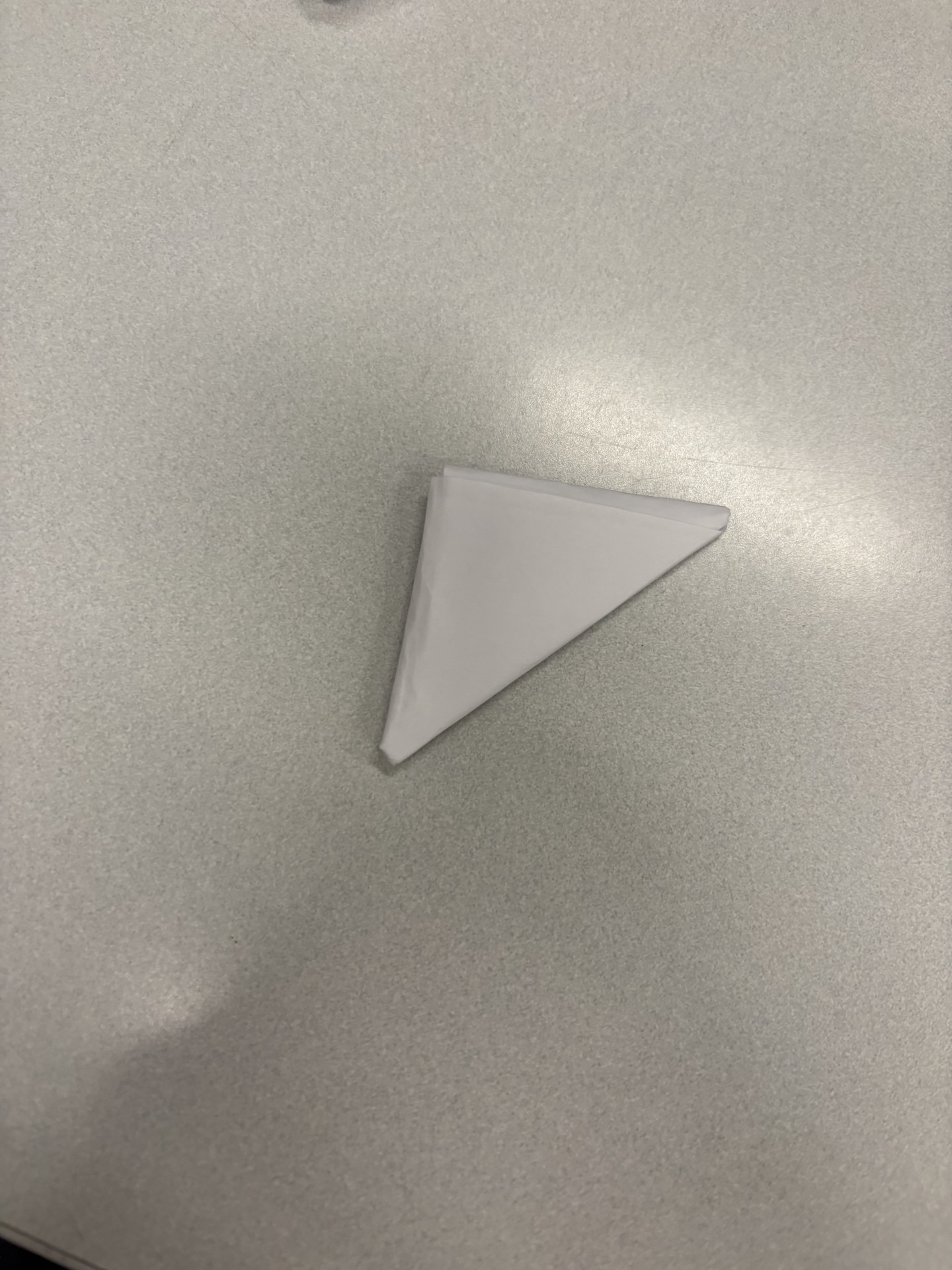
My informant repeatedly folded a standard 8×10 piece of printer paper, ensuring tight, straight folds with no unnecessary creases. The shape is formed by folding triangles into one another, making the final product dense and sturdy. My informant used an older YouTube video for assistance to remind him of some of the steps. He demonstrated the folding process and explained key details, such as the aforementioned tight folds, minimal creases, and common mistakes people make when folding them.

The final result is the Paper football pictured above, which can be used to play a fun game with a friend. Each takes a turn: one holds their fingers in the shape of a goalpost, the other positions the football in a punting position by holding the top corner and pushing down so it stands vertically. The “kicker” then flicks the football, propelling it forward into the goal. The player who gets five goals first wins.

Analysis:

It is interesting that he called it a football. I had never heard it called a paper football before, but when he showed me the process, I immediately knew what he was talking about, which I called a “paper triangle.” It’s funny, because I also learned how to make those from friends back in elementary school. These kinds of foldables often appear when we’re supposed to be learning, paying attention, or otherwise doing something else. Due to their location, students had to be somewhat sneaky when creating or playing with them, keeping them hidden from the teachers.

It is also a perfect representation of school children’s folk art. It is an item made informally from mass-produced materials, that’s taught from student to student, or unofficially online, and holds no monetary value. However, it does hold sentimental and nostalgic memories for the children and communities who grew up with these.

It is also interesting how he used some assistance from a random YouTube video. This reminds us that folklore continues to thrive online. There wasn’t one specific “right” video. Although the end product is roughly the same, each creator has a slightly different way of folding the paper or presenting the instructions, giving the process variety. Even though the digital tutorial exists, he still showed me in person how to make it, and the details (described earlier) he added were quite interesting and different than what the video did or could have mentioned.

Warli Paintings

Background provided by MN: MN is an individual who grew up in the Maharashtra state of India, where they learned 4 languages including Sanskrit. They recently moved to America for further education. 

Context:  As we were talking about different types of folklore, MN shared this information about this particular Indian tribal art that originated from their state in India. 

Main Piece Transcription of interview (contains the context of particular performance and additional background information): 

MN: “Warli paintings are also from where I am from, Maharashtra. There is a mountain range in Maharashtra called sayandrit (spelled Sahyadri) and it … originated there. And it is tribal art. Like tribes, there used to make this art and I think … there’s prehistoric caves … umm … like huge … huge prehistoric caves, the most significant of them are arjenda (proceeds to spell A-j-a-n-t-a and E-l-l-o-r-a) and alura I think they are UNESCO historic sites and they have … like … they’re approximately 2 BCE. They have this temple (gestures towards photo on UNESCO website) … it’s almost like a Buddhist temple … and they have closed entry there now … because it was a tourist location where you can see the paintings and stuff. And if you look online you can still see the color and stuff. It has these … like geometric shapes … this is like the feature of it. Almost like what kids draw, but there is a lot of imagery of the sun … and people dancing. In most of the Warli paintings, you will see the sun … and people dancing in a circle. It is kind of … a design choice.”

Me: “I kinda have a couple follow-up questions about the paintings with the Warli paintings. Like did you have a favorite … or like did you ever … like … interact with one … that kinda changed  the way you see things?”

MN: “ Ummm … not really, this is not really … uhh .. it’s a very abstract design. It’s not the same everywhere. Uhhh … it’s not like a particular painting or anything .. just specific features of this painting. It’s a … type of painting … I’d say… a stylistic choice.  So there’s not a particular one that I… but I do remember a restaurant having one mural … it was all the whole wall. 

Analysis: This type of folk art that MN had informed me about was very interesting because it first belonged to a very niche group, but transitioned to a UNESCO world heritage site. MN provides their unique perspective as a local emphasizes that Warli paintings are an art style that has since transformed and integrated into contemporary times. The motifs in the Warli art style continue to be adapted in the contemporary pieces, as MN mentions. The Warli paintings are connected largely to the Buddhist belief system and this connection could explain its prevalence in modern art. MN explained that the most common motifs are the Sun and the dancing people, which are very telling of a culture that values warmth and community. The Sun is often associated with masculinity, warmth, and energy. The geometric people suggest that modern Indian society is heavily influenced by dance.

MN recounted that Ajanta was once a tourist attraction, but later, UNESCO protected the cave to preserve India’s art history. After it turned into a UNESCO site Ajanta was no longer to be enjoyed by the general public and access was restricted. The Warli paintings are folk art that can no longer be enjoyed in person, which could have hurt the local economy. Tourism is the largest market and when UNESCO protected Ajanta, it also destroyed tourism. The locals were no longer able to visit the site either. This restriction could also explain the prevalence of Warli painting motifs in more contemporary pieces, such as decor in a restaurant as MN mentioned.

For more information about Ajanta, as well as visuals please visit the UNESCO website: https://whc.unesco.org/en/list/242.

Masks As Folk Art

Nationality: American
Age: 22
Occupation: Student/Journalist
Residence: Las Vegas, NV
Performance Date: 4/12/2020
Primary Language: English
Language: Spanish

The following is a transcribed interview conducted over a video chat between me and interviewee, hereby further referred to as CC.

Me: How have you been covering your face in public places due to the coronavirus?

CC: I just made a mask out of a bandana and two hair ties because I couldn’t get any other pre-made masks in time. 

Me: How did you do that and how effective is it?

CC: Well, it’s super easy and stays in place nicely so I don’t have to touch my face when I’m out and about. So, yeah, I’d say it’s effective.

Me: And how do you make it?

CC: Oh yeah, ok so basically you just lay the bandana out and then fold it a few times so it’s a long rectangle. Then you like put the hair ties around either end and move them towards the middle until as big as you want the mask to be. And then you just fold over the edges, I try to like fold one edge into the other so it doesn’t come loose but it’s kinda hard to get that part right. And then you just put it on with the hair ties around your ears and adjust if you want it bigger or smaller. I can send a step-by-step pics if you need help.

Me: Yeah that’d be great, thanks! And where did you get this idea?

CC: Not gonna lie, I saw some facebook post about it and copied it but honestly it’s kinda become a viral life-hack! 

Me: Cool, thanks.

Background: 

Interviewee is a long-time friend of mine who attends a school on the East Coast. She is an American who grew up in Las Vegas, NV. 

Context:

This piece of folklore was collected during a video call between me and interviewee during the Coronavirus Pandemic. I have known the interviewee for many years, so the conversation was casual. 

Thoughts:

I have seen many youtube videos and facebook posts about this method of making a mask quickly and without sewing for those who don’t know how to sew or don’t want to. I’ve tried it and I think it works pretty well, too. Going around to the grocery store and such, I see quite a few people using this method of making a mask, and because there are so many kinds of fabrics you can make it with, people get really creative and you can show more of your personal style than with a classic paper mask. 

To see how she makes this mask and with what kind of cloth, see this: https://www.allure.com/gallery/bandana-face-masks-covid-19-coronavirus