
Tag Archives: legend

The Legend of Chang’e and Houyi

Performance Date: 2/26/2026

CONTEXT:

The performance is a telling of the Chinese legend of Chang’e and Houyi told to me by a Chinese international student at USC, who I will refer to as “EY.” We are sitting together outside of Taper Hall discussing legends. EY goes on to explain the legend and its connection to the Mid-Autumn Festival, along with the cultural beliefs associated with the story.

TEXT:

EY: The legend story I’ll be telling you about is called Chang’e’s legend. It is a Chinese legend um that explains where we have or how we have the Mid- Autumn Festival in mid September in China. Umm so the story basically is about like there’s a goddess whose name is Chang’e who kinda like takes a pill and turns into a rabbit that runs to the moon on the day of mid-autumn festival. Nowadays people in China usually have moon cakes on that festival to celebrate Chang’e.

Interviewer: Oh that’s interesting

EY: So if you look closely at a picture of the moon, there’s a shade that’s in the shape of a rabbit and so people often see that shade as the picture of Cheng’e. The rabbit shape is Cheng’e.

The longer version of the story is mostly about how previously there’s a god called Houyi who kinda shoots the sun in the sky. Chang’e and Houyi get married to each other. Bu then, Houyi was originally supposed to take a pill but he refused to and like the person who asks him to take the pill hides in their home. When Houyi is out and Cheng’e is home, Cheng’e has no other options but to take the pill. When Houyi returns home, he finds out his wife is gone and he’s sad… He might be sad… He must must be sad.

Interviewer: Probably, he’s probably sad.

EY: Yeah, and so the two are separated and Cheng’e is in the sky.

Interviewer: Okay, that’s cool. Do you think there’s like a metaphor, like a meaning behind the story. A meaning that you or your family and friends associate with it?

EY: Yeah, so it’s mostly about nostalgia and separation, I guess. There’s a metaphor in China where we compare the moon to reunion and a happily ever after.

Interviewer: That’s pretty cool, I never thought of the moon as associated with that before.

EY: And so we can associate the moon with romance or reunion in some sense. In Western [Chinese culture] ideas.

Interviewer: I don’t think that’s very common over here. We don’t typically associate the moon with romance. I think I got the story and the meaning behind it. Is there a personal meaning for you that you take on specifically to that story?

EY: I just felt like the look of the rabbit is very interesting. Yeah if you google a picture of the moon.

*looking up a picture of the moon*
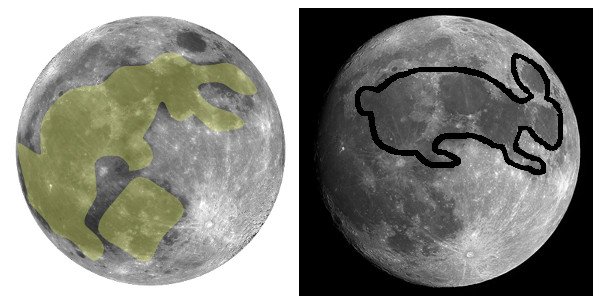
* not the image referenced, but gets the idea*

EY: For example, this part is the rabbit’s head. These two are the ears of the rabbit.

Interviewer: So, I gotta look at it upside down.

EY: Yeah, so this is something that most people don’t usually observe.

Interviewer: Interesting, is that something you can only see at a certain time? Cause there’s different phases of the moon and seasons. Is this something you can only see in September? [The month of the festival].

EY: I guess yeah, but like that time that day is when the moon is like a full moon.

*end of interview

Analysis:

EY explains the story has a significant meaning not just to her, but her family and culture. The story explains the shapes in the moon, gives meaning to culturally significant foods like moon cakes and serves as a fun story to tell. The story is distinctly Chinese and like any cultural story serves as a great reminder for who you are. Without the legend, the mid-autumn festival is really just another holiday. The legend gives the celebration new meaning and amplifies the significance beyond just a fun tradition.

It also gives a standard story to relate to across generations. The culture as a whole can appreciate and enjoy this story. Parents telling their children aren’t just entertaining them. They’re connecting them to their family and culture giving them an identity. It also creates a symbolic meaning that Chinese people can relate to.

EY explained how the story recontextualizes the moon as a symbol of reunion, romance or “happily ever after.” This is interesting because in my culture, the moon doesn’t really mean anything in particular, it’s just the moon. So, to hear how this legend breathes new meaning into the natural world is quite cool. It gives an “everyday” object new culturally significant meaning. In this case, love and reunion. I’m familiar with the idea of roses symbolizing love and affection. But I actually think the moon is better. Unlike a rose, the moon won’t fall apart over time. It might wane, but it always comes back. That makes the reunion and meaning so much more impactful. The same moon can be seen across cities or continents, so it really does connect family and friends. Also, I think there is some more meaning with the moon in that it represents reunion. Every morning, the moon disappears, but we know it’ll come back. That physical movement and repetition adds to meaning that EY explained.

I think that the ritual of eating moon cakes and celebrating during the festival is a way for people to connect with their family, culture, and partners. It’s something that I’ve heard my other friends do, whether they were in China or here in LA. That makes it a cultural signal and reminder of shared belief and identity. It’s given meaning by the story, and eating mooncakes is a way for people to actively participate in that story and culture. The food, story, and importance of the moon itself are great because they can be transmitted anywhere. People can relate to and appreciate that meaning, whether in China or here in America. That story, food, and connection to the moon a ways for people to share their culture without needing to be “at home” for the festival and celebrations. These traditions can be transported and adapted to new regions or environments while maintaining that unique cultural identity.

It’s very interesting to me because, like Houyi, my informant is away from home, separated from loved ones. This must be a very personal story for her, and maybe a very significant one at this moment as well. The legend she chose to share specifically covered longing, separation, and the desire to be together. Whether she meant to or not, the choice to tell that story seems to have been influenced by her feeling away from home; it is probably a way to process her emotions, which is quite cool.

La Siguanaba

Age: 23

“A Salvadorian folklore story I know is La Siguanaba. It originated from the Náhuat people. “Sihuehuet” means beautiful woman in Spanish. Its Salvadorian. The gods cursed her for neglecting her son. She was turned into a spirit who lures unfaithful men. She’s also beautiful, that’s how she lures and kills them. When they get close she shows her face, which is, a , mix of a horse or a skull- or a mix of the two, and drives them crazy. It’s basically about temptation. I had this as a research topic in high school. I wanted to learn about the indigenous tribes from where my family is from.”

context: My informant, is a 23 year old male born in America, whose parents were born in El Salvador. Both parents fled to America to escape the Salvadorian civil war. His mother is from a town called El Mozote, which was where one of the largest massacres caused by the US government took place in 1981.

analysis:

Looking at this from a functionalist perspective, the legend is meant to enforce societal norms. Neglecting your child and being unfaithful could lead to divine punishment and temptation could lead to supernatural consequences. I also believe that La Siguanaba follows a common Latin American folklore trope of a supernatural or ghost woman sent out to punish people, like with La Llorona. the informant’s retelling of the story is a way for him to reinforce his own Salvadoran cultural identity. I also believe that many violent Legends (or just legends centered around death) may have emerged due to the Mozote massacre and other horrendous imperialist acts that have been forced upon Salvadorians. Historical trauma can shape how some legends and folk tales in general are viewed, even if those stories predate such events. the passage of time can effect how those stories are remembered or emphasized.

Anhui Province Legend

Age: 18

TEXT

Interviewer: “Okay, would you like to introduce yourself?”

MC: “Yeah, hi, my name is ANONYMOUS, and I’m a freshman student at USC University.”

MC: “My story is set in a park in my hometown, and in the park, there’s a trail and along the trail there’s a cave called the cow nose cave. This cave has two holes that are kind of shaped like a cow’s nose, and there’s a legend about how it’s dangerous if you put your arm or fingers into the hole, as there might be a very mysterious force that basically sucks your whole arm in and it can be very dangerous. So kids are advised not to put their arms into the hole.”

Interviewer: “Was that a story, or like a legend that was always around or more of a family legend?”

MC: “It’s known in our region and it started like – actually I don’t know when it started but I heard it from my parents.”

Interviewer: “Ohhh I see.”

MC: “Yeah they told me not to put my arms in there, yeah.”

CONTEXT

My relationship with this informant is that she is my classmate for this anthropology lecture. My informant is an international freshman student at USC, originally from China. As mentioned in the text, her relationship to this piece stems from her hometown, in which a notable landmark has a surrounding legend that was passed down to her by her parents.

ANALYSIS

Considering this piece is set in the real world and tied to a real location, this is a legend that functions as a cautionary tale for children. In my opinion, it’s plausible that this legend started from a worried parent who could not supervise their curious children 24/7 – rather than explaining all the actual dangers of sticking your arm into an unknown hole, like injuries from getting stuck or getting bit by creatures that may be inside, replacing this with a supernatural force is a more vivid and memorable warning to children. As this legend spread informally to other children and generations after, a cultural value that may come specifically for this region in China is that an ordinary cave is now enshrined forever as a supernatural landmark with a distinct legend.

Camp Ghost Story

Informant: The old owner of the property had a daughter [named] Gertrude who was in a wheelchair and he built it all for her. Apparently, she haunts the manor house basement, like the cellar…She fell down the stairs in her wheelchair is the story. 

Context: The informant learned this song at her sleepaway summer camp located in the Berkshires. She was in middle school when she first heard the story and heard it reinforced as she grew older at this camp. 


Analysis: This story connects Gertrude to a specific location (the manor house basement), which is a key feature of legends; they are told as if they could be true and are grounded in real-world settings. The narrative follows a familiar memorate/legend pattern: a tragic backstory (a girl in a wheelchair who dies by falling down the stairs) explains the presence of a haunting. This kind of scary origin story gives a bigger meaning to the space. It turns a normal basement or cellar into a potentially dangerous location that children shouldn’t want to be around. It also reflects common motifs in ghost lore, including untimely death and a lingering presence.

Portuguese Bend Curse

Age: 19

Text
“When my boys and I were hiking the Portuguese Bend at night right on the coast on the cliffs, the ground like started shifting beneath us like kind of like an earthquake, it was pretty nuts. And at first we just kinda thought it was an earthquake but then we texted our boys back home and they didn’t feel anything, so we kind of just chalked it up to being the Portuguese Bend Curse because I don’t know, there was like no other explanation I guess.”

Context
RK explains that this is a curse/legend that is well known among his friends and other Palos Verdes residents, especially those that have spent time around the Portuguese Bend. He says that while hiking with his friends, he felt the ground move in a way that felt like an earthquake, but when he double checked with friends and family they didn’t feel anything. He says that he and his friends had no explanation for what happened, so they attributed it to the Portuguese Bend Curse. RK says that he’s been back to the Portuguese Bend a few times since that happened but nothing similar has happened.

Analysis
The Portuguese Bend Curse is a legend that is popular among the Palos Verdes area of Southern California, and RK’s specific story is a memorate. His experience shows that in weird moments that feel unexplainable, people will turn to folkloric and supernatural explanations for the event. This legend also shows that there is more to a place than just its geography; there is a ton of added identity to the Portuguese Bend that is built through stories and human memories. RK’s story is also a great example of Lindahl’s argument that legends and beliefs become stronger or validated through personal experience, as RK knew of the curse beforehand but never had any strong opinions about it until he experienced the ground shake in person. It’s also interesting that even though RK hasn’t felt the ground shake since that moment, he still believes in the Portuguese Bend Curse because of that one memorable and jarring experience.