
Tag Archives: tradition

Post-Fast In-N-Out Tradition

Text:

“My tradition is, I’m Coptic Orthodox, which means I’m Egyptian and Christian, and what we do is every Easter, because we fast from meat, we go to In-N-Out every single year, since I was a kid. And we basically get three-by-threes, double-doubles, and we get super fat. And it’s great.”

Context:

The informant is part of the Coptic Orthodox Christian community and describes a yearly tradition that takes place after the Lent fast leading up to Easter. During this period, members abstain from meat and other animal products, making the end of the fast a significant moment of return to those foods.

The informant explains that their family and friends mark this transition by going to In-N-Out every year, a practice that has been repeated since childhood. In-N-Out is a fast food American burger chain in California.

Analysis:

This example is a form of customary folklore, specifically a ritual tied to a religious calendar. While the fast remains part of the formal religious tradition, the act of going to In-N-Out is an informal, family-created practice that builds on that structure in a modern way.

It connects to broader patterns in foodways, particularly the idea that the end of a fast is marked by specific, often indulgent foods. The emphasis on meat-heavy meals also shows the contrast between a period of restriction for religion and belief and then abundance. This is a common feature is post-fast ritual not just in religion but across cultures like body building. In this case, the use of In-N-Out shows how traditional practices adapt to local contexts because it blends religious and cultural identity with American consumer culture.

The repetition of this activity every year also demonstrates how folklore is maintained through ritual. The joking tone of “we get super fat” shows the humor that reinforces the group identity and marks a space where “getting super fat” and breaking all these religious strict rules is not only okay but celebrated by the group. It brings balance to daily life and also provides a safe way to go against the structures of religion. The fast may be over but religion itself is against over indulgence, this space, folk group and the end of the fast, creates the frame to subvert authority while still playing into it.

More broadly, this example shows how folklore can exist at the intersection of religion and informal practices. While the fast is institutionally defined the way it is experienced and celebrated is shaped by peoples everyday choices. Individuals and families can activley participate and create meaningful culture, with similar impacts of a religious fast, within larger systems on their own.
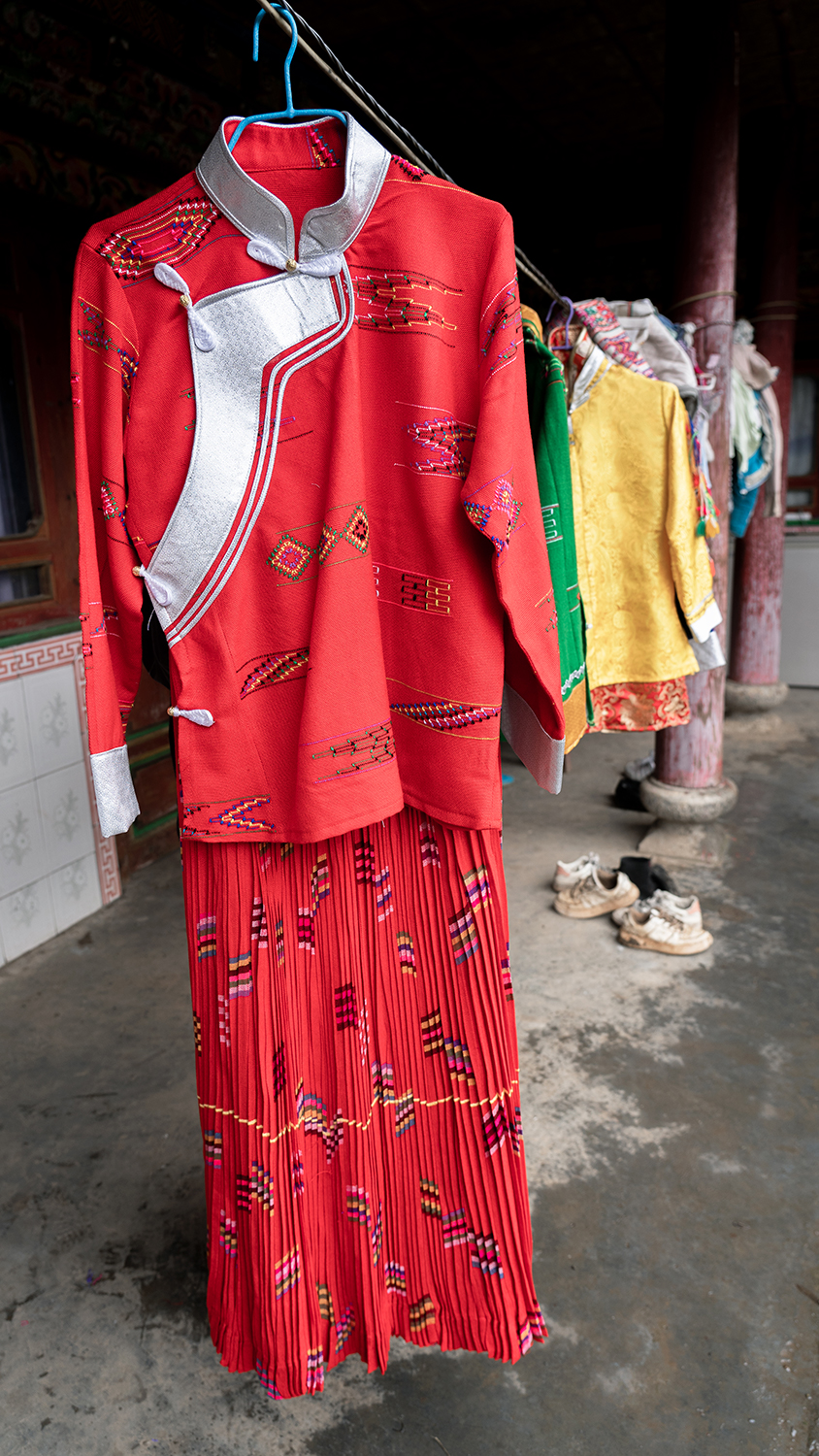
Material Culture – Mosuo Dress with Handwoven Mosuo Traditional Patterns

Text:

This dress is a traditional dress of the Mosuo people, handwoven by the Mosuo people.
The patterns on the dress are all traditional patterns with symbolic meanings to the Mosuo people.

This dress was made by my informant’s mother. Her name is Du Zhi Ma, a 60 years old Mosuo woman living in Lijiang, Yunnan’s Mosuo village. Du Zhi Ma is a provincial-level inheritor of the Mosuo traditional hand-weaving craft. Since 2003, Du Zhi Ma has transformed her home into a workshop studio, leading local Mosuo women in hand-weaving.

Over time, according to the informant, the growing tourist economy around Lugu Lake made machine-made textiles a lucrative commodity at tourist sites. Many Mosuo textile makers struggled to compete and lost income. Du Zhi Ma continued to lead women in Lugu Lake in weaving and making embroidery through her workshops, hoping that this tradition would not completely fade away.

Context:

The informant is the son of Du Zhi Ma. He learned about the story behind this dress from his mother, who made the dress and is a Mosuo person. The informant shared with me this picture as he told me about the Mosuo traditional handweaving as a cultural preserver—he is a local Mosuo museum owner, who specializes in the Mosuo culture (culture specific to the Mosuo ethnic group). The informant thinks of Mosuo traditional weaving as a precious technique that should be preserved, and he is personally very proud of this.

Analysis:

This Mosuo traditional dress is more than just a physical dress—it embodies the Mosuo culture, their artistic expertise, and traditional patterns which capture their cultural beliefs. It represents how material culture acts as a living tradition of the Mosuo.

Du Zhi Ma’s role as a provincial-level inheritor makes this culture endure in a special way. As society become modernized, machine-made clothes have created economic pressure that threatens to hollow out the living craft tradition. Du Zhi Ma’s workshops and her role as a provincial-level inheritor make room for this material culture to be preserved and promoted over time.

Family Death and Paranormal Activity

Text: Interviewer – “What kind of ghost stories have heard of or experienced? Anything relating to your family?”

JL – “Woo boy, I could write a book! I’ve always believed in the supernatural. I have a lot in mind, but one sticks out the most. That brings me to when my mom died, on October 13, 2012. My mom and I were always close. My kids were very close to her as she was the only grandparent they had a relationship with, and she absolutely ADORED them (she loved them to pieces!, as she would say). She’d visit us half a dozen times a year, we spent summers at her house, she’d join us on vacations. We were CLOSE. My kids were young when she passed, in third and fifth grades. One morning shortly after she died I was getting the kids ready for school. They were sitting at the kitchen table having breakfast, I was at our kitchen island making lunches. We have a light fixture above the table with 5 bulbs in it. One of them had been burned out for months and I just hadn’t gotten around to changing it. Anyway, one of us mentioned that we were feeling sad that day because we missed Granny, and the burned out light bulb switched ON. The three of us looked at each other and thought, “Huh, that’s odd.” I said, “Mom, if that’s you, turn that light back off.” And the light went off. None of us were scared, we all thought it was kindof… cool? Comforting? We spent the next 20 minutes asking questions, and that light bulb kept responding. I finally said, “Mom, thanks for visiting and letting us know you’re ok, but I have to get the kids to school.” And the light bulb never responded again. But Mom hasn’t completely gone. We have a door that leads from our garage into our house that has a deadbolt lock on it. There are times when I will open the door from the house, walk through the doorway, immediately go to shut the door behind me only to have it bounce on the doorjamb because the deadbolt has been fully extended. We’ve tried shaking the door, jiggling it to see if we could replicate it, and nope, no movement from the deadbolt. There have been times when I’ll be carrying groceries in from the car, keeping that door to the house open for several trips, and then when I finally go to close it, the deadbolt is extended. And it’s not just a little bit sticking out, it is fully extended. Every single person in my family has had this same experience. There are two things that I love about this: 1 – Mom still comes around to say hi, and 2 – my family’s reaction isn’t fright, it’s a casual, “Hi Granny, thanks for visiting.” This has been occurring for 14 years. With my daughter’s graduation approaching, I’m sure I’ll see a lot of activity with the deadbolt!”

Interviewer – “Have these paranormal activities diminished in frequency or stayed the same?”

JL – “They’ve diminished in frequency. Mom still comes around and plays with the lock on the door, but now it seems to coincide with times of extreme emotion – when we’re celebrating something like a birthday or a big event with the kids, when I’ve been exceptionally worried or stressed.”

Context: This long story came up as I was asking JL about some of the paranormal experiences they’ve had or if they believed in ghosts in the first place as I have my fair share of history with the supernatural and ghost encounters myself. This specific story has been shared throughout the past many, many years, for as long as since it happened, and is not exclusive to the family, though it is a piece of lore special to the family due to the circumstances of the events.

Analysis: This account is in it of itself a familial piece of lore. Whether it’s a tale to some or simply something that happened, the story of it all has continued to thrive as have the perpetual encounters. Due to the nature of the story and how it doesn’t necessarily have an end, whether someone who experiences it first hand believes in ghosts or not, the event of the deadbolt on a door elongating can be either calming, reassuring, or frightening based on who you are. All individuals who listen or experience this tale are bearers of it, and since the events have continued to repeat, the amount of first-hand sources simply grows as time passes. The ghost story evolves constantly, and the lore that the JL and their family once just held for themselves has continued to be shared to their friends and community.

Great Grandma’s Chair

Age: 72

Age: 19

Text:

“In our family, we have unassigned assigned seats for dinner. After my mother, Elizabeth, passed away in the house, we would keep that seat at the table empty out of habit. Well, one day, about a year after her death, we had a guest over and so I offered my seat up to the guest. I would sit in my mother’s seat. When I sat down, I felt an immense weight on my shoulders and an overwhelming feeling of sadness. It only left me once I left the chair. I ended up having to sit at a folding chair and the chair remained empty. Since then, I do not let anyone sit in that seat as it’s her chair. Even today when I am eating at the table, out of the corner of her eye it can look like someone is sitting in the seat. I believe it is her.”

Context:

This was told to the informant by his grandmother, about his great-grandmother. It was told on Thanksgiving at family dinner. The story itself took place roughly 10 years ago.

Analysis:

In this story, a grandmother speaks about her late mother to her grandchild to explain why a seat is kept at the dinner table for someone who has died. It is a sign of respect to the dead, as well as slight fear against change. This story sparks the debate of if there is truly a ghost or if grief itself can manifest into a spiritual form. The story functions as a warning against erasing past relatives, as well as a loving tale that past relatives never actually leave the family, even in the afterlife.

Rose, Theater Ghost Memorate

Age: 19

Story: What I remember is that Rose was a former student that died in the school and haunted the theatre in particular. She would bang around in the cats [catwalks] and ventilation especially if you were the only one in the theatre. Among techs I think there was more serious beliefs about how to treat Rose, aka ghost light and personally always saying hi and bye to rose if I was the first one in or last one out, or if she made noises I would talk to her sometimes. – JH

Context: This story was told directly to the archivist as a friend. It is regarding a ghost that was thought to populate their high school theater since the program’s inception.

Teller seems fairly convinced of the rituals that go into the ghost, they mention turning on the ‘ghost light,’ which is the last light left on the stage when people have left, and talking to it in their spare time.

Theaters are often places that claim to experience ghosts. The story of Rose was passed between multiple generations of student tech workers, perhaps to explain things like the weird banging in the ventilation shafts or unexplainable tech problems. There is no evidence showing that a former student died in the school, but a mockumentary was made by some former theater students showcasing Rose’s inception.