
Category Archives: Kinesthetic

Body movements

Knock on Wood

Background:

The informant is a 27-year-old that grew up in Madison Wisconsin and currently lives in Southern California. He has followed this superstition for as long as he can remember and believes he learned it from his older brother when he was young. He takes it very seriously and anytime he catches himself boasting about something prematurely, he will make sure to knock on wood.

Main Piece:

The Superstition involves a person knocking on wood in order to prevent something that had recently been said from not coming true. The practice is typically seen when someone says something boastful or implies that something good will happen to them with certainty. They will then knock on a piece of hardwood nearby as a way to ward off any jinxing that may have occurred by them stating this out loud.

Interpretation:

This folk belief is one of superstition. While superstition tends to have a negative connotation and be viewed as a pejorative term among many people, I think superstitions are usually a positive thing that people partake in. This ‘knock-on wood’ superstition that the informant discussed with me is particularly positive. The practice of doing something to sort of acknowledge an overzealous statement that one has made is a good thing for people to partake in. While it may or may not have any impact on the outcome of a certain event, it forces people to address hubris and maintain a humbler balance of how they speak about things. The literal ‘knock-on wood’ superstition reminds me of another common trope that I have heard many times throughout my life that goes “Don’t count your chickens before they hatch”. This tope relates to overzealous farmers that assumed that were going to have as many chickens as they had eggs.

For another version, see Evan Andrews, Aug 22. 2018, Why do people knock on wood for luck?
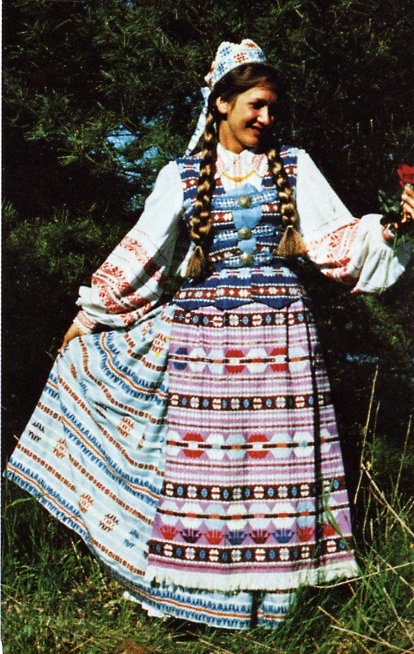
Šokių Šventė, Traditional Dance Clothing

Main Text

GD: “Šokių Šventė is the International Lithuanian Folk Dance Festival that happens once every four years, and what it is, it’s a folk celebration. So everyone dresses up in their tautiniais drabuziais which is their traditional clothing and does their hair, does their makeup. So everything is made out of wool and linen, the women traditionally wore like long skirts with aprons, obviously not floor-length as you have to go work, shirts with poofy sleeves which often had red embroidery around the wrist and a vest that matches the skirt. There are a lot of patterns in Lithuanian culture, in terms of vest and the skirt, and they would mainly distinguish where you are from.”

Background

D is a 19 year old Lithuanian-American second year student at USC studying Theatre and Classics. Her mother was born in Lithuania and moved to a Lithuanian community in New Jersey, where GD attended Lithuanian school and church. She is excited to attend Šokių Šventė for the very first time as it is being hosted in Philadelphia this year.

Context

This traditional clothing was once everyday wear for people living in Lithuania, but has now been relegated to special wear for high profile cultural events like Šokių Šventė. It is also worn at weddings and other folk celebrations.

Interviewer Analysis

JThe phenomenon of once widespread folk dances being raised up as a symbol of a culture and then relegated only to manufactured displays of “Folk Culture” is a very common occurrence. Dance trends change, especially in our modern and more global times. Taking a cultural snapshot of dance and placing it into a category of folk importance may ensure that the dance lives on, but not that it will continue being the preferred style by the people. This has happened not only with the dances performed at Šokių Šventė, but also the clothing worn to the festival.

The 11:11 Game

Informant Information – SI

  • Nationality: American
  • Age: 20
  • Occupation: Student
  • Residence: Los Angeles, California
  • Date of Performance/Collection: April 20, 2022
  • Primary Language: English

The informant grew up playing this game with their sister. They started playing this game as children and still play when they are together at their parents’ house. This information was shared with me in an in-person interview. 

The 11:11 game is played by the informant and their siblings; they began playing it as children and still play as adults when they are all together at their family home. 

If someone notices that it is 11:11am or pm, they must announce the time and shout out a task, such as standing on a chair or knocking on wood. Everyone that wants to play will then complete the task and then shout out a different task. 

Players should try to complete as many tasks as possible before the minute ends. Playing this game and completing these rituals is supposed to bring the players good luck. 

Analysis:

In this game, the time, 11:11, is ritualized. Participants must perform a prescribed set of actions, hoping that they will produce a desired result, good luck. As in other rituals, the bounds of acceptable behavior become flexible– while it might be strange to stand on a chair at another time, it is encouraged at 11:11.  

Danza del Venado (the deer dance)

–Informant Info–

Nationality: Mexcian

Age: 31

Occupation: Lawyer

Residence: Los Angeles, California

Date of Performance/Collection: 2022

Primary Language: English

Other Language(s): Spanish

(Notes-The informant will be referred to DA as and the interviewer as K)

Background info: DA was born in Mexico and moved to the United States when he was 15. He would go back to Mexico to visit family, and while there saw the deer dance performed by various members of his community. While telling me about the dance, he would occasionally perform small parts of it.

K: So what’s the dance called, and what’s the context of the performance? Like when or under, uh what circumstances was it performed.

DA: Its called Danza del Venado, or the deer dance in English. There’s a few different reasons why it would be performed. After Catholicism mixed with Mexico, it was performed around Lent or Easter. When my people still hunted, it was performed before hunting to ensure success, or as a welcome to spring.

K: Ok, so whenever you’re uh…ready to tell me about it go ahead

DA: I already mentioned when it’s performed but I forget to say that it’s now, along with the easter practices, a means to communicate with the spirit world, in which deers’ spirit resides. The dance is simple; it consists of a few men who are dressed in a cloth wrapped around them like a skirt, held up with a belt made of deer hooves. He has more hooves tied to his ankles and holds dried uh…calabaza (gourds) filled with beans or rice to make large rattling sounds. They would also have deer skulls attached to their heads with red uh…Cintas (ribbon) tied around the horns. All of this is meant to sort of thank the deer and celebrate how hard it fought and ran not to be hunted. All the noise from the hooves and calabaza is like it running and us chasing, while the cinta is meant to represent flowers actually, like rebirth and growth from spring. The entire dance is a thank you to earth.

Interpretation:
This was the first folklore I had collected specifically on a dance and it was so interesting to read about. The change in the dance from how it originally was, it being dedicated to the hunt and directly to spring, to the version it became after Catholicism was introduced, with the dance now being dedicated to easter, was so interesting to hear. DA also showed me a video he had taken of his family performing the dance, so I got to see it actually be performed. It’s a beautiful dance full of color and culture. What DA did not mention is how much audience participation there is. In the video I was shown, the entire audience was chanting and singing along with the dancers, and young children were even at the front of the room dancing alongside them. People in the audience were also dressed in ribbons and a few even have a hoove or two with them.

Pre-Show Warm Up Chant

Text

“Tarzan, swinging from a rubber band, crashed into a frying pan, ow that hurts. Now Tarzan has a tan, and I hope it doesn’t peel! (peel is said in a falsetto voice) like a banana (beat chest). Jane, flying in an aeroplane, swept up by a hurricane. Ow, that hurt. Now Jane has a pain, and Tarzan has a tan, and I hope it doesn’t peel! Like a banana!”

Context

According to my informant, this chant is a repeat-after-me type of chant that’s used as a pre-show warm-up in school theatres. My informant says that there will be one or two leaders who will start the chant, and after every line, the rest of the cast in the theatrical production will loudly repeat after them. According to her, it’s been done before nearly every single show she’s ever been in, and is used to bring everyone’s energy levels up before the show officially starts. Alongside different inflections in the voice when one performs this chant, there are also some bodily movements done as well, including beating ones chest like a gorilla during following the like “like a banana.”

My Analysis

Being involved in theatre myself, I immediately recognized this pre-show chant when my informant brought it up in our interview. Immediately, I could remember all of the vocal inflections done in the chant, and how it really did bring everyone’s energy levels up in order to create a great show for the audience. My informant and I grew up together, but now live in very different places, and I thought it was immensely neat that theatrical productions all across the United States are utilizing this pre-show chant as a means to hype everybody up.