
Tag Archives: paper

Origami Cranes

Informant: “I learned origami as a child in my home. My siblings were the ones to teach me. My parents had bought instructional books for my older brother and sister and before I could read, they were teaching me to fold paper cranes and frogs. At school, I would habitually fold scrap paper into birds and other creatures and sometimes gift them to friends or teachers. If asked, I would happily show my friends how to make origami creations of their own, as my siblings had for me.”

Context: Informant is a 23 year old Japanese American USC student who grew up in Lancaster, CA. He also recalls how often other classmates would make things out of paper in his elementary school. Fortune tellers, paper airplanes, and other origami animals were among the many things he learned to make when he was younger, usually taught by family.

analysis: Origami is a classic example of material folklore. This material folklore tradition may have a deeper meaning to the informant’s family due to his Japanese cultural heritage, because origami originated in Japan and has been taught across multiple generations. It’s interesting how the origin of this folklore has adapted and changed over time. Although the original teachings of Origami may have required someone to physically be there to teach you, it has been more commercialized due to its instructions being published and spread in kids books across the world. Also, being able to make Origami swans in school is a way for children to socially collaborate and interact with one another. Its a living tradition amongst children, and is still shared even today.
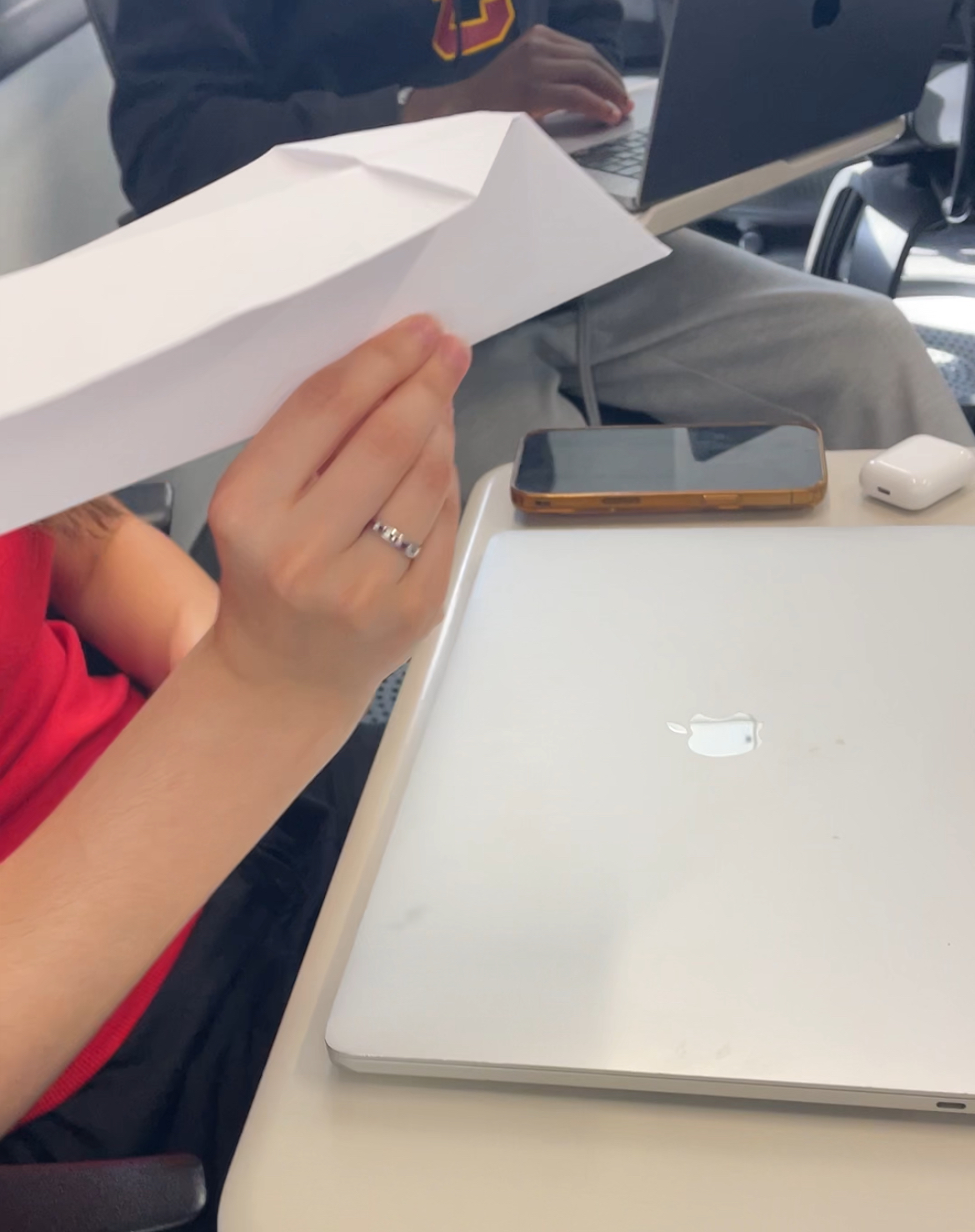
How to Make a Paper Plane

Context:

My informant is a college student from Arizona and learned how to make this paper plane in elementary school from one of her classmates.

Text:

Take a loose-leaf piece of white paper and fold two corners of the top of the paper to the middle. Then fold the paper in half. Take one half and fold that in half again. Repeat to the other side. Now you have a simple paper airplane.

Analysis:

This is a common childhood craft that many children learn how to make when they are bored. People often learn different variations of the paper airplane. In this case, C learned how to make a simple version of the plane. Since this is such as simple craft, this piece of material folklore is easy to pass from person to person.

Hamburger/Hotdog Folding

Nationality: American
Age: 29
Occupation: Actress
Residence: New York City
Performance Date: April 20, 2017
Primary Language: English

My sister grew up in the United States, where most kids are introduced to arts and crafts at a very young age. As many know, there are two ways to fold a piece of paper: hamburger (narrow edge to narrow edge) or hotdog (wide edge to wide edge).

Allegra: “I was introduced to the folding pattern ‘hot dog versus hamburger style’ in first grade. We were fashioning tri-corner hats out of newspaper. The first step was to fold the newspaper down along a crease to maintain its width, rather than its length. This was referred to as “hamburger style.” If the first step had instead been to fold the newspaper vertically, longer than it was wide, the instruction would have been ‘hot dog style.'”

Me: Did you notice that other teachers referred to hamburger and hotdog folding in class?

Allegra: Oh totally. It was a commonly used instruction in art rooms and day care centers that I went to throughout my childhood. A teacher would say, ‘To make a paper fan, fold the materials hot dog style.’ or ‘To begin your fortune teller, fold the paper hamburger style.’

Analysis: If I could hazard a guess, I think the metaphor works because these sandwich fixings come out of the package with a natural crease. Buns fold along a perforation for easier separation. A hot dog bun opens but does not disintegrate, much like how many paper projects require the traces of former folds to last, so that they may be used later. Two American culinary staples, same dough, two different ways to enjoy them. Hot dogs and hamburgers are also quintessential components to the American child’s diet. Notoriously fussy eaters, the one or two lunch room items every kid likes are hot dogs and hamburgers. Its an easily relatable illustration for a strange new technique, like origami.

Curing “deadly” Colombian hiccups

Nationality: Colombian
Age: 32
Occupation: Event Planner/ English students
Residence: Santa Monica
Performance Date: 4/16/2017
Primary Language: Spanish
Language: Basic English

Juliana remembered that if you get hiccups,  you should place a small piece of wet paper between your eyebrows in the middle of your forehead to stop the hiccups. She has no idea why but it will usually do the trick. However, if that does not work, then you are supposed to place the wet piece of paper inside on the roof of your mouth. If that fails, then get some “panela” (harden brown sugar) shave it into a thimble of hot brandy, lie on the bed with your head hanging off the bed, drinking it upside down. If all of that fails, then you run the risk of dying because she knows someone who had the hiccups for one week and died in their sleep. Spooky. I asked the other Colombians there at Easter dinner about the hiccups and they had a few other variations but all claimed to know someone different who had died of the hiccups. Colombians take hiccups seriously and will be on you to take measure to stop the hiccups as fast as possible because you can die.  They say that chewing your food slowly and eating slow is the key to not getting hiccups. Colombians already take their time eating on average twice to three times longer than most Americans. They seem to think that this was common knowledge and warned me against my ignorance because they did not want me to  die.

Analysis: Did not know hiccups were so dangerous. It is something most people will experience and an annoying nuisance and maybe because it is so common out of coincidence someone may die while having hiccups. But I have never heard of anyone in the US dying of hiccups and American mow their food at high velocity. Colombian eat much slower and yet it seems like everyone had heard of someone who has died of it in Colombia. I did Google it and someone on Grey’s Anatomy (TV show) died who had prolonged hiccups but her death was the result of infection from surgery to correct the acid reflux that was aggravating the hiccups. Also, we are talking about a fictional character.

Hate Ritual

Nationality: American
Age: 24
Occupation: Student
Residence: Los Angeles
Performance Date: April 13th, 2013
Primary Language: English
Language: Cantonese

Informant Background: The informant is originally from Hong Kong. She now lives permanently in the United States but travels back once a year to visit her relatives in Hong Kong. She speaks both Cantonese and English. Her family practices many of the Chinese traditions, folk-beliefs, and superstitions. She celebrates many of the Chinese holidays through cooking of special “holiday food.”


This is something you do if you have someone you really really hate. You can draw a picture of that person, then write his/her name on the paper…The paper is the special kind that people use to burn during funerals…Then you can take that piece of paper to a tree and put it down above the root. Then take of your shoes and hit the paper on the drawing as hard as you can. Just hold the shoe in your hand and go ta-ta-ta-ta…Oh, and it has to be your shoes. Then you shout stuff you want to say to that person like: “go die,” “die,” “I hate you,” etc. Then hopefully the stuff you said would happen to the person you drew on the paper.

The informant said she learned about this while she was growing up in Hong Kong. She heard it from her classmates. It is something children would do when they dislike their classmates or friends.


I think this shows how while both Eastern and Western culture perceive children as a separate group from society where they are always represented as innocence beings. In contrary to many beliefs children has anger and hatred that adult does. Though many society tries to have a separate category for children where they are thought of as innocence creatures, children do understand the concept of hatred and violence. This ritual shows anger and repression of anger among children. This ritual shows that children can be violent and ill-meaning, the opposite of the ideal angelic image of children.

This ritual is an example of homeopathic magic where “like” creates   “like;” idea that the drawing of the person on the paper. It also has element of contagious magic through the use of one’s own shoes. It appears that this ritual is a metaphor how you will stomp the person you dislike into the ground with your own feet. Similar to sticking pins into voodoo dolls.

The use of funeral paper reflects how you wish bad thing for the person because funeral rituals and objects are reserved for that event, and not everyday life. Using funeral paper is to foreshadow the misfortune that individual. The chanting of bad omens while stomping the paper with your own shoes reflects the idea of homeopathic magic how you wish the words you said will translate into that person’s life. This is similar to the idea of the voodoo doll how the image of the target is created on an object and the rituals performed will reflect on the target.

This ritual not only shows anger as emotions but also as action. It is both violent in force and words through both the hitting of the paper and the shouting of ill-intention phrases.